This essay first appeared in Turkish. The English version is my own.

Die Traumdeutung aber ist die Via regia zur Kenntnis des Unbewußten im Seelenleben.
Sigmund Freud, Die Traumdeutung (1900)
Wo Es war, soll Ich werden.
Sigmund Freud, Neue Folge der Vorlesungen (1933)
I
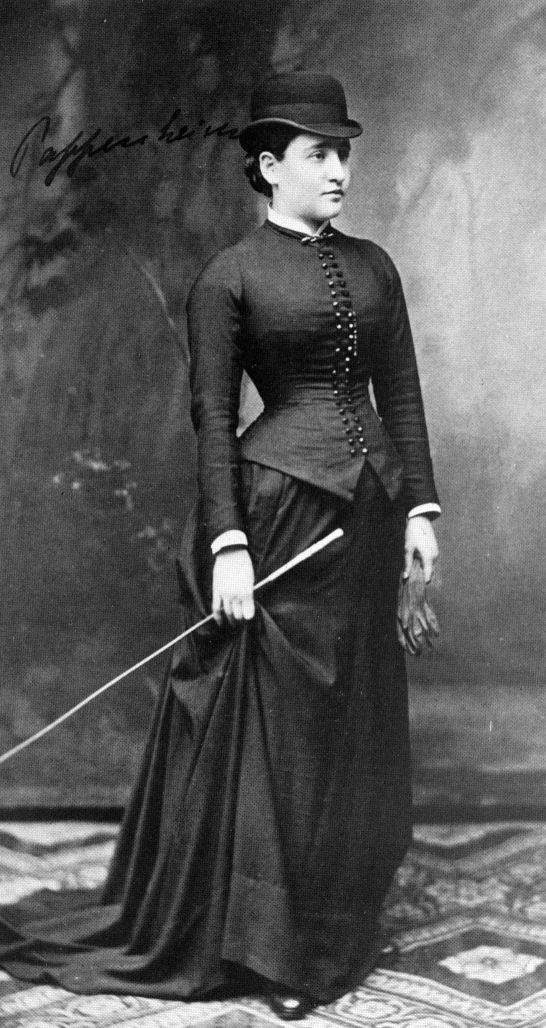
Unusually, the birth of psychoanalysis bears the name a patient gave to her own experience. The young woman whom the Viennese physician Josef Breuer treated between 1880 and 1882, and who entered the case records as “Anna O.”, had developed severe symptoms during her father’s fatal illness: paralyses of the arms and legs, disturbances of vision, losses of language that for a time left her able to speak only English, and two distinct states of consciousness alternating through the day. Breuer noticed that her symptoms eased when, in the late afternoons, he let her recount in detail what she had been through. The young woman gave the method two English names: in earnest, the talking cure; half in jest, chimney sweeping.1
The most famous scene of the case comes at the end of a period of weeks during which Anna O. could not drink. Tormented by thirst but unable to raise a glass to her lips, she one evening recounted, giving full voice to the disgust she had held back at the time, a scene in which she had seen the dog of an English companion she disliked drinking from a glass; then she asked for a glass of water and drank it. The symptom had been the bodily inscription of a feeling never put into words; once put into words, it disappeared. Years later it became known that Anna O.’s real name was Bertha Pappenheim. After her recovery Pappenheim became one of Germany’s pioneering social workers and campaigners for women’s rights; in 1904 she founded the League of Jewish Women, and after her death a postage stamp was issued in her name. The first patient of psychoanalysis had also known how to rewrite her own life.

II
Starting from Breuer’s experience, Freud worked first with hypnosis, then with a “pressure technique”, in which he pressed his hand on the patient’s forehead and asked memories to come. The real turn came, in one of the loveliest accidents in the history of psychoanalysis, once again from a patient’s objection. In 1889 the woman who appears in the case records as “Frau Emmy von N.” told Freud during a session, with evident displeasure, to stop asking her where this or that came from and to let her tell him what she had to say. Freud’s English translator and editor, James Strachey, marks the sentence as the first appearance of the method that would later be called free association.2 Before it was an analyst’s invention, the basic method of psychoanalysis was the demand of a patient who objected to being interrupted. Freud’s greatness lies in having been able to hear the objection not as rudeness or resistance, but as a lesson.
In 1913, in his technical paper on the beginning of treatment, Freud describes the method through an image that would be quoted again and again. The analysand should behave like a traveller sitting by the window of a railway carriage, describing to someone inside the changing view outside; whatever comes to mind should be said, even if it seems trivial, embarrassing, illogical or beside the point.3 This is almost the only rule of psychoanalysis, and at first sight it looks easy. In practice it is one of the hardest things there is, because when we speak we all arrange ourselves, censor ourselves, try to build a reasonable and coherent account. Free association makes it possible for another voice, the voice of the unconscious, to begin speaking at the point where this arrangement loosens.
How the analyst should listen to this speech Freud had explained a year earlier, in his recommendations of 1912. The analyst should listen with an attention that is evenly suspended, directed at nothing in particular and holding everything said in the same balance; to take one thing as important and pass over another would be to impose one’s own expectations on the analysand’s speech. In the same text Freud advises his colleagues to take the surgeon as their model during treatment: the surgeon puts aside all his feelings, even human sympathy, and concentrates all his attention on performing the operation as skilfully as possible.4 The comparison was later much misunderstood and read as meaning that the analyst should be cold and indifferent. Freud meant something else: the analyst’s own feelings, judgements and eagerness to cure must not get in the way of hearing the analysand’s speech. The analyst’s task is not to lead the other person where the analyst wants, but to accompany them as they speak towards what they know and do not want to know.
It was also in these years that Freud found a name for the method. The word “psychoanalysis” appears for the first time in 1896, as psycho-analyse, in a paper Freud wrote in French and published in a French neurological journal; a few weeks later it recurs in a German paper as Psychoanalyse.5 The word is made of the Greek psykhē, soul, and analysis, loosening or breaking up; Freud also gives it an echo of the chemist’s operation of separating a substance into its elements. But Freud himself knew that this chemical echo could mislead: analysis does not merely take the mind apart; it allows the parts to come together again, of their own accord, in a new form.
III
The unconscious, the basic concept of psychoanalysis, is not a dark and primitive basement of the mind; it is rather a knowledge the subject has about himself and does not want to know. Freud carefully examined where this knowledge shows itself in two great books. In The Interpretation of Dreams, published in 1900, he defined the dream as the royal road to the unconscious; in The Psychopathology of Everyday Life, published a year later, he studied forgettings, misreadings, accidental actions and slips of the tongue. One of the book’s examples shows how short a road the unconscious can take to speak. Opening a session, the President of the Austrian Parliament declares that he notes the presence of a quorum and declares the sitting “closed”. In Freud’s interpretation, the President wishes that the sitting, which he knows will be difficult, were already over; and that wish, against his will, has had itself spoken by putting a word’s opposite in its place.6
From the 1950s onward Lacan reread Freud’s discovery with the tools of linguistics and argued that the unconscious is structured like a language. The formula means that the unconscious works through words, associations, similarities of sound and slippages of meaning. One word taking the place of another, a sentence left unfinished, the same expression returning again and again in different contexts: these are the traces of the unconscious in speech. What the analyst listens to, therefore, is not only the content of the story but the texture of the telling: how something is said as much as what is said, where the speaker stumbles, which word calls up which word.
Freud knew how shattering the discovery was. In a short piece written in 1917 he speaks of three great blows that science had dealt to humanity’s love of itself, its narcissism. The first was cosmological: Copernicus showed that the earth is not the centre of the universe but a small planet circling the sun. The second was biological: Darwin showed that the human being is not a creature made apart from and outside the animal kingdom, but descends from it. The third is psychological, and it is psychoanalysis that strikes it: the ego is not master in its own house.7 Some of the things we believe we think, we think without knowing it; behind what we believe we want stand other wishes of which we know nothing; the sentences we speak sometimes say something else in our place. Freud thought that this third blow aroused more resistance than the other two, because it wounds us from the closest possible place, our own minds.
IV
A dream holds a special place in the founding story of psychoanalysis. On the night of 24 July 1895, on holiday at the Bellevue villa near Vienna, Freud had the dream that would come to be known as “Irma’s injection”. In it, a young patient whose treatment he was conducting, Irma, appears at a reception; she complains of pains, Freud looks into her throat, and a colleague announces that the illness comes from an injection carelessly given by one of their friends. Freud uses this dream in The Interpretation of Dreams as the “specimen dream” of a detailed analysis, and concludes that it fulfils his wish to be cleared of responsibility for Irma’s continuing suffering.8 Five years later, in a letter to his friend Wilhelm Fliess, he asks, half joking, whether one day a marble tablet will be placed on the house, announcing that here, on 24 July 1895, the secret of dreams was revealed to Dr Sigmund Freud.9 Today, although the villa has been demolished, such a tablet stands on the spot.
In his analysis of the same dream Freud adds a footnote that would be quoted many times. In every dream, however well it is interpreted, there is a spot that remains in darkness; Freud calls it the navel of the dream, the point where it reaches down into the unknown.10 The dream-thoughts, Freud says, come to no conclusion; branching out in every direction, they are lost in the netlike fabric of our world of thought. The footnote is an admission of psychoanalysis’s own limit. Interpretation does not explain everything, nor should it; at the core of every subject, every dream, every symptom, there remains a place that never fully comes into words, around which one can only speak. This navel is one of the first traces in Freud’s writing of what Lacan would later call the Real.
The real contribution of Freud’s theory of dreams lies less in saying that dreams have a meaning than in showing how that meaning is hidden. Between the manifest content of the dream and its latent thoughts operates a “dream-work”. Condensation combines several thoughts in a single image; displacement shifts the emotional emphasis from what matters onto a detail that seems unimportant; and the dream is obliged to express its thoughts in images rather than words. This is why Freud proposes to read the dream not as a picture but as a picture puzzle, a rebus, in which each element stands for a syllable or a word. A boat on the roof of a house, a man running beside a letter: whoever looks at such a picture as a landscape will think it absurd; whoever knows how to translate each piece into a syllable or a word will discover that it is a sentence, perhaps a meaningful saying.11 It is no accident that Lacan based his thesis that the unconscious is structured like a language above all on this chapter: condensation and displacement correspond to the two basic operations linguists call metaphor and metonymy.
V
From a medical point of view, a symptom is a fault to be removed. Psychoanalysis gives the symptom a different status: the symptom carries a conflict the subject cannot put into words; it is a formation that both conceals and reveals a repressed wish. Anna O.’s inability to drink was the first example, and all Freud’s later cases displayed the same logic in different forms. Anxiety attacks, obsessive thoughts, repeating patterns in relationships or unexplained bodily complaints point to something in a person’s life that has not yet been put into words. This is why the aim of psychoanalytic work is not only to silence the symptom but to hear what it is saying. As the meaning of the symptom opens up in speech, people often find that they can relate to it differently; sometimes the symptom dissolves, sometimes it takes a less crushing, more liveable form.
VI
Another basic concept of the psychoanalytic process is transference. To understand it, it helps to think about how an ordinary slip works in a session. An analysand, telling the story of a quarrel with her mother, for a moment says the name of a former lover instead of “my mother”, corrects herself with a laugh and carries on. In everyday conversation the slip would pass as a verbal accident. In an analytic session the analyst, perhaps simply by repeating the name, allows the analysand to come back to her own words. That single word may reveal a link between two relationships that she has never consciously made: that a mother and a lover arouse in her the same place, the same anxiety, the same demand. The whole work of psychoanalysis is woven around small breaks of this kind. Breuer had brought Anna O.’s treatment to an abrupt end. According to the account given years later by Freud’s biographer Ernest Jones, which historians now dispute, the reason was the patient’s intense feelings for her physician and Breuer’s panic in the face of them.12 Rather than flee the same phenomenon, Freud chose to turn it into material for the work. He saw that the feelings a patient directs towards the analyst repeat older feelings towards important figures in the patient’s life, and he called this transference. Transference is not an obstacle but the engine of the treatment: what repeats in a person’s life appears in the analytic relationship too, and so, for the first time, becomes something that can be spoken about.
In Freud’s lifetime psychoanalysis spread from a small Viennese circle to the whole world. In 1909 Freud travelled to America with Jung and Ferenczi and gave five lectures at Clark University in Massachusetts; it was the only American journey of Freud’s life and the first official academic recognition of psychoanalysis.13 Forty-six years later, in a lecture given in Vienna, Lacan recounted an anecdote he said he had heard from Jung about the journey: as the ship approached New York harbour, Freud, seeing the Statue of Liberty, said to Jung that they did not know we were bringing them the plague.14 The anecdote cannot be verified, but Lacan’s reason for recalling it is clear. Psychoanalysis was not a soothing treatment but a discovery that unsettled established ideas; and, for Lacan, the more it was accepted, the greater the danger that it would be tamed.
The power of Freud’s writing was recognised outside the scientific world as well. In 1930 the city of Frankfurt awarded him the Goethe Prize for his contribution to literature and thought; Freud was ill and could not attend, and his daughter Anna read his speech of thanks.15 Three years later, on 10 May 1933, Freud’s books were among those thrown into the fire at the book burnings held in Berlin and many other German university towns. According to Ernest Jones, Freud met the news with bitter irony: what progress we are making; in the Middle Ages they would have burned me, now they are content with burning my books. Five years later, after the annexation of Austria in March 1938 and the questioning of his daughter Anna by the Gestapo, Freud emigrated to London with his family, and died there in September 1939, in the first weeks of the Second World War. Four of Freud’s sisters, who stayed in Vienna in their old age, were murdered in the camps.
After Freud’s death the English poet W. H. Auden, in the elegy he wrote for him, said that Freud had ceased to be a person and become a whole climate of opinion.16 More than eighty years later the line still holds. The subconscious, the ego, the Oedipus complex, the Freudian slip, repression, defence, projection: these words have settled into everyday language, and when we talk about a film, a novel or a political debate we think, without noticing, with Freud’s concepts. This spread is a danger as much as a gain: as concepts enter everyday speech they lose their sharp edges, and unsettling discoveries turn into clichés everyone knows. Psychoanalytic work itself is concerned, quite against these clichés, with the singular texture of each subject’s unconscious, which no general concept ever quite contains.
Very different approaches are grouped together today under the name of “talking therapies”. What distinguishes psychoanalysis is less speech itself than the way speech is listened to. In psychoanalytic work the analyst does not give advice, does not propose correct ways of behaving and does not try to correct the analysand’s thoughts. Instead, the analyst attends to what the analysand says without knowing it, within what they say: a slip, a repetition, a gap, a dream. This attention allows the analysand to form a new relation to their own speech, to hear themselves anew in their own sentences. This is also why the duration of the work is not fixed in advance; the calendar of a subject’s encounter with their own unconscious does not follow the calendar of a programme.
VII
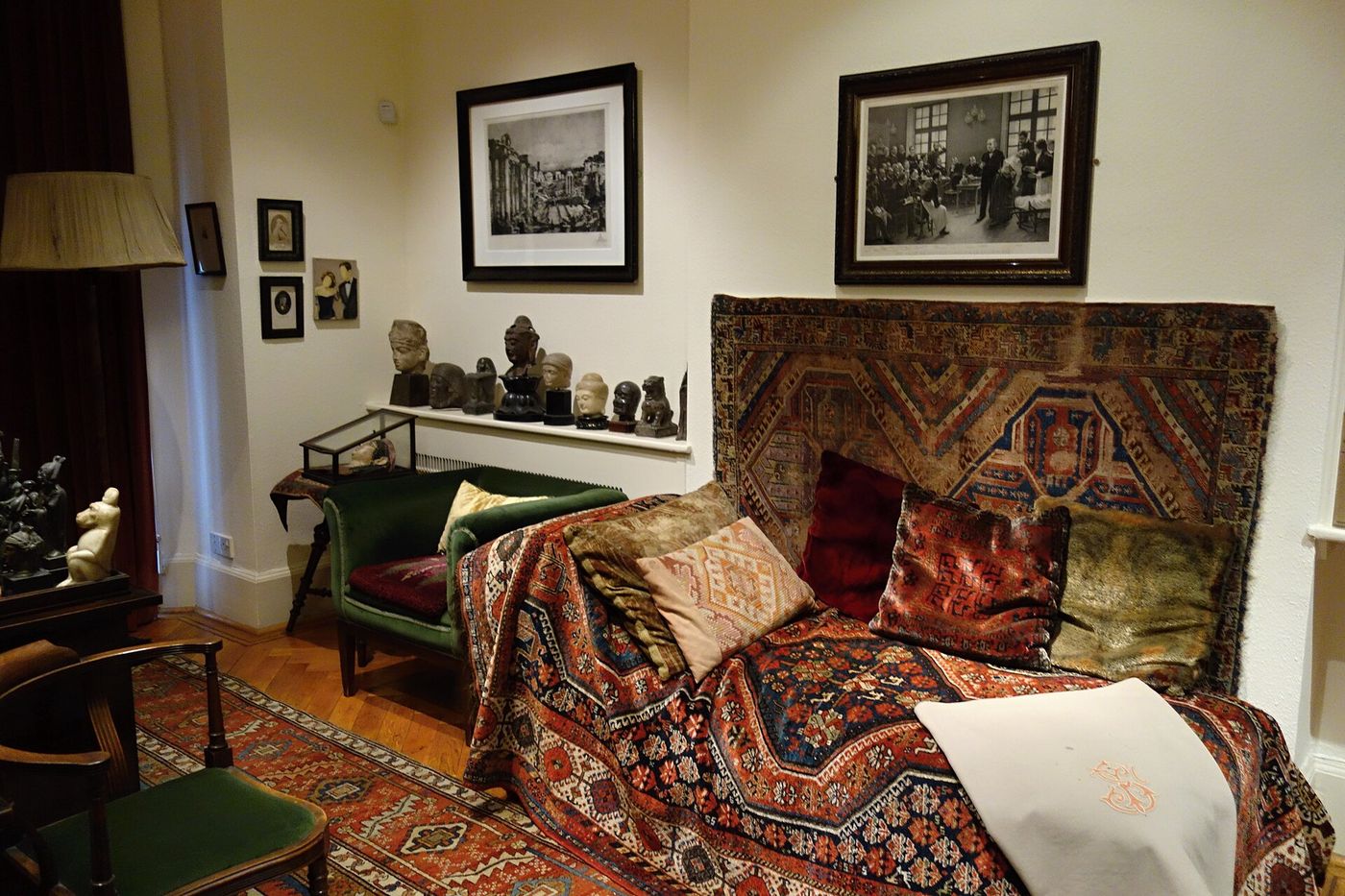
The couch is the best-known symbol of psychoanalysis, and its history is as interesting as the couch itself. Freud’s couch was a gift from a grateful patient, Madame Benvenisti, around 1890; Freud added the Persian rug that covers it himself. In his technical paper of 1913 he explains why he uses the couch with a disarmingly human reason: he cannot bear to be stared at by other people for eight hours a day or more.17 But the couch’s real function concerns the analysand. In a face-to-face conversation we are used to reading the other person’s face and adjusting ourselves to their reactions. On the couch this gaze disappears, and speech is freed to some extent from the expectation of approval or judgement. Today much psychoanalytic work takes place face to face or online; the couch is a possibility, not a requirement.
In the New Introductory Lectures of 1933, Freud sums up the aim of psychoanalysis in a sentence that would be interpreted countless times: Wo Es war, soll Ich werden; where It was, there I shall come to be. American ego psychology read the sentence as the ego bringing unconscious drives under control. Lacan reads it the other way round: what is at stake is not extending the domain of the ego but the subject’s recognising himself in the very place where the unconscious speaks, and taking up his own desire there. Freud’s The Question of Lay Analysis, written in 1926, also deserves mention in this context; in it Freud argues that psychoanalysis is not a sub-branch of medicine, and that well-trained analysts who are not physicians and have been through their own analysis can do this work too.18
VIII
Psychoanalysis has been a contested discipline from the day it was born, and an introduction that ignored the controversies would be incomplete. Some of these controversies took place within psychoanalysis itself. The International Psychoanalytical Association, founded by Freud in Nuremberg in 1910, was shaken in its first decade by the departures of Adler and Jung; after Freud’s death psychoanalysis divided into clearly distinct schools. Ego psychology in the United States, with its emphasis on the ego’s capacity for adaptation; the object relations theories of Melanie Klein and Donald Winnicott in Britain, focused on the relationships of early infancy; Heinz Kohut’s self psychology in the 1970s; and Lacan’s call for a return to Freud in France: these are different readings of the same legacy.19 In 1963 Lacan was removed from the International Association’s list of training analysts, and the following year he founded his own school. Each of these separations arose from different answers to the questions of what psychoanalysis treats, what the analyst does and how an analysis comes to an end. The philosopher of science Karl Popper argued that psychoanalysis, because it could explain any observation whatever, could be refuted by none, and therefore could not count as a scientific theory.20 In his comprehensive critique of 1984 the philosopher Adolf Grünbaum argued that the clinical data of psychoanalysis cannot be purified of the analyst’s suggestion, so that the theory cannot be confirmed by clinical evidence.21
These criticisms pushed psychoanalysis both to think about its own method more rigorously and to test its effectiveness against external measures; the studies mentioned below are one result of that testing. But the Lacanian tradition also answers the criticisms on another level: psychoanalysis does not aim to produce knowledge on the model of the natural sciences, but to transform the relation a singular subject has to their own speech. The truth that emerges in the analysand’s speech is not the truth of a statistical generalisation but the truth of that speech itself. The two perspectives need not exclude each other; good psychoanalytic work should be able both to question its own effects honestly and to remain faithful to the singularity of each subject.
IX
Unlike many therapeutic approaches that work with set goals, homework and structured techniques, psychoanalysis does not follow a predetermined programme. The aim is not to fit a person to an average but to transform the relation they have to their own desire, their repetitions and their history. This does not mean that psychoanalysis is uninterested in symptoms. The review published by the psychologist Jonathan Shedler in American Psychologist in 2010, and the meta-analysis published by Falk Leichsenring and Sven Rabung in JAMA in 2008, showed that psychoanalytic and psychodynamic therapies bring significant relief of symptoms, and that these gains tend to last, and even to grow, after the treatment has ended.22
Among people who come to psychoanalytic work, anxiety and panic, low mood and a sense of meaninglessness, repeating patterns in relationships, difficulty coping with grief and separation, obsessive thoughts and indecision are common experiences; but one does not need a defined complaint in order to come. The wish to understand oneself more deeply, or curiosity about what keeps repeating in one’s life, is a beginning in itself. That said, if you have thoughts of harming yourself or someone else, or are in an acute crisis, the first step is to call your local emergency number (112 in Turkey and the European Union) or to go to the nearest health service. Psychoanalytic work can also be carried out alongside psychiatric assessment and medication where necessary.
The first sessions are a process of mutual acquaintance and assessment: what led the person to come, what they expect and what frame the work might take are discussed, and then the frequency and rhythm of sessions are agreed together. In sessions, it is mostly the analysand who speaks. From time to time the analyst asks a question, underlines a word or draws attention to a connection; these interventions aim less to offer ready-made interpretations than to allow the analysand to hear again what they have said. What Anna O. discovered is perhaps still the best definition of psychoanalysis: a place where what has not been said can be said, and a speech that changes the person speaking as they speak. Begun a hundred and forty years ago in Vienna with the stories a young woman told her physician in the late afternoons, this conversation continues today in other cities, other languages, other rooms and on screens. What does not change is the moment when a person, for the first time, truly hears their own words in someone else’s attentive ear.
Notes
- J. Breuer and S. Freud, Studies on Hysteria (1895), case of “Anna O.”, SE II. Freud’s works are cited by their titles in the Standard Edition (SE), with volume numbers. ↩︎
- Breuer and Freud, Studies on Hysteria, case of “Frau Emmy von N.” and Strachey’s note to the passage, SE II. ↩︎
- S. Freud, “On Beginning the Treatment” (1913), SE XII. ↩︎
- S. Freud, “Recommendations to Physicians Practising Psycho-Analysis” (1912), Gesammelte Werke VIII; SE XII. The surgeon comparison was much debated in later psychoanalytic tradition and misread as a demand that the analyst be cold and distant; accounts of Freud’s own clinical practice show that he was often warm and attentive towards his patients. ↩︎
- S. Freud, “L’hérédité et l’étiologie des névroses”, Revue neurologique 4 (1896); SE III. In this paper Freud calls the method he had developed with Breuer “a new method of psycho-analysis”. ↩︎
- S. Freud, The Psychopathology of Everyday Life (1901), chapter V, SE VI. ↩︎
- S. Freud, “A Difficulty in the Path of Psycho-Analysis” (1917), Gesammelte Werke XII; SE XVII. Freud’s words are: daß das Ich nicht Herr sei in seinem eigenen Hause. The piece was written for the Hungarian review Nyugat. ↩︎
- S. Freud, The Interpretation of Dreams (1900), chapter II, SE IV. ↩︎
- Freud to Fliess, 12 June 1900. J. M. Masson (Ed.), The Complete Letters of Sigmund Freud to Wilhelm Fliess, 1887–1904 (1985). ↩︎
- Freud, Die Traumdeutung (1900), the footnote to the Irma dream in chapter II, and chapter VII. Freud’s phrase is der Nabel des Traums: the place where the dream-thoughts, without reaching any end, branch out in every direction into the intricate network of our world of thought. ↩︎
- Freud, The Interpretation of Dreams, chapter VI, SE IV–V. ↩︎
- E. Jones, The Life and Work of Sigmund Freud, vol. I (1953). The historical accuracy of Jones’s account has been seriously questioned by later research. ↩︎
- S. Freud, Five Lectures on Psycho-Analysis (1910), SE XI. In these lectures Freud presents the history and basic concepts of psychoanalysis in language meant for a non-specialist audience; the text is still counted among the best introductions to psychoanalysis. ↩︎
- J. Lacan, “La chose freudienne” (1955), Écrits, Paris: Seuil, 1966. Lacan’s account is the only source for the anecdote; the sentence is found neither in Freud’s writings nor in Jung’s. Lacan uses it to sharpen his criticism that American psychoanalysis had turned Freud’s discovery into an adaptive therapy. ↩︎
- S. Freud, “Address Delivered in the Goethe House at Frankfurt” (1930), Gesammelte Werke XIV; SE XXI. In his address Freud recalls Goethe as a writer and thinker whose keen observations of the human mind had anticipated some of the insights of psychoanalysis; that the prize was given as to a writer rather than to a scientist also meant that Freud’s style was being recognised. ↩︎
- W. H. Auden, “In Memory of Sigmund Freud” (1939), in Another Time, New York: Random House, 1940: “to us he is no more a person / now but a whole climate of opinion”. ↩︎
- Freud, “On Beginning the Treatment” (1913). ↩︎
- S. Freud, The Question of Lay Analysis (1926), SE XX. ↩︎
- For the history of these divisions see E. Roudinesco and M. Plon, Dictionnaire de la psychanalyse, Paris: Fayard, 1997; also E. Zaretsky, Secrets of the Soul: A Social and Cultural History of Psychoanalysis, New York: Knopf, 2004. ↩︎
- K. Popper, Conjectures and Refutations (1963). ↩︎
- A. Grünbaum, The Foundations of Psychoanalysis: A Philosophical Critique (1984). ↩︎
- J. Shedler, “The efficacy of psychodynamic psychotherapy”, American Psychologist 65/2 (2010), pp. 98–109; F. Leichsenring and S. Rabung, “Effectiveness of long-term psychodynamic psychotherapy: A meta-analysis”, JAMA 300/13 (2008), pp. 1551–1565. ↩︎
References
- Auden, W. H. (1940). In memory of Sigmund Freud (1939). In Another time. Random House.
- Breuer, J., & Freud, S. (1895). Studies on hysteria. SE II.
- Freud, S. (1896). L’hérédité et l’étiologie des névroses. Revue neurologique, 4; SE III.
- Freud, S. (1900). The interpretation of dreams. SE IV–V.
- Freud, S. (1901). The psychopathology of everyday life. SE VI.
- Freud, S. (1910). Five lectures on psycho-analysis. SE XI.
- Freud, S. (1912). Recommendations to physicians practising psycho-analysis. SE XII.
- Freud, S. (1913). On beginning the treatment. SE XII.
- Freud, S. (1917). A difficulty in the path of psycho-analysis. SE XVII.
- Freud, S. (1926). The question of lay analysis. SE XX.
- Freud, S. (1930). Address delivered in the Goethe House at Frankfurt. SE XXI.
- Freud, S. (1933). New introductory lectures on psycho-analysis. SE XXII.
- Grünbaum, A. (1984). The foundations of psychoanalysis: A philosophical critique. University of California Press.
- Jones, E. (1953). The life and work of Sigmund Freud (Vol. I). Basic Books.
- Lacan, J. (1966). La chose freudienne (1955). In Écrits. Seuil. [English: Écrits (B. Fink, Trans.). Norton, 2006.]
- Leichsenring, F., & Rabung, S. (2008). Effectiveness of long-term psychodynamic psychotherapy: A meta-analysis. JAMA, 300(13), 1551–1565.
- Masson, J. M. (Ed.). (1985). The complete letters of Sigmund Freud to Wilhelm Fliess, 1887–1904. Harvard University Press.
- Popper, K. (1963). Conjectures and refutations. Routledge.
- Roudinesco, E., & Plon, M. (1997). Dictionnaire de la psychanalyse. Fayard.
- Shedler, J. (2010). The efficacy of psychodynamic psychotherapy. American Psychologist, 65(2), 98–109.
- Zaretsky, E. (2004). Secrets of the soul: A social and cultural history of psychoanalysis. Knopf.