This essay first appeared in Turkish. The English version is my own. Lacan’s texts are cited in the French originals, with English translations given where one exists. Freud’s works are cited by their titles in the Standard Edition (SE), with volume numbers. I give the matheme labels in English; in the notation I keep Lacan’s letters S1, S2, $ and a.
Ce à quoi vous aspirez comme révolutionnaires, c’est à un maître. Vous l’aurez.
Jacques Lacan, Vincennes, 3 December 1969
What you aspire to as revolutionaries is a master. You will get one.
I
Since 1964 Lacan’s seminars had been held in Paris, in the Salle Dussane of the École normale supérieure in the rue d’Ulm. In the spring of 1969 the school’s administration informed Lacan that the room would no longer be made available to him. The last lesson of the seminar in June 1969 ended in a protest; a group of listeners, after Lacan’s lecture, occupied the director’s office. The next autumn the seminar moved to the great lecture hall of the Faculty of Law on the Place du Panthéon. The title of the seventeenth seminar Lacan gave that year was L’envers de la psychanalyse, “The Other Side of Psychoanalysis”.1
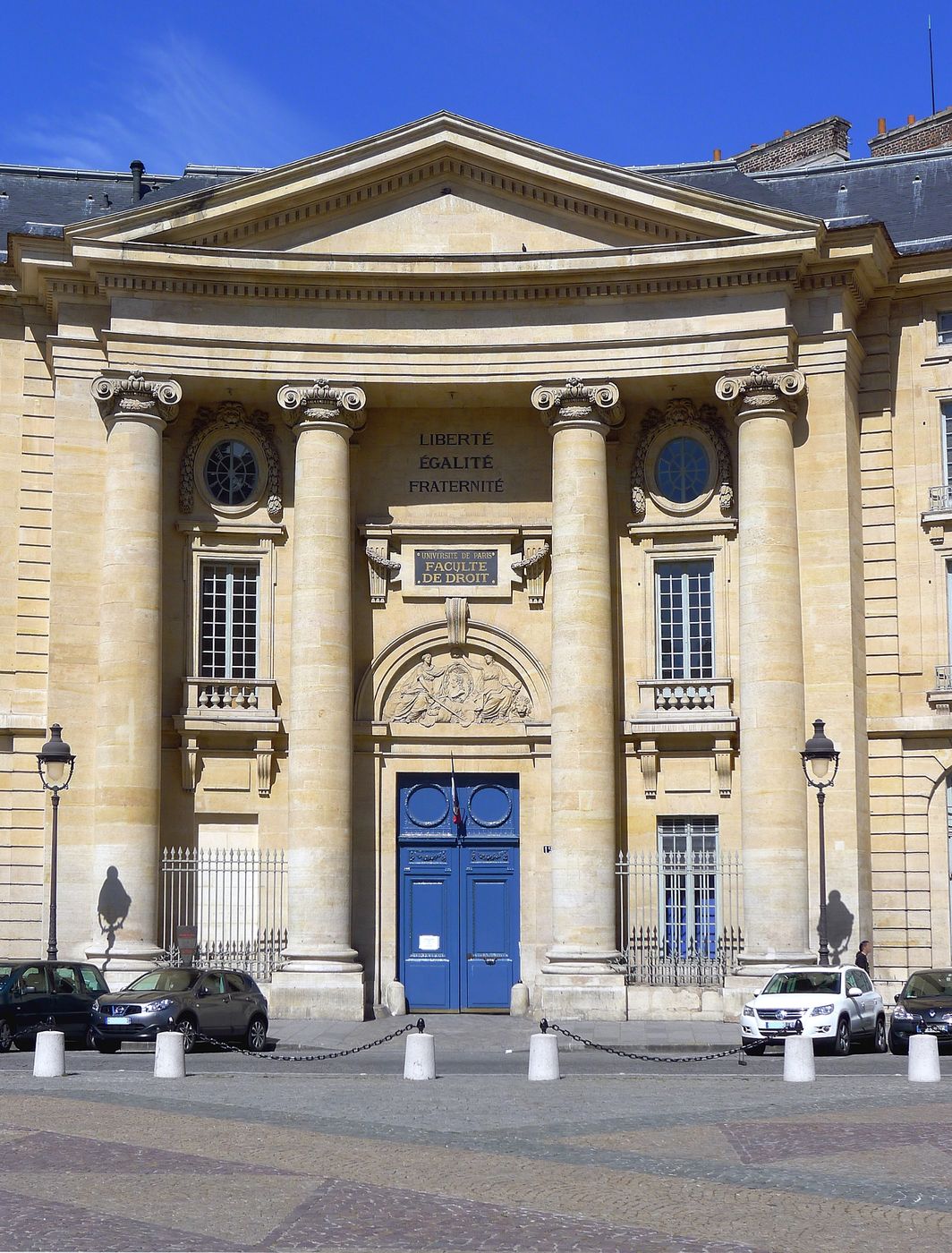

This move changed the seminar’s audience too. Lacan’s lectures were now attended not only by analysts and philosophers but by hundreds of students and militants politicised by May 1968, and by the curious. One of the most widely circulated slogans of the events of May was a mockery written on the walls of the Sorbonne: Structures do not take to the streets. Lacan answered it a few months later, in the discussion following Michel Foucault’s lecture “What Is an Author?” at the Société française de philosophie in February 1969: if the events of May had shown anything, it was precisely that structures do take to the streets.2 What Lacan set about building that year was a theory of these structures taking to the streets.
The best-known scene of the theory, however, took place not at the Panthéon but in the east of Paris. The experimental university established after 1968 at the edge of the Vincennes woods was an attempt to institutionalise the spirit of May, and was one of the first French universities to have a department of psychoanalysis. Lacan went there on 3 December 1969 to give a talk. The hall was full of a crowd that was packed, tense, and hostile to Lacan himself; the talk soon turned into a tumult of shouts, heckling, students climbing onto the stage. In the midst of this tumult Lacan said the sentence I have taken as an epigraph: What you aspire to as revolutionaries is a master. You will get one.3
This sentence is often read as political mockery, as an old master’s contempt for young revolutionaries. But the theory Lacan developed in his seminar that year gives it another weight. What Lacan was saying was not that revolt is futile but that revolt too takes place within a discourse. Every speech against the master speaks from within the structure in which the master speaks, and without recognising this structure puts only a new master in his place.
II
In the first lesson of the seminar Lacan defines discourse as something independent of words. For him discourse is a discourse without words: a structure that comes before the single sentences uttered and determines by whom, to whom and from what place they can be uttered.4 The single conversations between a teacher and a pupil, a doctor and a patient, an employer and a worker, an analyst and an analysand may vary; but the form of the bond between them, the structure that determines who speaks and who listens, who is supposed to know, what will come out of the bond, is more lasting than the words.
Lacan writes this structure with four fixed positions and four terms that circulate among them. The first of the positions is the place that opens the discourse, the place of speaking; Lacan calls it the agent. The agent always addresses another. From this address a product comes. Beneath the agent stands something that sets it in motion but is itself not visible: the truth of the discourse. Lacan writes these positions as a fraction, joining the two upper terms with an arrow.
The four terms that fill these positions are basic concepts of Lacan’s teaching developed in earlier years. S1 is the master signifier, the first signifier with which the subject identifies himself, accepted without question. S2 is knowledge, the chain in which signifiers are linked together, accumulated and transmissible knowledge. $ is the divided subject, who, because he speaks within language, can never coincide with himself. And a is what Lacan, inspired the year before by Marx’s surplus value, called surplus jouissance, in French plus-de-jouir: the remainder of pleasure that every discourse produces but no discourse can wholly appropriate.5
The elegance of the theory lies in the order of these four terms never changing. S1 is always followed by S2, S2 by a, a by $. When you rotate the terms by a quarter turn over the positions, you obtain four different discourses: the discourses of the master, the university, the hysteric and the analyst. All forms of social bond, according to Lacan, are a combination of these four structures or a passage from one to another.
A misunderstanding should be forestalled from the start. The names of the discourses, master, university, hysteric, analyst, do not describe persons or diagnostic categories. Someone speaking in the hysteric’s discourse does not have to be hysterical in the clinical sense; a student, a scientist, a citizen can speak from this place too. An analyst, even in his own consulting room, may for a moment slip into the discourse of the master, for a moment into that of the university. The discourses are the names not of people but of places. The same person in the course of a day passes from one of these places to another: in the morning in a meeting he speaks from the master’s place, in the afternoon in a class from that of knowledge, in the evening before a lover from that of the hysteric. The strength of the theory lies less in classifying an individual than in letting us ask from within which structure each speech is made.
III
Lacan’s discourse of the master is a rereading of the famous dialectic of master and slave in Hegel’s Phenomenology of Spirit. In Hegel two consciousnesses face one another and demand recognition from one another. In the struggle to the death the one who is willing to risk his life becomes the master; the one who fears death and submits, the slave. But history advances not on the master’s side but on the slave’s: in working for the master the slave shapes the world and himself, and holds in his hands knowledge and craft. The master only consumes, and remains dependent on the slave, the sole source of his recognition.
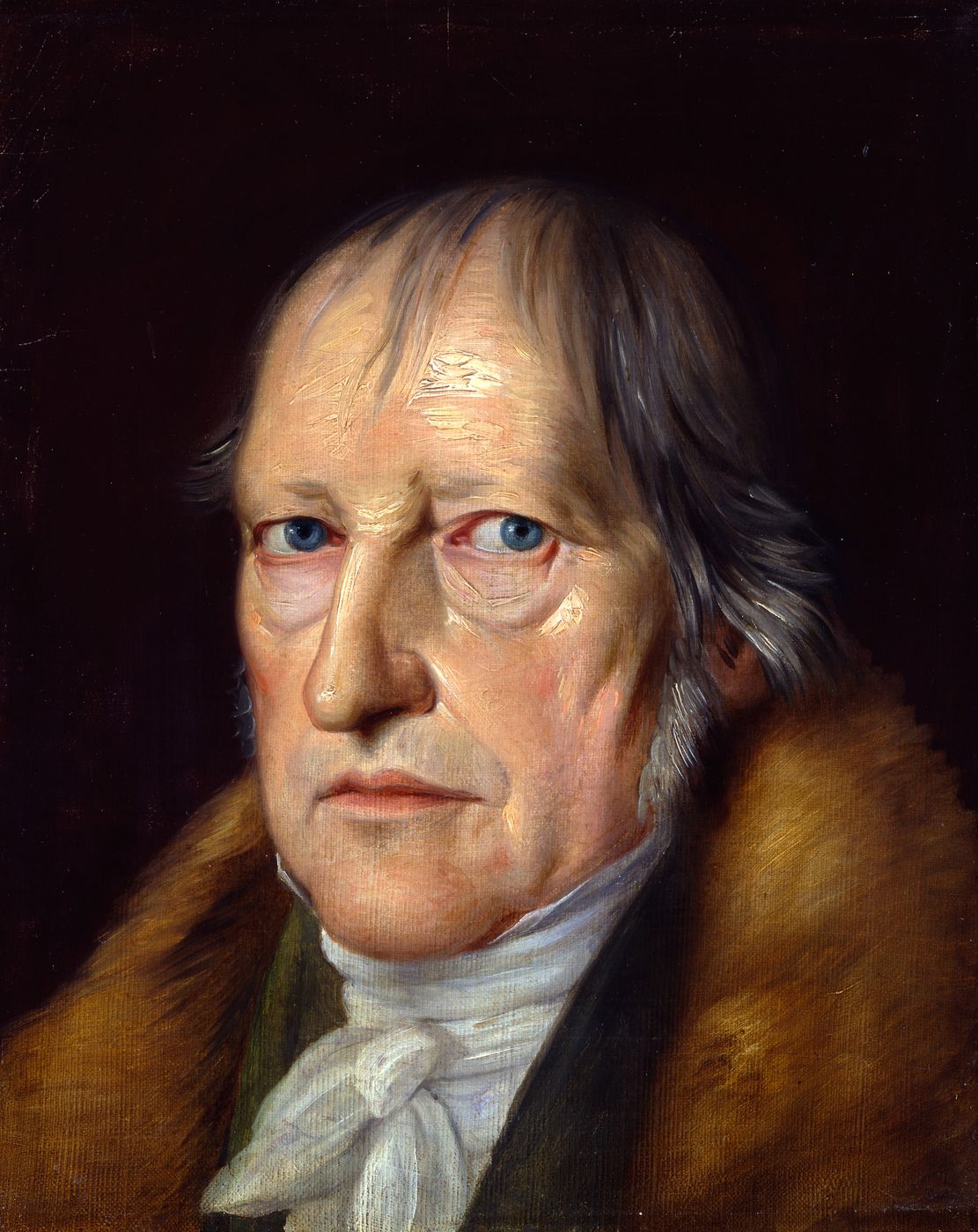

Lacan’s generation had read Hegel largely through Alexandre Kojève’s eyes. From 1933 to 1939 Kojève gave lectures on the Phenomenology at the École pratique des hautes études in Paris; among his listeners, besides Lacan, were Georges Bataille, Raymond Queneau and Maurice Merleau-Ponty, important names of twentieth-century French thought. In Kojève’s reading the desire for recognition becomes the essence of human desire: man desires the desire of the other.6 Lacan’s early writings on the mirror stage, aggressivity and recognition bear the marks of this reading.
But by 1969 Lacan had moved far from Hegel. For Lacan the master has no relation to knowledge; the master does not want to know. In Lacan’s phrase a real master never desires to know; what he wants is for things to work, que ça marche. The history of philosophy, in Lacan’s eyes, is the history of the master stealing the slave’s knowledge and presenting it as his own. Lacan finds the first scene of this theft in Plato’s dialogue Meno: Socrates, by asking questions of a slave boy who has never learned geometry, makes him solve the problem of doubling the area of a square, and claims to show that this knowledge was already in the boy.7
In the formula the master signifier, S1, is in the place of the agent and addresses knowledge, S2, that is, the slave’s knowing labour. From this bond a surplus of pleasure, a, is produced: a remainder that comes out of the slave’s labour but does not belong to him. Beneath the master, in the place of truth, stands the divided subject. The truth of the master’s discourse is that the master too is a divided, lacking, mortal subject. All the master’s power comes from covering over this truth. When a master speaks, what he says need not have a justification; it is valid because it comes out of the master’s mouth. This discourse, for Lacan, is also the structure of the unconscious. The first signifiers with which the subject identifies himself, his name, the place his family gave him, the identities he lives without questioning, work like a master’s commands.
IV
When you turn the terms back a quarter turn, knowledge, S2, takes the place of the agent. This is the discourse of the university. The one who speaks here is less a person than a body of knowledge: the textbook, the manual, the expert opinion, the regulation. Knowledge addresses another, someone put in the place of a, the student, and produces from him a divided subject, $.
The most important feature of the university’s discourse is that the master signifier stands in the place of truth. Knowledge speaks as something neutral, objective, impersonal; but beneath it, setting it in motion, is an unquestioned command. “Science says so”, “the rules require it”, “the system does not allow it” are sentences that hide a master’s command within the neutrality of knowledge. Lacan describes the dominance of this discourse in our time, with mordant irony, through the system of course credits introduced in French universities after 1968, in French unités de valeur, “units of value”: the student himself has become a unit of value, a credit accumulated within the system.8
The product of this discourse is the divided subject. Before knowledge the student moves ever further from his own question, his own desire, his own singularity; he is divided in the interval between the knowledge offered him and his own experience. The university’s discourse is the discourse of the second of the “impossible” professions Freud named, education. The same structure is at work in every institution that reduces a patient to a list of diagnostic criteria, an employee to performance indicators, a citizen to statistics. In these institutions it is always knowledge that speaks; but by whose command, on whose account that knowledge speaks remains invisible.
V
When you turn the terms a quarter turn forward from the master’s discourse, the divided subject, $, takes the place of the agent. This is the hysteric’s discourse and, perhaps, the most fruitful in Lacan’s theory. The one who speaks here is a subject speaking from his own division, his lack, his symptom, and he addresses a master, S1: Tell me what I am. The product of this demand is knowledge, S2. In the place of truth stands a, the object-cause of the desire that sets the demand in motion, which the hysteric herself does not quite know.
The historical scene of this discourse is the birthplace of psychoanalysis. At the end of the nineteenth century, at the Salpêtrière Hospital in Paris, the neurologist Jean-Martin Charcot presented hysterical patients every Tuesday before a crowd of physicians and students, starting and stopping their fits by hypnosis. André Brouillet’s painting exhibited at the Salon of 1887 shows one of these lessons: Charcot, standing, speaks facing his audience; beside him a young woman, Blanche Wittmann, her arms hanging in a half-conscious state, is about to fall into the arms of Joseph Babinski.
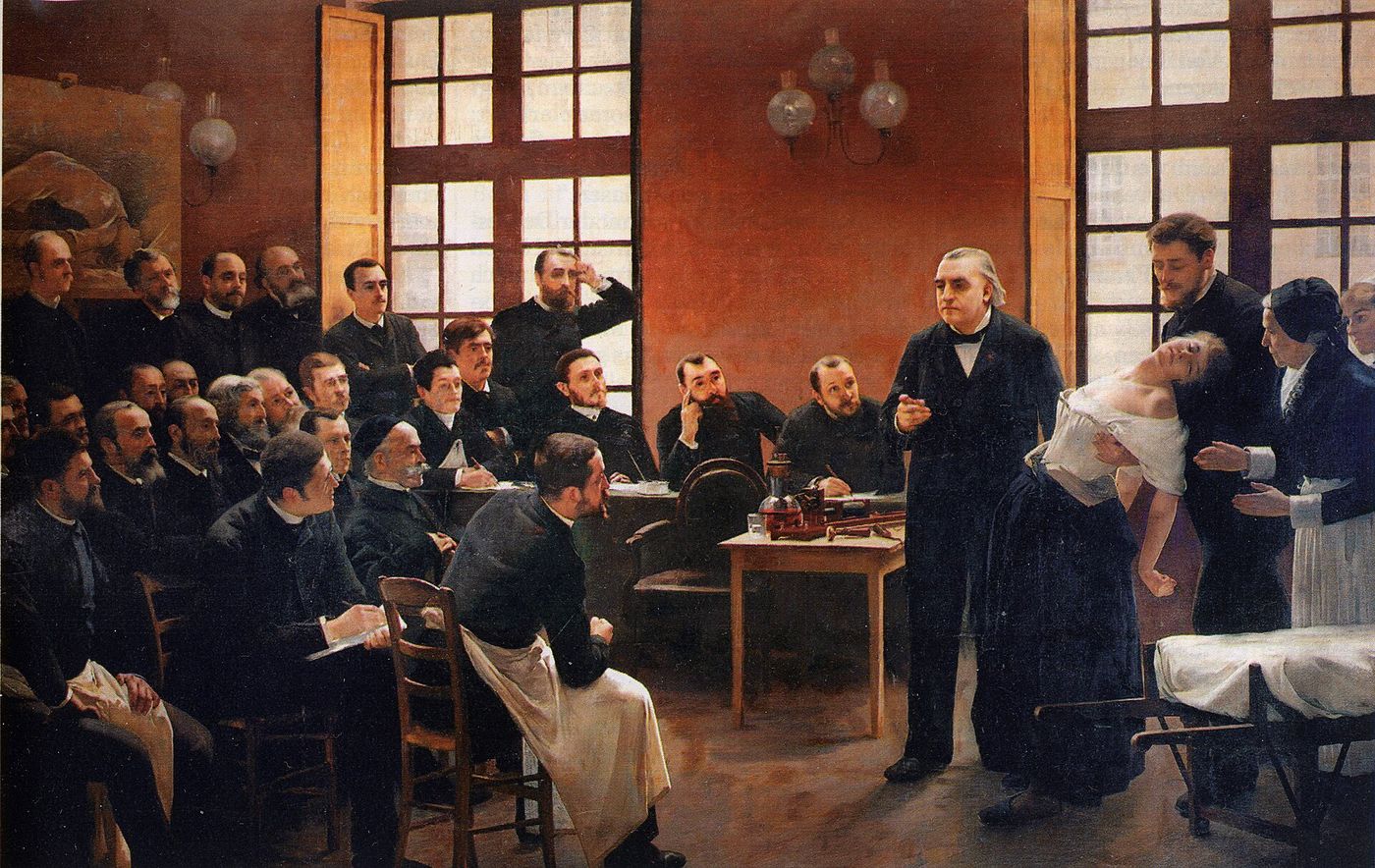

Freud spent a few months with Charcot in the winter of 1885–1886 and kept a lithograph copy of this painting hanging on the wall of his consulting room all his life.9 But what gave birth to psychoanalysis was less Charcot’s stage than the turning of this stage upside down. In Charcot knowledge is on the master’s side; the patient is a body that shows the master’s knowledge to the audience. Freud’s hysterical patients taught him something else. Emmy von N., whom he treated in 1889, asked him to stop constantly asking where this or that symptom came from, and to let her say what she had to say.10 Knowledge was to be born not from the master’s mouth but from the hysteric’s speech.
In the hysteric’s discourse Lacan sees a structure that forces the master to produce knowledge. The hysteric puts a question to the master and is content with no answer; she shows that every answer falls short, that the master’s knowledge does not cover her truth. This is why Lacan adds to Freud’s three impossible professions, governing, educating and analysing, a fourth impossibility: making desire. The hysteric keeps the master’s desire alive; she drives him to know, to search, to begin again. Science itself, for Lacan, owes a great deal to this structure.
The most instructive example of this structure is one of Freud’s own failures. Ida Bauer, eighteen years old, brought to Freud in October 1900 and known in the case Freud published as Dora, complained that her father did not help her against the attentions of the family friend Herr K., and was using her as a kind of object of exchange. In trying to resolve Dora’s symptoms Freud pressed on her ever more insistently his own interpretation, that Dora was really in love with Herr K. Three months later, on 31 December 1900, Dora broke off the analysis.11 In the postscript at the end of the case Freud writes that he realised very late that Dora’s interest was directed principally not at Herr K. but at Frau K. Lacan’s theory of the four discourses gives this failure a structure: Freud had answered the hysteric’s question with the master’s knowledge, and in the face of the hysteric’s discourse had ceased to be an analyst and taken the master’s place. Dora’s departure was the last and clearest move showing that the master’s knowledge does not cover her truth.
VI
The last quarter turn gives the analyst’s discourse. Here, in the place of the agent, stands a, the object-cause of desire; the analyst takes the place of the emptiness that sets the analysand’s desire in motion. This discourse addresses the divided subject, the analysand, and produces from him master signifiers, S1. In the place of truth stands knowledge, S2.
Every detail of the formula corresponds to a feature of analytic experience. The analyst does not impose what he knows on the analysand like a master; his knowledge stands in the place of truth, below, in silence. The analyst listens more than speaks, punctuates more than explains, keeps the question open more than he answers. Faced with this silence the analysand begins to speak from his own division, and as he speaks produces the master signifiers that govern his life, the words, names, identities and sentences that bind him to an unquestioned command. These signifiers now appear outside him, as material of the analysis; the subject can put a distance between himself and them.
An example may make this more concrete. An analysand may speak for a long time without knowing it under the sway of an epithet governing his life, say the epithet “strong” which has been fastened on him in his family since childhood. He describes himself as someone who never asks for help, carries other people’s burdens, shows his tiredness to no one; each of these attitudes seems to him his own choice. At some point in the analysis, perhaps in a slip, perhaps in a dream, perhaps when the analyst repeats a single word, this epithet suddenly separates from his speech and is heard as a command. At that moment the analysand realises that what he took for years to be himself was a master signifier that came out of another’s mouth, out of the desire of his family or of one of its members. That S1 stands in the place of the product in the formula says this: analysis does not abolish master signifiers, it produces them, that is, makes them visible and open to discussion.
The analyst’s discourse is the master’s discourse turned a full half turn. The S1 that stands above on the left in the master’s discourse appears below on the right in the analyst’s discourse, as a product; the a that the master’s discourse produces below on the right becomes the agent in the analyst’s. The seminar’s title comes from here: the master’s discourse is the reverse of psychoanalysis. Lacan draws attention to another important consequence of this structure: analysis first hystericises the analysand’s discourse. A person who comes to analysis with a symptom, a distress, a question, is invited within the analytic bond to speak from his own division and put a question to his master, that is, to the analyst. Unless the analysand’s discourse turns into the hysteric’s discourse, the analytic discourse cannot be established.
VII
Lacan reads an impossibility in the upper line of each discourse, on the arrow running from the agent to the other. The demand the agent makes of the other can never be wholly satisfied. In 1937 Freud had written that analysis was one of three “impossible” professions in which one can be sure from the start of an unsatisfying outcome; the other two were the long-known educating and governing.12 Lacan turns this sentence into a structural principle: governing is the impossibility of the master’s discourse, educating of the university’s, analysing of the analyst’s, making desire of the hysteric’s. This impossibility is not a sign of failure but the founding limit of every social bond. A master can never wholly make himself obeyed, a teacher can never teach everything, an analyst can never bring the analysand’s truth wholly to light.
In the lower line, between the product and the truth, there is an obstacle to which Lacan gives the name of powerlessness. What a discourse produces can never reach the truth that sets it in motion. The surplus of pleasure produced by the master’s discourse does not repair the master’s division; the divided subject produced by the university’s discourse cannot see the master’s command beneath knowledge. In the long interview he gave to Belgian radio in June 1970, as the seminar ended, Lacan sets out these two obstacles, impossibility and powerlessness, in detail.13 One consequence that can be drawn from this distinction is that many complaints of everyday life speak in a language of powerlessness: what we think does not exist because we have not worked enough, been loved enough, known enough is often something the structure itself does not allow. To complain of being unable is easier than facing a limit of the structure.
The discourses are not separated from one another by sharp lines. Social life is full of continual passages from one discourse to another, and Lacan also touches on a special sign of these passages. In the Encore seminar three years later he will say that love is the sign that discourse is being changed.14 The love a student feels for his teacher, an analysand for his analyst, appears at the moment the form of the bond changes, when one structure gives way to another.
VIII
In 1969–1970 the four discourses seemed a closed system. Two years later Lacan added a fifth structure. In a lecture given at the University of Milan on 12 May 1972 he wrote a formula he called the capitalist discourse.15 The formula arises from a small change to the master’s discourse: the two terms on the left, the master signifier and the divided subject, change places. The subject is now in the place of the agent; the master signifier has moved beneath him, to the place of truth.
This small displacement transforms the whole working of the structure. The arrows Lacan draws no longer contain a break, an impossibility; they set up an uninterrupted circulation among the terms. The subject, on the command he receives from the master signifier, addresses knowledge, that is, the knowledge produced by science and technology; this knowledge produces objects for him, and the objects return directly to the subject. Here no other subject, no other person, is addressed; the subject is related only to objects. Lacan says that this structure is madly clever, that it runs as if on wheels, but that, precisely because it runs so well, it consumes itself.
Lacan had already described the historical condition of this transformation in the seminar on the Other Side of Psychoanalysis. Hegel’s slave had a knowledge, a craft, over against his master; it was he who shaped the world by his labour. In the modern age the slave’s knowledge has been taken from his hands. The knowledge in the craftsman’s hands has been transferred to the machine, the order of the factory, the formulas of science; the worker has become a subject deprived of the knowledge of his own labour. For Lacan the exploitation Marx described is, before the appropriation of surplus value, the appropriation of this knowledge. Knowledge was once on the slave’s side; now it is on the side of science, technology and the institutions that govern them, and returns to the subject only in the form of objects for him to consume.
In the same seminar Lacan had also given a name to the objects this structure produces: lathouses. The word is a play Lacan makes out of the Greek words for truth, aletheia, and being, ousia, and describes the little devices, screens and machines produced by science and put in the place of the object-cause of desire, objects that never satisfy but are constantly renewed.16 Reading this phrase half a century later, it is hard not to think of the telephone in our pocket, the endless feeds, the constantly renewed products, the apps with which we manage ourselves as a project. In the capitalist discourse lack never turns into a question; every lack is at once met with an object, and the subject, in the circulation of these objects, without forming a bond with other subjects, enters the service of his own pleasure.
What Lacan said about the capitalist discourse is short and scattered; whether this structure can be counted a discourse at all, since it forms no social bond, is still debated in the Lacanian literature. But the clinical counterpart of the concept is clear. Many of the people who come to psychoanalysts’ consulting rooms today come not in conflict with a master’s prohibition or a father’s command in the old sense, but exhausted by limitless pleasure, limitless choice, a never-ending “more”. What they lack is not an object but a place from which they can ask a question in the face of the object.
IX
Let us go back to Vincennes. In the light of this theory the sentence Lacan said to the revolutionary students is less an insult than a diagnosis. The speech that revolts against the master is the speech of the hysteric’s discourse, the master’s discourse turned a quarter turn: the divided subject addresses the master and asks of him an answer, a knowledge, a truth. The product of this discourse is a new knowledge, but it may also be a new master. The hysteric does not want to overthrow the master; she wants to show him, face to face, that he lacks. What Lacan told the students was that, so long as their revolt remained within this structure, they could do nothing but call a new master in the place of the old.
The last thing to say about the sentence is that Lacan asked himself the same question that year. Lacan had founded a school, built a doctrine, become a master speaking before thousands of listeners. The analyst’s discourse is in theory the reverse of the master’s; in practice an analyst is at every moment ready to use his own knowledge like a master. Lacan’s dissolution of his own school in his last years, in 1980, of the École freudienne de Paris, is perhaps the answer this question left him.17 The theory of the four discourses reminds us that the analyst’s own place is never secure. The analyst is an analyst to the extent that, wherever a master begins to speak, he can remain someone who looks at the reverse side of that speech.
Notes
- J. Lacan, Le Séminaire, Livre XVII: L’envers de la psychanalyse (1969–1970), ed. J.-A. Miller, Paris: Seuil, 1991; English: The Seminar of Jacques Lacan, Book XVII: The Other Side of Psychoanalysis, trans. R. Grigg (2007). French envers names the reverse side of a fabric, of a garment, the side on which the seams show; the title also hints that psychoanalysis looks at the seams of the social discourses that show their smooth face. ↩︎
- M. Foucault, “Qu’est-ce qu’un auteur?”, Bulletin de la Société française de philosophie 63/3 (1969). The lecture was given on 22 February 1969, and Lucien Goldmann and Lacan were among those taking part in the discussion. Lacan’s reply is in the record of the discussion. ↩︎
- The talk is published in the Seuil edition as an appendix to the seminar, under the title “Analyticon”. In what follows Lacan tells his listeners that the order has made them part of its own game, has made them say, “Look how they enjoy themselves.” ↩︎
- Lacan gives this definition in the first lesson, on 26 November 1969: « un discours sans paroles ». Discourse here is not a text in the linguistic sense but an enduring form of relation that regulates in advance the circulation of speech; in the same years Lacan also calls it the “social bond”. ↩︎
- J. Lacan, Le Séminaire, Livre XVI: D’un Autre à l’autre (1968–1969), Paris: Seuil, 2006. Here Lacan transposes into the economy of pleasure Marx’s concept of Mehrwert, the surplus value the capitalist appropriates from the worker’s labour: every discourse extracts from the subjects within it a surplus of pleasure that cannot be measured. ↩︎
- A. Kojève, Introduction à la lecture de Hegel, ed. R. Queneau, Paris: Gallimard, 1947; English: Introduction to the Reading of Hegel, trans. J. H. Nichols Jr. (1969). Lacan’s formula “desire is the desire of the Other” is a psychoanalytic transformation of the idea formed in these lectures. ↩︎
- Plato, Meno, 82b–85b. Socrates uses this scene to prove the thesis that knowledge is recollection, anamnesis. In Lacan’s reading the scene is a model of the master extracting by his questions the knowledge in the slave’s hands and appropriating it. ↩︎
- The higher education law of autumn 1968, known by the name of the minister of education of the time, Edgar Faure, reorganised the French universities and structured courses into credit units. Lacan reminds the students at Vincennes that these units also mark themselves as a unit of value. ↩︎
- The lithograph was among the things Freud took from Berggasse 19 in Vienna to London and is today in the Freud Museum in London. Freud’s admiration for Charcot is plain in the obituary he wrote in 1893. ↩︎
- S. Freud and J. Breuer, Studies on Hysteria (1895), the case of “Frau Emmy v. N.”, SE II (German: Studien über Hysterie). Freud notes this request in his account of the case and records it as one of the forerunners of the method later called free association. ↩︎
- S. Freud, “Fragment of an Analysis of a Case of Hysteria” (1905), SE VII (German: “Bruchstück einer Hysterie-Analyse”, Gesammelte Werke V). In the postscript he added to the case Freud admits that he failed in time to notice and interpret the transference, and understood too late the importance of Dora’s attachment to Frau K. Lacan rereads the case from this angle in the text “Intervention sur le transfert” of 1951. ↩︎
- S. Freud, “Analysis Terminable and Interminable” (1937), SE XXIII (German: “Die endliche und die unendliche Analyse”, Gesammelte Werke XVI). Freud had expressed the same thought earlier, in 1925, in the preface to August Aichhorn’s Verwahrloste Jugend. ↩︎
- J. Lacan, “Radiophonie” (1970), Scilicet 2/3 (1970); Autres écrits, Paris: Seuil, 2001. The interview was recorded in June 1970 for Belgian radio and television. ↩︎
- J. Lacan, Le Séminaire, Livre XX: Encore (1972–1973), Paris: Seuil, 1975. Lacan defines love as a phenomenon that appears at every passage from one discourse to another; transference-love is the best-known form of the love that appears at the moment the analytic discourse is established. ↩︎
- J. Lacan, “Du discours psychanalytique”, Milan, 12 May 1972; Lacan in Italia 1953–1978 / En Italie Lacan, Milan: La Salamandra, 1978. Lacan returns to the capitalist discourse only briefly a few times in his seminars; the importance the formula has acquired in contemporary psychoanalysis is largely the work of later commentators. ↩︎
- Lacan uses the word in one of the later lessons of the seminar, telling his listeners that the world is increasingly filled with these objects, each of which answers the subject’s lack for a moment and reopens it. ↩︎
- In a letter written in January 1980 Lacan announced the dissolution of the École freudienne de Paris, which he had founded in 1964. The dissolution was presented as a move against the institutional rigidity that had formed within the school, the group’s freezing by clinging to itself; Lacan died about a year and a half later, in September 1981. ↩︎
References
- Foucault, M. (1969). Qu’est-ce qu’un auteur? Bulletin de la Société française de philosophie, 63(3).
- Freud, S., & Breuer, J. (1895). Studies on hysteria. SE II.
- Freud, S. (1905 [1901]). Fragment of an analysis of a case of hysteria. SE VII.
- Freud, S. (1937). Analysis terminable and interminable. SE XXIII.
- Hegel, G. W. F. (1807). Phänomenologie des Geistes. Goebhardt.
- Kojève, A. (1947). Introduction à la lecture de Hegel (R. Queneau, Ed.). Gallimard.
- Lacan, J. (1970). Radiophonie. Scilicet, 2/3.
- Lacan, J. (1975). Le Séminaire, Livre XX: Encore (1972–1973). Seuil.
- Lacan, J. (1978). Du discours psychanalytique. In Lacan in Italia 1953–1978. La Salamandra.
- Lacan, J. (1991). Le Séminaire, Livre XVII: L’envers de la psychanalyse (1969–1970). Seuil.
- Lacan, J. (2006). Le Séminaire, Livre XVI: D’un Autre à l’autre (1968–1969). Seuil.
- Plato. Meno.
- Roudinesco, E. (1993). Jacques Lacan: Esquisse d’une vie, histoire d’un système de pensée. Fayard.