This essay first appeared in Turkish. The English version is my own. Lacan’s texts are cited in the French originals, with English translations given where one exists. Freud’s works are cited by their titles in the Standard Edition (SE), with volume numbers. I leave jouissance untranslated, as English-language Lacanian writing generally does.

Das Ziel alles Lebens ist der Tod.
Sigmund Freud, Jenseits des Lustprinzips (1920)
The aim of all life is death.
Le surmoi, c’est l’impératif de la jouissance — Jouis !
Jacques Lacan, Le Séminaire XX: Encore
The superego is the imperative of jouissance: Enjoy!
I
The French word jouissance carries several meanings at once. In everyday language it names the enjoyment taken in something, in sexual language the orgasm; in legal language the right of use and enjoyment of a property, the authority to benefit from a thing separately from ownership. In building the concept Lacan gives up none of these meanings entirely, but lets it be reduced to none of them. The possible English renderings, enjoyment, pleasure, satisfaction, catch one side of the word and miss its real paradox: jouissance is a satisfaction that exceeds the limit of pleasure, that is often intertwined with pain, and that the subject cannot give up though he complains of it. This is why the concept, like Lacan’s other concepts, has to be used in its original form.
The word’s legal sense is no ornament for Lacan. Article 578 of the French Civil Code defines usufruct, in French usufruit, as the right to enjoy things of which another has the ownership, as the owner himself would, but on condition of preserving their substance. Lacan opens the first lesson of Encore with precisely this legal concept.1 Usufruct brings together the difference between what is useful and what is enjoyed: one may benefit from a thing, but must not consume it, expend it or destroy its substance. Jouissance begins precisely where this limit is crossed. Law regulates enjoyment as a right while limiting it; what psychoanalysis calls jouissance is a satisfaction that does not recognise this limit, that is ready to consume, expend, even destroy the substance of the thing. That Lacan uses the word with this legal connotation also reminds us why jouissance must always be thought together with a law, a limit, a “so far and no further”. In the same lesson Lacan gives another short and provocative definition: jouissance is what serves no purpose. What is useful, what serves an end, what meets a need, belongs to the economy of pleasure; jouissance is an expenditure that overflows this economy and cannot be accounted for. In the same seminar Lacan will go on to say that we do not know what it is to be alive, that all we know is that a body enjoys.2 Jouissance is not a thought but something lived inside the body, with the body.
The clinical source of the concept is one of the oldest astonishments of psychoanalysis. Freud had observed over and over that his patients suffered, that they came to him to be rid of the suffering, but that as the treatment advanced they clung to their suffering with a strange obstinacy. When their symptoms were interpreted they gave way to another, and as recovery came within reach an unexpected deterioration occurred. It was as if there were something in the suffering that was not merely suffering.
Freud had seen this “something that is not suffering” in a patient’s face, in a single moment. The Rat Man, whose treatment began in 1907, tries in the second session to tell Freud of the terrible punishment a cruel captain had described during military manoeuvres; his sentences break off, he gets up, walks about the room, asks Freud to spare him from telling the details. At the most horrifying moment of the patient’s narration, Freud writes, a strange, complex expression appeared on his face, and he describes it in a single phrase: horror at a pleasure of his own of which he himself was unaware.3 This phrase is perhaps the best definition of Lacan’s concept of jouissance. The patient recoils from what he is telling, is ashamed to say it, wants to be rid of it; but on his face, beyond all his conscious attitudes, a satisfaction appears which the scene gives him and which he himself does not know. Jouissance is a pleasure the subject does not know, but his body, his face, his voice give away.
II
Freud’s first theoretical framework was built on the pleasure principle. The mental apparatus tries to reduce tension, to keep excitation as low and constant as possible; pleasure is the discharge of tension, unpleasure its accumulation. In this framework a person’s turning towards what hurts him is an inexplicable exception. In 1920, in Beyond the Pleasure Principle, Freud begins to think that these exceptions may in fact be a rule. The dreams that in war neuroses take the sufferer back every night to the traumatic scene, his grandson’s game of repeatedly playing his mother’s departure with a reel, and the insistence analysands show in the treatment on re-living the most painful disappointments of their childhood, suggest to him the existence of a tendency working beyond the pleasure principle.4 In the most speculative parts of the book he interprets this tendency as the wish of a living thing to return to the inanimate state, and makes the statement I have taken as an epigraph: the aim of all life is death.
Four years later, in “The Economic Problem of Masochism”, Freud ties the same idea to a clinical concept. Masochism is now thought of as a primary tendency before being a form of sadism turned on the self. In this paper Freud discusses moral masochism, in which the person needs to be punished because of an unconscious sense of guilt, and the “negative reaction” in the treatment, situations in which recovery itself is lived as a threat.5 Lacan’s concept of jouissance gives a name to these clinical observations: within suffering there is a satisfaction that prevents the subject from giving it up.
Freud had described the most astonishing appearance of this structure in everyday life as early as 1916, in a character type he called “those wrecked by success”. These persons fall ill, collapse, ruin everything at the very moment they fully attain something they have long wanted, a position, a marriage, a success. Freud finds literary examples of this type in Shakespeare’s Lady Macbeth and in Rebekka West in Ibsen’s Rosmersholm: Lady Macbeth, who had risked everything to make her husband king, becomes at the very moment of success a shadow walking in her sleep, trying to wash imaginary blood from her hands; Rebekka West refuses the proposal of marriage she had wanted for years when at last it comes.6 For Freud what ruins these people is not an external frustration but the fulfilment of a wish; and what holds them back from the fulfilled wish is an unconscious sense of guilt. In Lacan’s language an economy of jouissance is at work here: the pleasure promised by success is knotted in the unconscious with a forbidden pleasure, perhaps with taking a father’s place, with defeating a rival; and the subject, instead of reaching this pleasure, finds quite another satisfaction in punishment, collapse, loss.
III
Lacan first works out the concept systematically in his seminar on ethics of 1959–1960. The concept of das Ding, the Thing, which he takes from Freud’s Project, is at the centre of this seminar: the absolute object the subject tries to reach but which would destroy him the moment he reached it. The pleasure principle, in Lacan’s reading, is a regulator that keeps the subject at an appropriate distance from this Thing; jouissance is the place at which this distance is crossed and pleasure turns into pain. In the same seminar, discussing the commandment to love one’s neighbour as oneself, Lacan argues that in the neighbour we find a reflection of our own jouissance, of that malevolent core within us that exceeds us. The sceptical questions Freud put to this commandment in Civilization and Its Discontents become, in Lacan’s hands, the starting point of an ethics.7
Lacan gives this thought its most provocative form in the text “Kant with Sade”, published in 1963. The thesis of the text is that Sade’s Philosophy in the Bedroom completes the truth of Kant’s Critique of Practical Reason. Kant’s moral law is a universal imperative, purged of all personal interests and feelings; Lacan shows that in Sade’s texts there echoes another imperative with the same formal structure, an imperative of jouissance proclaiming the right of everyone to enjoy everyone else’s body without limit.8 This uncanny proximity between the moral law and jouissance leads psychoanalysis to rethink the concept of the superego.
The history of the text itself fits this uncanniness. Lacan wrote “Kant with Sade” as a preface to Philosophy in the Bedroom for a new collected edition of Sade’s works; in the end the text was not used as a preface and was published in 1963 in the review Critique.9 Sade himself had spent about thirty years of his life in prisons and asylums. In 1785, in his cell in the Bastille, he wrote The 120 Days of Sodom in minute handwriting on a roll of over twelve metres made of paper strips pasted together; a few days before the storming of the Bastille in 1789 he was transferred elsewhere and the roll was left behind. Believing the manuscript lost, Sade wrote that he wept tears of blood over it until his death; the roll was found years later and could be published only in the twentieth century.10 Philosophy in the Bedroom was published in 1795, in the midst of the Revolution; it contains a famous pamphlet, advising the French that if they want to be republicans they must make one more effort, and calling for the abolition of every prohibition.
The key to the link Lacan draws between Kant and Sade is an example Kant gives in the Critique of Practical Reason. Kant asks us to think of a man who says he cannot resist his lust: if a gallows were set up in front of the house where he could spend a night with the woman he desires, to hang him after that night, would he still yield to his lust? For Kant, no: the fear of losing his life is stronger than lust. But suppose the same man were told by his prince, on pain of death, to bear false witness against an honest man: this time he might refuse, risking death. From this example Kant concludes that the moral law can be stronger than the strongest natural inclination, even than the wish to live.11 Lacan objects to the first half of the example. There are people for whom the gallows ceases to be a deterrent and itself provokes desire: the courtly lover going to his beloved at the risk of death, the pervert for whom danger heightens pleasure, or the tragic hero who pursues a desire at the cost of his life. Jouissance upsets the calculation of the pleasure principle and of the will to live. Both Kant’s moral law and Sade’s imperative of jouissance speak beyond this calculation, as an imperative that can treat life itself as nothing.
Freud’s superego is the agency of prohibitions and conscience. Lacan, in the first lesson of the seminar Encore, of 1972–1973, says that the real command of this agency is not a prohibition but an order: nothing forces anyone to enjoy except the superego; the superego is the imperative of jouissance: Enjoy!12 This formula offers an unexpected key to the mood of contemporary society. What oppresses people most today is often not a prohibition but the obligation to be happy, to be satisfied, to enjoy life; and the inadequacy felt before this obligation is no less devastating than the guilt created by the old prohibitions.
Freud had described this strange economy of the superego before Lacan, in the seventh chapter of Civilization and Its Discontents. By everyday intuition we think that someone who behaves well will have an easy conscience. Freud observes the opposite: the more virtuous a person is, the harsher and more suspicious his conscience; saints accuse themselves as the greatest of sinners. The superego feeds on every concession made to it, on every aggression repressed, and demands more.13 Lacan’s concept of jouissance gives this vicious circle a name: there is a pleasure in the superego’s criticising, humiliating, punishing the subject. Listening to the inner voice so often met in the clinic, the voice that belittles every success, magnifies every mistake, finds the person constantly inadequate, one of the important moments of analytic work is to notice that it works less as a warning or a morality than as an inexhaustible source of satisfaction.
IV
One of Freud’s texts showing the structure of jouissance most clearly is “A Child Is Being Beaten”, published in 1919. In this paper Freud examines a fantasy many analysands confess with shame: imagining a child being beaten, with this imagining accompanied by a masturbatory satisfaction. Freud shows that the fantasy passes through three phases. In the first the fantasy takes the form “My father is beating the child I hate.” In the second it takes a form that never reaches consciousness and can only be reconstructed by analytic work: “My father is beating me.” In the third the fantasy becomes an anonymous scene in which the subject takes part only as a spectator: “A child is being beaten.”14 The lesson of the paper is that the phase of greatest satisfaction, the second, in which the father’s love and a beating, punishment and desire, are joined, is precisely the phase that remains unconscious. Jouissance is lived in a scene the subject himself does not know, where pain and love are knotted together.
Lacan takes up this knot from another angle in the eleventh seminar of 1964, rethinking the concept of the drive. In reading Freud’s distinctions concerning the source, pressure, object and aim of the drive he makes use of two English words: aim and goal. The drive’s aim is not a point to be reached but a path followed; the drive is satisfied not by reaching its object but by circling round it.15 The image Freud built in 1905 in describing the infant’s thumb-sucking is the first sketch of this structure: the infant goes on sucking after his hunger is satisfied, this time not for nourishment but for the sucking itself. Freud describes this activity as an auto-eroticism like the lips kissing themselves; Lacan reuses the image, that of a mouth kissing itself, as a picture of the circular structure of the drive.16 This formula offers an unexpected key to many of the experiences we call “addiction” today. Scrolling through a screen for hours, returning again and again to the same food, writing again to the same person, express less an effort to reach an object than a satisfaction taken from circling the object. The circuit does not satisfy, but stopping is not possible either; jouissance is exactly the circuit itself.
In literature the barest witness of this circuit is Dostoevsky’s passion for gambling. In the 1860s, at the roulette tables of the casinos of the German spa towns, Dostoevsky repeatedly lost all his money, his wife’s jewels, his own overcoat; after each loss he wrote to his wife letters of apology swearing never to play again, and each time played anew. In 1866, with a heavy contract with a publisher about to expire, he finished The Gambler in twenty-six days, dictating it to a young stenographer; the next year he married her, Anna Snitkina.17 In his essay on Dostoevsky in 1928 Freud examines this passion and draws attention to a curious detail: when Dostoevsky had lost everything he felt a relief, a lightness, and only then could write again. For Freud gambling was a form of self-punishment; losing was the price exacted by an unconscious sense of guilt, and when this price was paid creativity became possible again.18 The jouissance of gambling lies not in winning but in the tension between winning and losing, in the spinning ball itself; and the deepest satisfaction is perhaps at the moment when everything is lost.
V
The clinical value of the concept of jouissance lies in its explaining the obstinacy of the symptom. Freud had thought of the symptom as the disguised expression of a repressed wish, that is, as an interpretable message; but he had also seen that an interpreted symptom often does not resolve. For Lacan the symptom is not only a message but also an apparatus of jouissance: it both says the subject’s unconscious conflict and harbours the specific form of satisfaction arising from that conflict. Interpretation can resolve the message, but it does not disperse the jouissance. Someone who for years has repeated the same pattern of relationship, been left, been devastated, and entered the next relationship from the same position, wants consciously to change; but somewhere in the unconscious the pattern itself is producing something. What hurts also satisfies; and this satisfaction is lived in a place the person cannot admit even to himself, cannot name, on a scene which consciousness never visits.
In his seventeenth seminar of 1969–1970 Lacan proposes a concept that also extends to an analysis of capitalism: surplus jouissance, in French plus-de-jouir. The subject’s entry into language and society takes place through a loss of jouissance; but this loss returns as a remainder, like Marx’s surplus value, and stands in the place of the cause of desire.19 The logic of the consumer society, which promises ever new objects, new experiences, new pleasures, can be read as an unending search that tries to catch this remainder.
VI
The most debated part of Lacan’s theory of jouissance is the distinction he makes in Encore. Here Lacan separates phallic jouissance, which he defines as the jouissance of language, of limit and of lack, from another jouissance that remains outside this logic, that does not come into words, and relates this second jouissance to the feminine position in the formulas of sexuation. This distinction is not anatomical but logical; each subject, according to his structure, stands somewhere between these two jouissances.
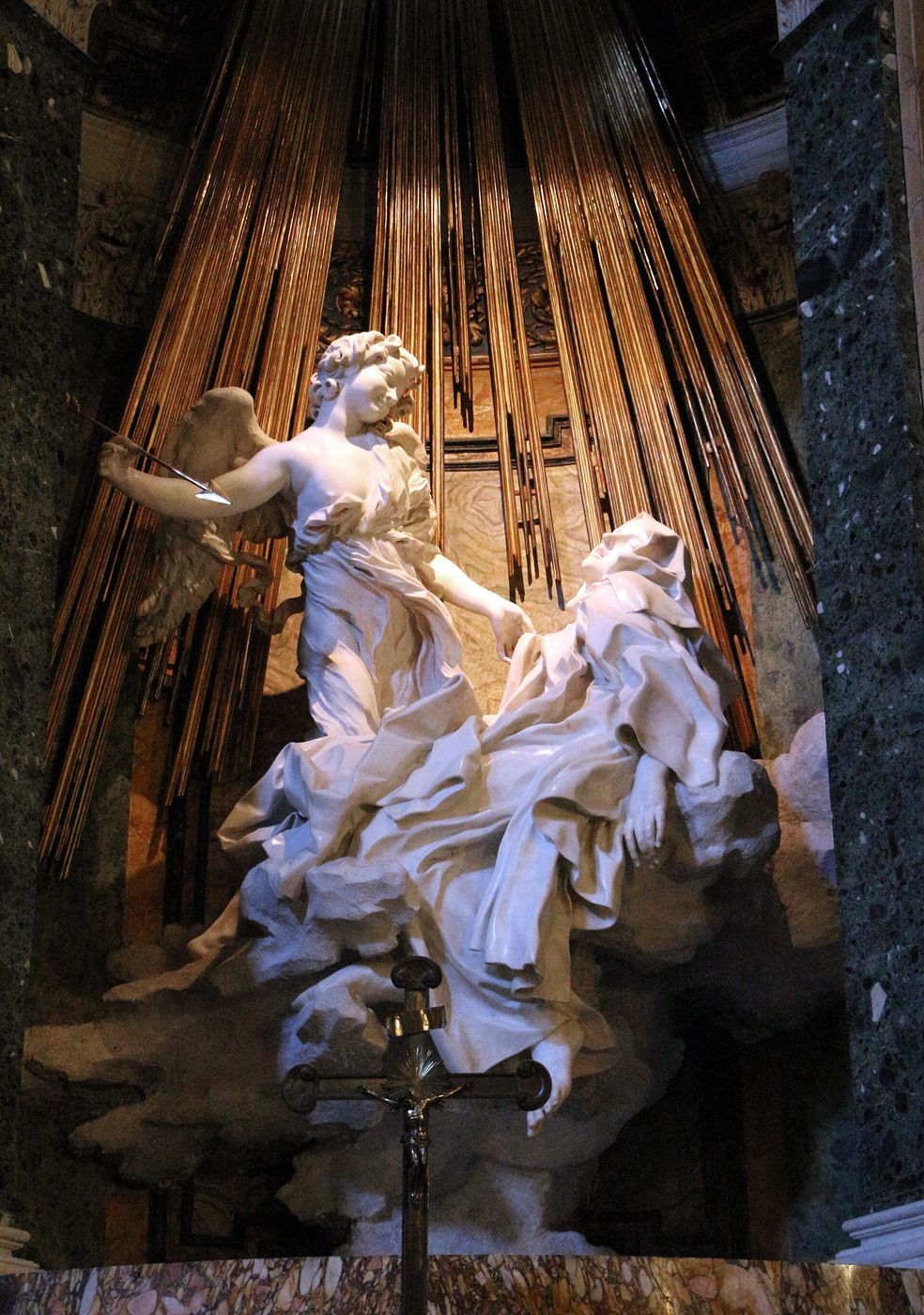
Lacan finds a trace of this other jouissance in the testimonies of the mystics, and in one of the most quoted moments of the seminar points to a statue in Rome: he says that looking at Bernini’s statue of Saint Teresa in the church of Santa Maria della Vittoria is enough to understand at once that the saint is in a state of jouissance; the mystics’ fundamental testimony is that they experience this jouissance but know nothing about it.20 Teresa’s own account carries the same paradox: in her autobiography she writes that an angel plunged a golden spear with a fiery tip several times into her heart, that the pain was so great that it made her moan, but that the sweetness of the pain was so excessive that she would not wish it to cease.21
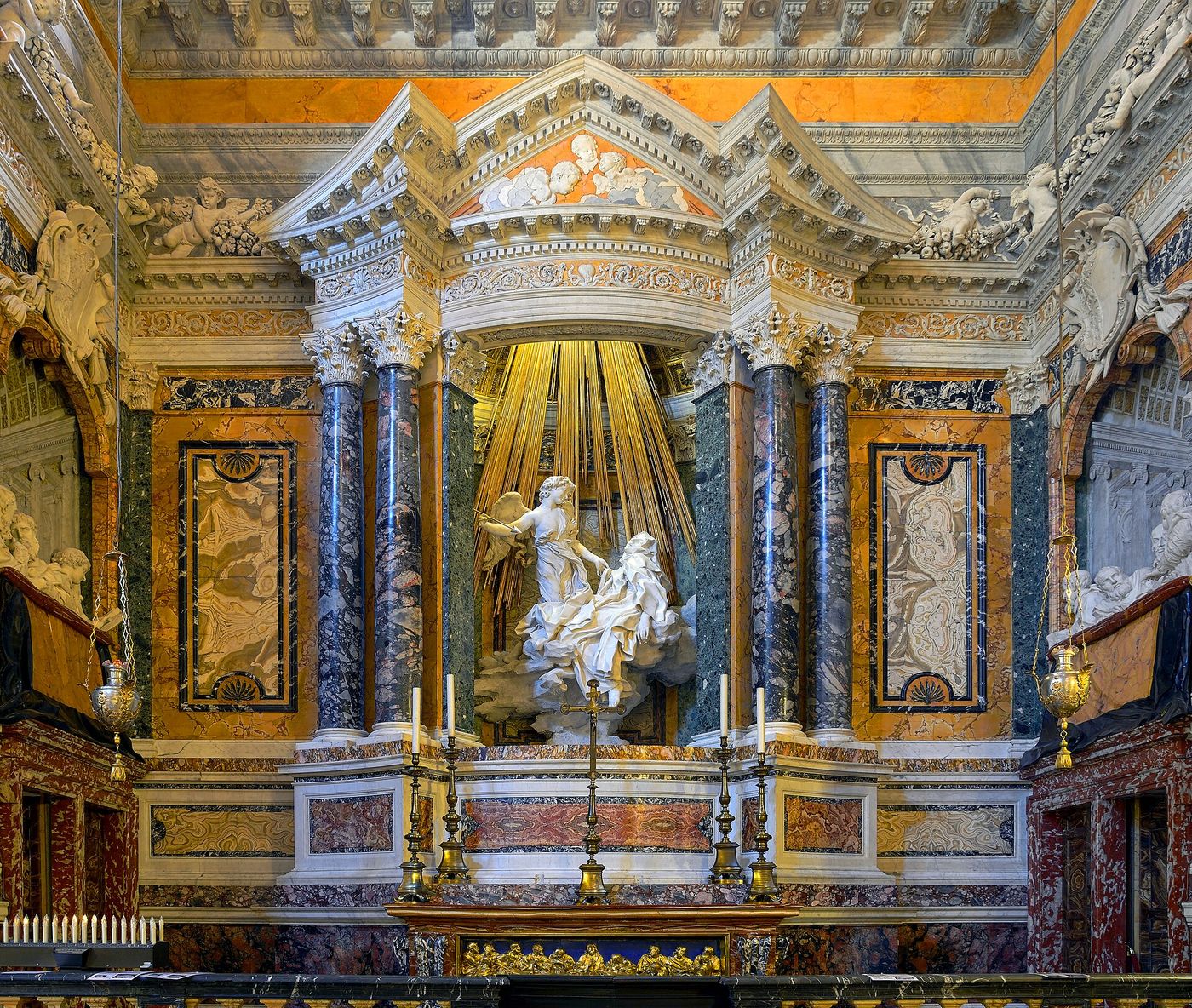

This passage has been the subject of sharp feminist criticism. In texts written in reply to Encore, Luce Irigaray stresses that Lacan again defines women’s jouissance through a man’s gaze and a male artist’s work, putting at the centre not women’s own speech but a discourse speaking about them.22 The architecture of the Cornaro Chapel offers this criticism an unexpected support: Bernini staged the saint’s ecstasy under the gaze of the men watching from the boxes on either side. Teresa’s experience is, from the start, an experience that is watched.
VII
The most powerful figure Lacan turns to in thinking the limits of jouissance in the seminar on ethics is Sophocles’ Antigone. King Creon forbids the burial of the body of Polyneices, who had fought against Thebes; his sister Antigone defies the prohibition, buries her brother and is condemned to be shut alive in a cave. Lacan reads this tragedy, unlike Hegel’s classical reading, not as a conflict of two laws but as a desire pursued to the end. Antigone stands, in Lacan’s phrase, “between two deaths”, a being who has died symbolically before her biological death, and from this border region there radiates a glow that lights the whole stage of the tragedy.23 The expression “two deaths” Lacan takes, unexpectedly, again from Sade. In a long speech Sade has Pope Pius VI make in Juliette, a system is described in which the biological death of individuals is not enough for nature to be able to recreate itself, and a second death, an absolute crime, which would wipe individuals entirely from nature’s cycle, is imagined.24 Lacan uses this idea to think the interval between symbolic and biological death. For Lacan beauty, precisely as this glow, is the last veil that prevents the subject from approaching the Thing, that is, a destructive jouissance, too closely. Antigone’s beauty fascinates us because it protects us from the place she goes to.
The relation between jouissance and desire is the knotting point of Lacan’s ethics and is not as simple as supposed. By everyday intuition we think that desire wants to reach jouissance, runs after it. Lacan says the opposite in 1960: desire is a defence, a defence against going beyond a limit in jouissance.25 Desire circles round lack, keeps it open, slides to the next object; and this slide protects the subject from a jouissance that would swallow him whole. The desiring subject, precisely because he desires, does not fall into a pleasure that would consume him. The formula Lacan states in the seminar on ethics, later much quoted, must be understood in this context: the only thing of which one can be guilty is having given ground relative to one’s desire.26 This sentence is not a hedonism, a “do what you like”. The subject who gives ground on his desire falls most often not into comfort or security but into a blind jouissance, into the closed circuit of a symptom, a repetition, an addiction. To sustain desire is also a way of protecting oneself from the destructive pull of jouissance.
VIII
Psychoanalysis does not promise to abolish jouissance. Such a promise would not be honest; for jouissance cannot be separated from life itself, it is something inscribed in the subject’s body and history. What can be done is to change the subject’s relation to jouissance: to let him carry it in a less destructive, less repetitive, less blind way. In his late seminars Lacan speaks not so much of the subject’s being freed from his symptom at the end of analysis as of his learning to know what to do with it, to recognise it and make something of it. This is not resignation. Someone who, within a circuit that causes him pain, knows what that circuit satisfies, in whose name and for what old scene it turns, no longer has to go round it blindly; he can step out at some point, slow it down, give it another direction.
Jouissance stands at the centre of clinical thinking but is still hard to speak of; perhaps for just this reason. The moment we speak of it we miss it; speech pushes part of jouissance away, carries it elsewhere. The clinic works within this paradox: to change jouissance by speaking, while accepting the impossibility of speaking it entirely. What Bernini wrote in stone, what Teresa tried and failed to tell in words, what appeared for a moment on the Rat Man’s face, what Dostoevsky sought at the roulette table, is just this impossibility itself.
Notes
- Code civil, article 578: « L’usufruit est le droit de jouir des choses dont un autre a la propriété, comme le propriétaire lui-même, mais à la charge d’en conserver la substance. » Lacan, Le Séminaire, Livre XX: Encore (1972–1973), first lesson, 21 November 1972; English: On Feminine Sexuality, the Limits of Love and Knowledge, trans. B. Fink (1998). ↩︎
- Lacan, Encore: « La jouissance, c’est ce qui ne sert à rien »; and in the same seminar, the idea that the body itself is an enjoying substance: « un corps, cela se jouit ». ↩︎
- S. Freud, “Notes upon a Case of Obsessional Neurosis” (1909), SE X (German: “Bemerkungen über einen Fall von Zwangsneurose”, Gesammelte Werke VII). Freud’s phrase is: Grausen vor seiner ihm selbst unbekannten Lust. ↩︎
- S. Freud, Beyond the Pleasure Principle (1920), SE XVIII. ↩︎
- S. Freud, “The Economic Problem of Masochism” (1924), SE XIX. ↩︎
- S. Freud, “Some Character-Types Met with in Psycho-Analytic Work” (1916), SE XIV (German: “Einige Charaktertypen aus der psychoanalytischen Arbeit”, Gesammelte Werke X), section II: “Those wrecked by success”. Freud stresses that these persons’ illness arises not from an external frustration but from the fulfilment of a wish. ↩︎
- J. Lacan, Le Séminaire, Livre VII: L’éthique de la psychanalyse (1959–1960), Paris: Seuil, 1986; English: The Ethics of Psychoanalysis, trans. D. Porter (1992); S. Freud, Civilization and Its Discontents (1930), SE XXI. ↩︎
- J. Lacan, “Kant avec Sade” (1963), Écrits (1966), pp. 765–790; English in Écrits, trans. B. Fink (2006). ↩︎
- Lacan’s text was written for the La Philosophie dans le boudoir volume of the Sade edition prepared in the 1960s by the publisher Cercle du livre précieux, but, at the publisher’s choice, was not printed as a preface; it appeared in issue 191 of the review Critique (April 1963). ↩︎
- For the adventure of the roll see M. Lever, Donatien Alphonse François, marquis de Sade, Paris: Fayard, 1991; English: Marquis de Sade: A Biography, trans. A. Goldhammer (1993). The manuscript has since been classified by France as a national treasure. ↩︎
- I. Kant, Kritik der praktischen Vernunft (1788), book one, § 6, remark. Lacan takes up the example both in Le Séminaire, Livre VII and in “Kant avec Sade”. ↩︎
- J. Lacan, Le Séminaire, Livre XX: Encore (1972–1973), Paris: Seuil, 1975, first lesson: “Rien ne force personne à jouir, sauf le surmoi. Le surmoi, c’est l’impératif de la jouissance — Jouis !” ↩︎
- S. Freud, Civilization and Its Discontents (1930), SE XXI (German: Das Unbehagen in der Kultur, Gesammelte Werke XIV), chapter VII. Freud argues here that every renunciation of a drive increases rather than reduces the severity of the superego, that conscience works in a vicious circle. ↩︎
- S. Freud, “‘A Child Is Being Beaten’: A Contribution to the Study of the Origin of Sexual Perversions” (1919), SE XVII. ↩︎
- J. Lacan, Le Séminaire, Livre XI: Les quatre concepts fondamentaux de la psychanalyse (1964), Paris: Seuil, 1973, lessons on the drive. ↩︎
- S. Freud, Three Essays on the Theory of Sexuality (1905), SE VII (German: Drei Abhandlungen zur Sexualtheorie, Gesammelte Werke V), second essay. Freud writes that the infant would like to be able to kiss his own lips, that the impossibility of it creates a feeling of inadequacy; in the seminar Lacan describes the closed circuit of the drive as a mouth kissing itself. ↩︎
- The most valuable testimony to Dostoevsky’s gambling years is the diaries and memoirs of Anna Grigoryevna Dostoevskaya. The Gambler was written in twenty-six days in October 1866 because of a contract with the publisher Fyodor Stellovsky under which, if the book was not delivered on time, Dostoevsky would hand over to the publisher the rights to all his future works. ↩︎
- S. Freud, “Dostoevsky and Parricide” (1928), SE XXI (German: “Dostojewski und die Vatertötung”, Gesammelte Werke XIV). Freud also interprets the passion for gambling as a substitute for childhood masturbation and a repetition of the guilt around it, developing this reading through a story by Stefan Zweig. ↩︎
- J. Lacan, Le Séminaire, Livre XVII: L’envers de la psychanalyse (1969–1970), Paris: Seuil, 1991; English: The Other Side of Psychoanalysis, trans. R. Grigg (2007). ↩︎
- Lacan, Encore, the lesson “Dieu et la jouissance de La femme”. ↩︎
- Teresa of Ávila, Libro de la Vida (ca. 1565), chapter 29. ↩︎
- L. Irigaray, Speculum de l’autre femme (1974), especially “La Mystérique”; Ce sexe qui n’en est pas un (1977), “Così fan tutti”; English: Speculum of the Other Woman, trans. G. C. Gill (1985); This Sex Which Is Not One, trans. C. Porter (1985). ↩︎
- Lacan, Séminaire VII, the lessons on Antigone; Sophocles, Antigone (ca. 441 BCE). ↩︎
- Sade, Histoire de Juliette (1797–1801), the system Pius VI expounds to Juliette. Lacan takes up this section in the lessons of Le Séminaire, Livre VII on the second death. ↩︎
- J. Lacan, “Subversion du sujet et dialectique du désir dans l’inconscient freudien” (1960), Écrits, Paris: Seuil, 1966: « Car le désir est une défense, défense d’outre-passer une limite dans la jouissance. » ↩︎
- Lacan, Le Séminaire, Livre VII: L’éthique de la psychanalyse, last lessons: « la seule chose dont on puisse être coupable, c’est d’avoir cédé sur son désir ». ↩︎
References
- Freud, S. (1905). Three essays on the theory of sexuality. SE VII.
- Freud, S. (1909). Notes upon a case of obsessional neurosis. SE X.
- Freud, S. (1916). Some character-types met with in psycho-analytic work. SE XIV.
- Freud, S. (1919). “A child is being beaten”: A contribution to the study of the origin of sexual perversions. SE XVII.
- Freud, S. (1920). Beyond the pleasure principle. SE XVIII.
- Freud, S. (1924). The economic problem of masochism. SE XIX.
- Freud, S. (1928). Dostoevsky and parricide. SE XXI.
- Freud, S. (1930). Civilization and its discontents. SE XXI.
- Irigaray, L. (1974). Speculum de l’autre femme. Minuit.
- Irigaray, L. (1977). Ce sexe qui n’en est pas un. Minuit.
- Kant, I. (1788). Kritik der praktischen Vernunft. Hartknoch.
- Lacan, J. (1966). Kant avec Sade (1963); Subversion du sujet et dialectique du désir dans l’inconscient freudien (1960). In Écrits. Seuil.
- Lacan, J. (1973). Le Séminaire, Livre XI: Les quatre concepts fondamentaux de la psychanalyse (1964). Seuil.
- Lacan, J. (1975). Le Séminaire, Livre XX: Encore (1972–1973). Seuil.
- Lacan, J. (1986). Le Séminaire, Livre VII: L’éthique de la psychanalyse (1959–1960). Seuil.
- Lacan, J. (1991). Le Séminaire, Livre XVII: L’envers de la psychanalyse (1969–1970). Seuil.
- Lever, M. (1991). Donatien Alphonse François, marquis de Sade. Fayard.
- Sade, D. A. F. de (1797–1801). Histoire de Juliette, ou les Prospérités du vice.
- Sade, D. A. F. de (1795). La Philosophie dans le boudoir.
- Sophocles. Antigone.
- Teresa de Ávila. Libro de la Vida.