This essay first appeared in Turkish. The English version is my own. Lacan’s texts are cited in the French originals, with English translations given where one exists. Freud’s works are cited by their titles in the Standard Edition (SE), with volume numbers. I leave objet petit a untranslated, as Lacan himself insisted.

Die Objektfindung ist eigentlich eine Wiederfindung.
Sigmund Freud, Drei Abhandlungen zur Sexualtheorie (1905)
The finding of an object is in fact a refinding of it.
I
The name of the concept is a small letter in Lacan’s algebra. The small a, the initial of the French word autre, “other”, is used in Lacan’s teaching first for the semblable, the other derived from the mirror image who is the ego’s rival; the capital A is for Autre, the Big Other. From the early 1960s the small letter acquires a quite different meaning and becomes the name of the concept regarded as the most important of Lacan’s own inventions. Lacan insisted that the name not be translated, so that the term should remain not a word whose meaning varies with context but an algebraic sign whose function it takes only from its place in a structure.1 In this essay too I shall use the term in its original form; but I shall try to show why the common English rendering, “object of desire”, can be misleading.
II
The roots of the concept are in Freud. In the Three Essays on the Theory of Sexuality of 1905, writing that the infant has its first experience of satisfaction at the mother’s breast and that all later choices of object are shaped by this first experience, Freud makes the statement I have taken as an epigraph: the finding of an object is in fact a refinding of it.2 The hidden paradox of the sentence emerges in Lacan’s reading: the object one tries to refind was never an object really possessed. It is an object constructed afterwards, backwards, out of loss, and no concrete object can wholly take its place. Twenty years later, in the short but dense paper on negation of 1925, Freud returns to the same thought: the first and immediate aim of reality-testing is not to find in perception an object corresponding to the one present in the mind, but to refind it, to convince oneself that it is still there.3 The world we perceive is, in a way, always built in the wake of a loss; in recognising objects we are really looking for the trace of something we have lost. Objet petit a is the name of this trace. The das Ding, the Thing, of Freud’s Project of 1895, the name he gives to the residue of the human being facing the infant, which the infant can never wholly grasp, is another precursor of this thought; Lacan works the concept out at length in his seminar on ethics.
Another source of the concept is the thinking of the post-Freudian psychoanalytic tradition on “part-objects”. Karl Abraham and, after him, Melanie Klein had shown that the infant’s world is made up, before whole persons, of parts, the breast lived as good or bad, the voice, the gaze. The transitional object Donald Winnicott defined in 1953, the blanket or toy the infant clings to as it separates from its mother, is the best-known example of these intermediate objects that belong both to the inner and the outer world.4 Lacan takes up this inheritance but transforms it at the root: objet petit a, before being a part-object, is the name of an emptiness, of the place left by a part that is torn from the body with the subject’s entry into language.
III
The concept reaches its most mature form in the tenth seminar, which Lacan devoted to anxiety in 1962–1963. Here Lacan defines a not as the object of desire but as its cause. The distinction is fine but decisive. The object of desire is what desire seeks ahead of it; the cause of desire stands behind desire, in the place that sets it in motion. One does not desire a person as a whole; one desires in him a particular detail that has taken one captive, a look, a tone of voice, a way of walking, and this detail, independently of the beloved’s conscious qualities, is what lights the fire of desire. Lacan counts as the principal forms of this object the breast, the faeces, the gaze and the voice: parts detached from the body, parts of the subject that are both his own and not his own.5
Lacan also reverses the received thought on the question of whom these objects belong to. The breast is at first sight a part of the mother’s body; the infant finds it in her, takes from it, separates from it. In the seminar on anxiety Lacan argues instead that the breast stands in a way on the infant’s side, attached to the mother’s body, working as an intermediate organ between infant and mother, like the placenta that is torn away at birth and of which it cannot quite be said whether it belongs to the infant or the mother.6 The consequence of this thought is deep: what the weaned infant loses is not another’s part but a part of its own being. Objet petit a is therefore less an object outside than a part of the subject torn from himself, which both leaves him lacking and sets his desire in motion.
Lacan writes this tearing away as a myth too. In 1964, in a text on the position of the unconscious, he asks us to imagine that at the moment of birth, as the membranes of the egg tear, something escapes from it: an organ, extremely thin, flat, able like an amoeba to slip everywhere, a membrane, in Lacan’s phrase a “lamella”. Lacan calls it, in a play on words, hommelette: a fusion of homme, man, and omelette, the little man that comes out when the egg is broken.7 This mythical organ is libido itself: the pure and immortal life lost by a being born through sexual reproduction and therefore mortal. All the forms of objet petit a, breast, faeces, gaze, voice, are representatives of this lost life appearing at different shores of the body. The myth is strange, even a little uncanny; but it conveys intuitively why Lacan defines the cause of desire through a lack, a tearing away, a loss.
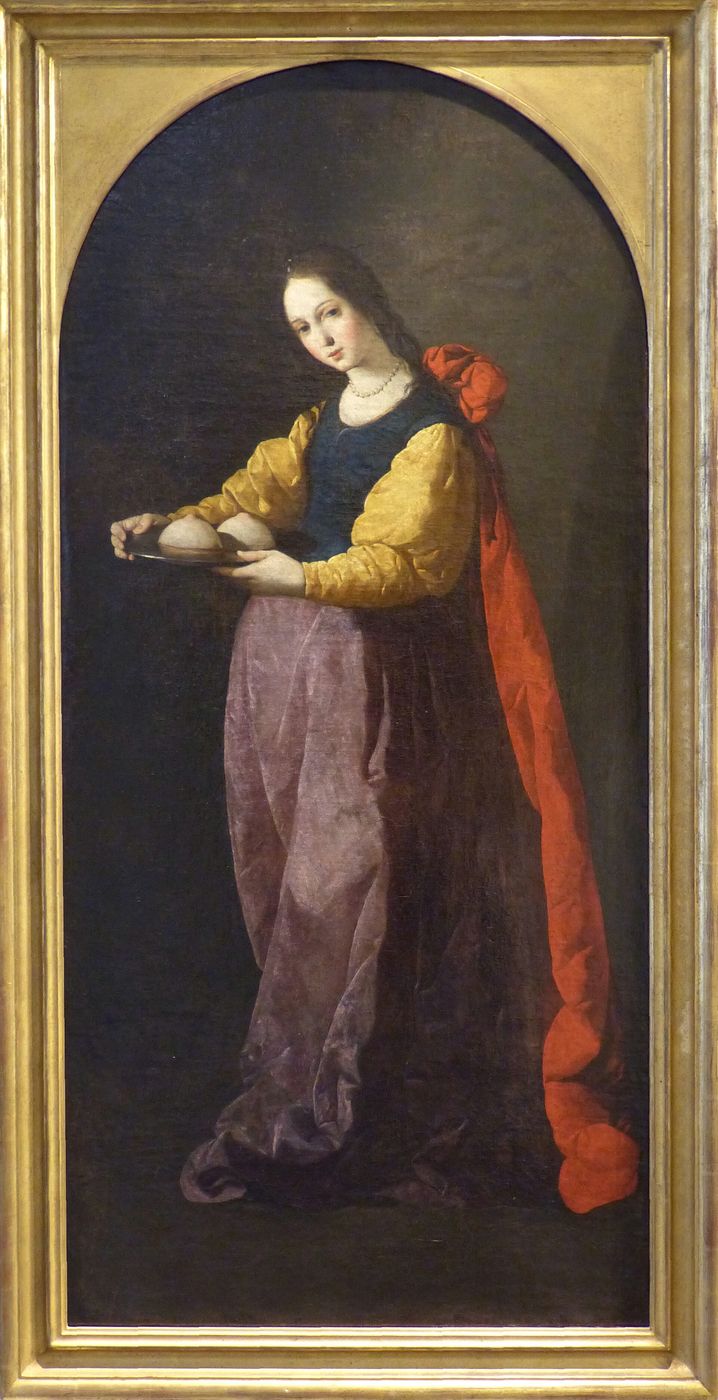
The history of painting had long since depicted these parts torn from the body, in an unexpected place, in the iconography of the saints. The Saint Agatha by the seventeenth-century Spanish painter Francisco de Zurbarán, now in the Musée Fabre in Montpellier, shows a young woman carrying, with a calm face, her severed breasts on a silver dish, cut off during her martyrdom. In another painting from Zurbarán’s workshop Saint Lucy presents her gouged-out eyes in the same way on a dish. Lacan touches on these images in the seminar on anxiety.8 The breasts and eyes on the dish have become objects detached from the body, offered, looked at; and the strange calm on the saints’ faces suggests that the loss of these parts is lived less as a pain than as a gift. What Lacan calls objet petit a is just this: the part torn from the body, both the subject and not the subject, which can be offered to another.

One of the most interesting parts of the seminar is the lessons in which the voice is treated as an object. Starting from a study by the psychoanalyst Theodor Reik of the shofar, the ram’s-horn trumpet used in Jewish ritual, Lacan discusses the existence in the sound of the shofar of a voice independent of meaning, working beyond the word, a call. The voice is what remains of the meaning of the word said; and this remainder can affect us far more deeply than the content of a speech.
IV
The gaze is the object Lacan examines in detail in the eleventh seminar of 1964, and he begins this examination with a memory from his own youth. In his twenties, on a day when he had put out to sea with fishermen off the coast of Brittany, one of them, Petit-Jean, pointed out to him a sardine can floating on the water, glittering in the sun, and said with a laugh: You see that can? You see it, don’t you? Well, it doesn’t see you!9 Petit-Jean found this very funny; Lacan, telling this small memory to his audience at the seminar after so many years, at the age of sixty-two, says plainly that he did not find it funny at all. For in a sense the can was looking at him: at that bright point where the light was reflected there appeared a gaze in which he was seen as an intellectual out of place among these people who made their living with difficulty. The gaze is not in the seer’s eye but on the side of the object, at the point in the field of vision where the subject himself is included as a stain.
Roland Barthes, in his last book, published sixteen years after this seminar of Lacan’s, a few weeks before his death, reached the same structure by his own road while thinking about photography. In Camera Lucida he divides our looking at a photograph into two elements. The first is, in a Latin word, the studium: the general, cultural, educated interest we take in a photograph, the knowledge that lets us recognise a period, a garment, a street. The second is the punctum: the small detail that leaps from the photograph, pierces us, wounds us, pricks us. A child’s bad teeth, the necklace at a woman’s throat, a man’s laced shoes.10 The punctum is not the same for everyone; nor is it something the photographer has placed there. It depends on the history of the one who looks, on his lack. The photograph at the centre of Barthes’s book, the one showing his mother at five in a winter garden, is not in the book; Barthes refuses to publish it because only he can see the wound in that photograph. Objet petit a is like this: what is an ordinary detail in another’s eyes can carry the whole cause of a subject’s desire.
In the same seminar Lacan also recalls a famous painting contest told by Pliny. Zeuxis painted grapes with such skill that birds came down from the sky and tried to peck at them. His rival Parrhasius painted a curtain on a wall; Zeuxis asked for the curtain to be drawn aside to see his rival’s picture, and understood at that moment that he had lost the contest. To deceive birds, grapes are enough; to deceive a human being, a curtain is needed, a veil promising that there is something behind it. On Lacan’s reading what sets human desire in motion is less the object behind the curtain than what the curtain itself promises.
Cinema finds this structure in its plainest form in Alfred Hitchcock. In his long interview with François Truffaut, Hitchcock explains the name he gives to what sets the plot of his films in motion, the MacGuffin, with a little joke. Two men are sitting opposite one another in a train. One asks what the package on the luggage rack is. The other says it is a MacGuffin. What is a MacGuffin? An apparatus for trapping lions in the Scottish Highlands. But there are no lions in the Scottish Highlands! Well then, that is no MacGuffin.11 The MacGuffin is what everyone in the film runs after, kills for, flees, lies about: the stolen formula, the lost document, the secret plan. But the audience never quite learns what it is, and it does not matter at all. What matters is that it sets everyone in motion. Hitchcock’s joke says that this is exactly what the cause of desire is: hollow, of uncertain existence, yet a nothing that begins all the movement.
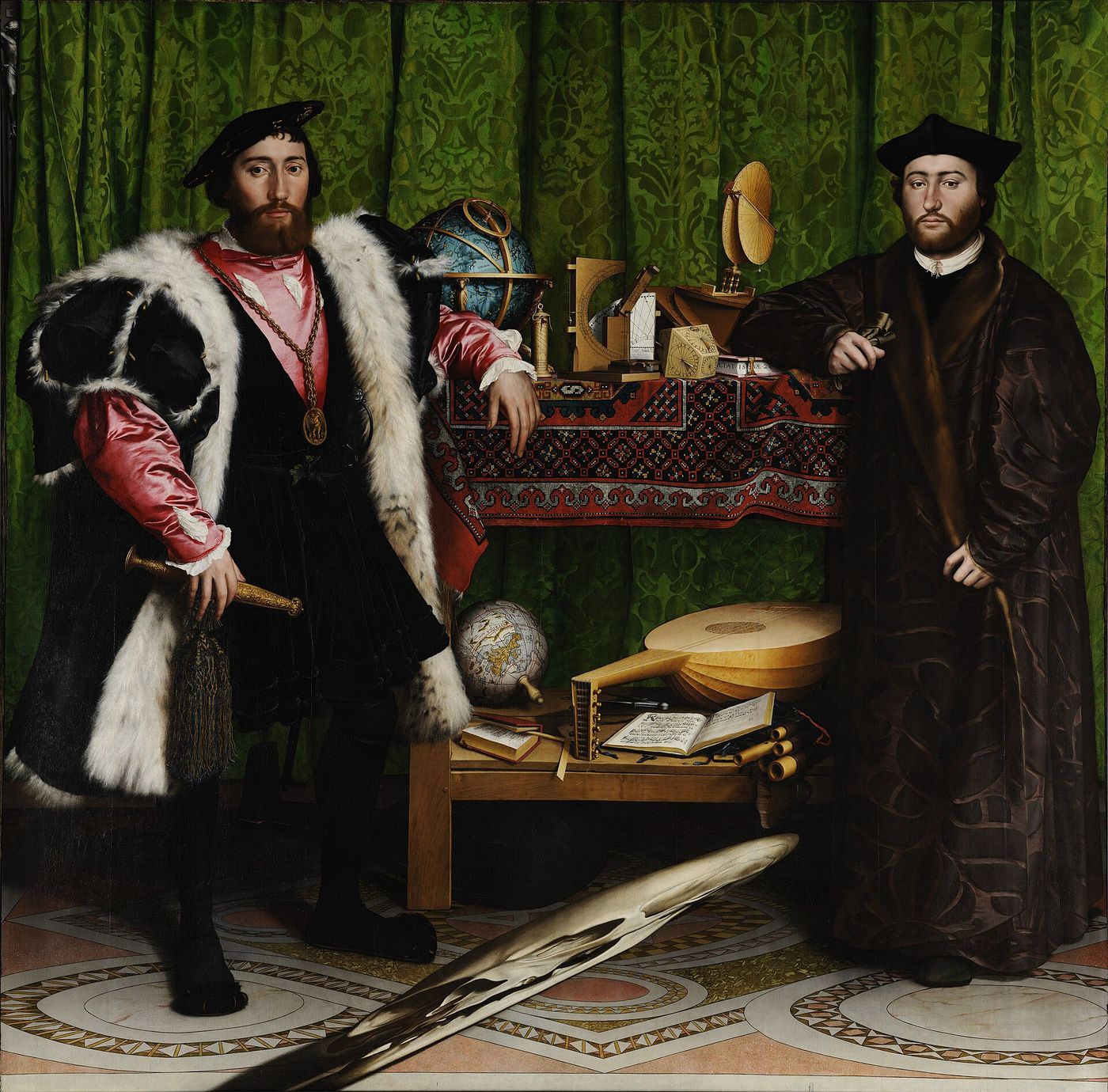
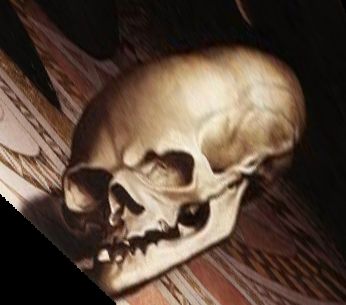
The greatest picture of the gaze is Holbein’s Ambassadors of 1533. Two rich and learned French ambassadors stand self-assured before a shelf full of instruments symbolising the science, music and knowledge of the world of their time. In the foreground of the painting a strange, distorted, meaningless shape floats above the floor. When the viewer leaves the front of the painting and looks from the side, at an oblique angle, the shape becomes a skull. Lacan reads this anamorphosis as a picture of the structure of the gaze: in the midst of a calm world in which everything is in its place, ordering our field of vision, there appears, within that world, the stain of our own mortality, that is, of a lack no knowledge can fill.

V
Objet petit a also holds a central place in Lacan’s formula of fantasy. Lacan writes fantasy as the relation of the divided subject to this object; fantasy is an unconscious scenario that organises the subject’s desire and gives it a direction. This scenario places the object inside a frame, and so makes it both desirable and bearable. Without fantasy desire loses its direction; at the very centre of fantasy stands the object that can never be reached.
This structure explains one of the most familiar disappointments of everyday experience. When something long desired is finally reached, a person, a job, a house, a strange feeling of emptiness often appears: Was this it? Lacan’s answer is that the object that is the cause of desire can never be found entire in any concrete object. Desire goes on by sliding from object to object, metonymically. Lacan says this in 1958 in a short formula: desire is the metonymy of the want-to-be. Each object stands for a moment in the place of that lack in the subject’s being and then hands over to another.12 This is not a defect of desire but its condition; if an object once reached exhausted desire, we should cease to be desiring beings. The relation between love and desire is knotted at this point too: love believes it finds the cause of desire in the beloved; and this belief, in the word Lacan borrows from Plato’s Symposium in his seminar on transference, is the belief that something precious is hidden inside the beloved, an agalma.
One of the most widely read love novels of Turkish literature is almost a textbook of this structure. In Sabahattin Ali’s Kürk Mantolu Madonna, Madonna in a Fur Coat, published in book form in 1943, the youthful story told in the notebook found after the death of the quiet, colourless clerk Raif Efendi begins with a picture. The young Raif, in Berlin in the twenties, freezes before the self-portrait of a woman in a fur coat at an exhibition. He comes back to see the picture the next day, the day after, every day. The woman’s face reminds him of the Virgin in Andrea del Sarto’s Madonna of the Harpies in Florence; to himself he names the picture “the Madonna in the fur coat”.13 Before falling in love with a woman Raif has fallen in love with a gaze, with one face recalling another, with the softness of a fur. Then he meets the woman who painted the picture, Maria Puder, and the whole drama of the novel is played out in the interval between the Madonna in the picture and the real Maria.
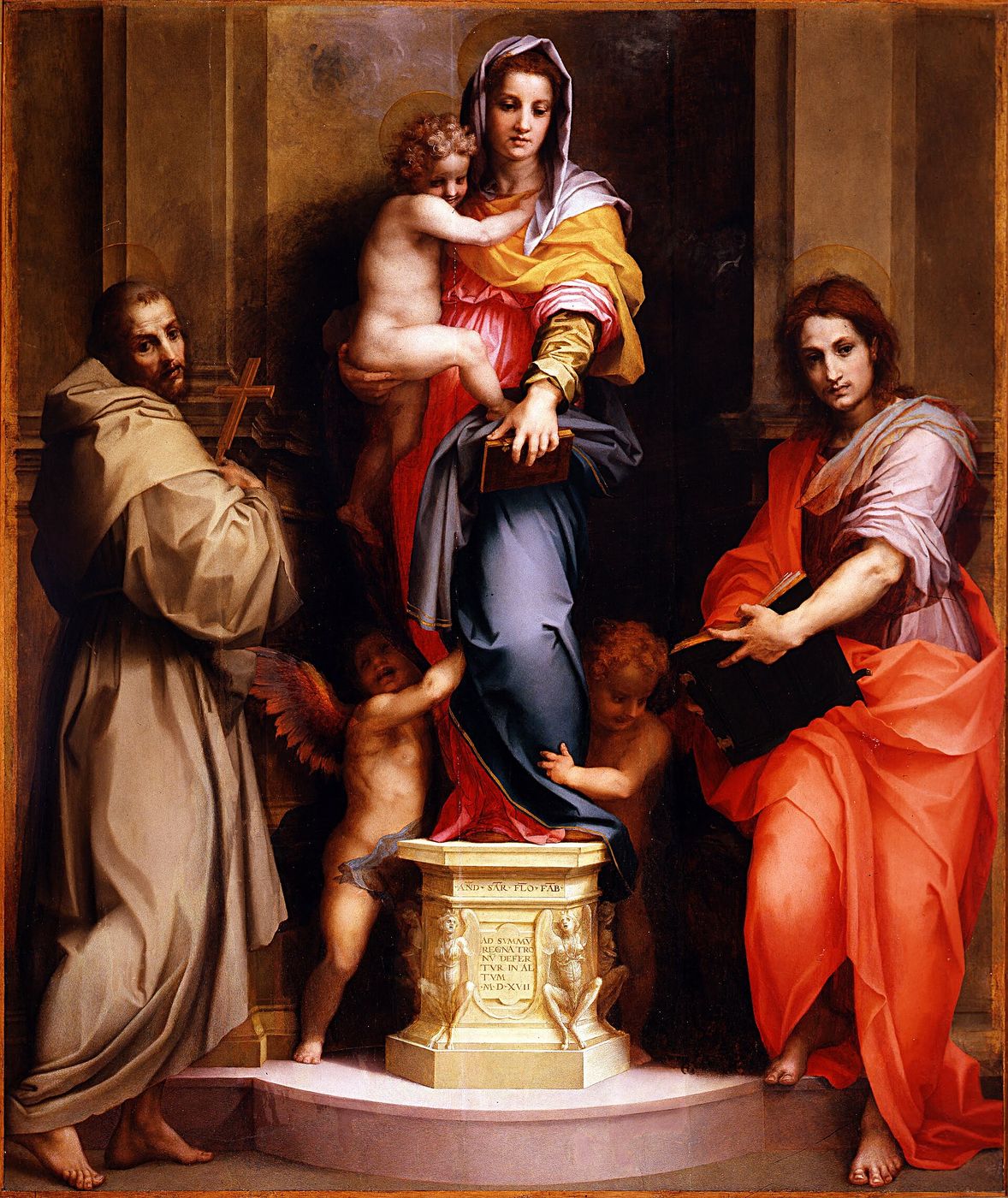

Lacan’s concept also explains why this novel touches so many readers. What sets Raif’s desire in motion is, before Maria herself, a gaze in a picture, a resemblance, a detail; the cause of desire comes before the object of desire. Maria senses it: she does not want to bear the burden of being the beloved, of standing in for an image in someone’s imagination, and for a long time resists this love. At the end of the novel, when years later Raif learns that Maria has long been dead, the lost object once more, this time for ever, withdraws to an unreachable place. The rest of Raif’s life is a silent waiting woven around a loss. Objet petit a glitters in the novel in the fur coat, in the Madonna’s face, in Maria’s gaze; but settles wholly in none of them.
Literature knew this structure of love long before psychoanalysis. In On Love, published in 1822, Stendhal describes what goes on in a lover’s mind with an image taken from the salt mines of Salzburg: a leafless bough thrown into the abandoned depths of the mine in winter is found two or three months later covered with countless glittering salt crystals; even the thinnest twigs are decked with diamonds, and the original bough is no longer recognisable.14 Stendhal calls this process crystallisation. The lover sees every trait, every movement, even every flaw of the beloved as a sign of perfection; the bough is lost beneath the crystals. In Lacan’s language the beloved is covered with the cause of desire; what is seen is not the bough itself but the glitter that covers it.
The greatest love story of Eastern literature shows how far this glitter can go. In Fuzûlî’s Leylâ vü Mecnûn, completed in 1535, Qays loses his reason through his love for Layla, takes the name Majnun, “possessed”, falls into the deserts, lives with the animals. Layla is married to another; years later, when her husband dies, she goes into the desert to find Majnun. But Majnun does not want the Layla who stands before him: he says that the love of the Layla within him fills him so entirely that there is no longer room for the Layla outside.15 This scene is read as an account of mystical love, of the ascent from human to divine love, and it is that. But psychoanalysis hears in it something else too: the cause of desire, once detached from a real person, can be so strong that it makes the person herself superfluous. Majnun loves not Layla herself but what glitters in Layla and which he now carries within himself.
VI
In the sixteenth seminar, of 1968–1969, Lacan adds another dimension to the concept and compares it with Marx’s concept of surplus value. In Marx, surplus value is the value the worker produces beyond the wage paid for his labour and which the capitalist appropriates. Lacan thinks objet petit a as a kind of surplus jouissance, in French plus-de-jouir: the pleasure the subject lost as the price of entering discourse and which returns as a remainder.16 This comparison shows that the concept is not only an individual clinical concept but is productive for thinking the economy of pleasure in contemporary society. In his seminar of the following year Lacan gives the countless small objects produced by science and technology, put on the market with the promise of filling the place of the cause of desire, the forerunners of the devices we cannot put down today, the name of a word of his own coining, lathouses.
VII
One of Lacan’s finest readings refining the concept is the lessons he devoted to Shakespeare’s Hamlet in the seminar Desire and Its Interpretation of 1958–1959. For Lacan Hamlet is a tragedy of desire: Hamlet is a subject who does not know what he wants, who continually postpones action, whose desire is caught in the enigma of his mother’s desire. At the centre of this reading stands Ophelia. In Ophelia’s name Lacan hears an echo of the Greek phallos and reads her as a figure of the object that shifts its place within Hamlet’s desire, that is, of a.17 Hamlet first loves Ophelia, then rejects her, crying “Get thee to a nunnery!”; and only after Ophelia has died, scuffling with Laertes at her grave, does he declare that he loved her more than forty thousand brothers could. On Lacan’s reading the object finds its place in desire again at the very moment it is lost; mourning restores the object of desire.
One of the most striking clinical counterparts of the concept is an observation Lacan makes on eating disorders. In the seminar on object relation of 1956–1957 Lacan defines anorexia nervosa not as not eating but as eating “nothing”.18 This small shift carries a great conceptual difference. The anorexic subject does not merely refuse an object; he turns nothingness, absence itself, into an object and feeds on it. Facing an other who offers food in place of love, who answers his demand with the satisfaction of his need, eating “nothing” may be the only place where the subject can preserve his desire. Objet petit a is here the object of an absence, not of a presence, and the whole subtlety of the concept lies in this absence’s being able to carry desire itself.
VIII
Clinically the concept of objet petit a is the key to understanding why people attach themselves again and again to particular persons, particular situations, particular pains. When the repeating relationships in an analysand’s life are examined, what often appears is less the partners as wholes than a small common feature binding them together, a manner of looking, a distance, a deprivation; this feature stands in the place of the cause of desire in the analysand’s fantasy. Psychoanalytic work does not show the way to possess this object; it aims at changing the subject’s relation to it. This does not mean extinguishing desire; on the contrary, it means that desire ceases to be the prisoner of a repetition, a fate, a necessity, and becomes again a question, a search, an opening. At the end of the eleventh seminar Lacan imagines at the horizon of analysis a place where the fantasy is traversed, where the subject can desire without being the captive of this scenario. To traverse the fantasy is not to abolish it; one does not live without fantasy. To traverse it is to realise that fantasy is a scenario, that it was once an answer found in the face of the Other’s desire, and, passing through it, to be able to desire without being wholly dependent on it. When an analysand discovers, for instance, that he has always attached himself to partners who belittle him, keep their distance, give him only crumbs, he can ask what this scenario promises him, what old scene it makes him replay. When this question is asked, the same detail, the same distance, the same deprivation, begins to look not like a fate but like a choice; and a choice can be changed.
The analyst’s place in this process too is related to objet petit a. In the transference the analysand believes he is seeking in the analyst the cause of his desire, something precious, a knowledge about himself. The analyst holds this place for a time, standing in for an object, for an emptiness; but he does not fill the place, does not plug it with his own person, his own knowledge, his own desire. At the end of the analysis the place empties: the analysand realises that what he sought in the analyst was never there, that the cause of his desire lies in his own history, in his own loss.
The misleading character of the rendering “object of desire” can be understood from here too. The objects of desire are countless, and every one of them disappoints somewhere. Objet petit a is none of these objects; it is the fugitive glitter that shines in all of them and clings to none, that carries desire from one object to another. Like Holbein’s skull, looked at directly it is nothing but a meaningless stain; only from the side, at an oblique angle, from a place from which we accept our own mortality and lack, does it tell us something of who we are. The days Raif Efendi spent before the picture, Majnun’s years in the desert, the photograph Barthes did not publish, Hitchcock’s empty package, are different faces of the same thing: what sets desire in motion is not something to be obtained but something once lost, which can be sought only in the trace of that loss.
Two interactive models accompany this essay: The Torus of Demand and Desire and The Cross-Cap, which shows the objet a being cut out and lifted away.
Notes
- Lacan’s insistence that the term not be translated is also noted by Alan Sheridan, translator of the English selection of the Écrits (J. Lacan, Écrits: A Selection, trans. A. Sheridan, 1977). ↩︎
- S. Freud, Three Essays on the Theory of Sexuality (1905), SE VII. ↩︎
- S. Freud, “Negation” (1925), SE XIX (German: “Die Verneinung”, Gesammelte Werke XIV). In the same paper Freud adds that reality-testing presupposes that objects which once brought real satisfaction have been lost. Lacan rereads this short text repeatedly, together with Jean Hyppolite’s famous commentary in his seminar of 1954. ↩︎
- D. W. Winnicott, “Transitional objects and transitional phenomena”, International Journal of Psycho-Analysis 34 (1953). ↩︎
- J. Lacan, Le Séminaire, Livre X: L’angoisse (1962–1963), Paris: Seuil, 2004; English: Anxiety, trans. A. R. Price (2014). ↩︎
- Lacan, Le Séminaire, Livre X, lessons of May 1963. Lacan stresses here that the cut, the separation, takes place not between infant and breast but between breast and the mother’s body; what the infant loses is not its mother but a part of itself. ↩︎
- J. Lacan, “Position de l’inconscient” (1960/1964), Écrits, Paris: Seuil, 1966; also Le Séminaire, Livre XI, lessons on the drive. Lacan builds the myth of the lamella against the myth told by Aristophanes in Plato’s Symposium, of human beings cut in two and searching for their other halves: what is lost is not our other half but immortal life itself, lost as the price of sexual reproduction. ↩︎
- Lacan, Le Séminaire, Livre X: L’angoisse (1962–1963). Saint Agatha is held to have been martyred in Sicily in the third century, Saint Lucy at Syracuse at the beginning of the fourth; in iconography Agatha is recognised by her breasts, Lucy by her eyes. ↩︎
- J. Lacan, Le Séminaire, Livre XI: Les quatre concepts fondamentaux de la psychanalyse (1964), Paris: Seuil, 1973, lessons on the gaze; English: The Four Fundamental Concepts of Psychoanalysis, trans. A. Sheridan (1977). ↩︎
- R. Barthes, La Chambre claire: Note sur la photographie, Paris: Gallimard / Seuil / Cahiers du cinéma, 1980; English: Camera Lucida, trans. R. Howard (1981). Barthes devotes the second part of the book to a photograph he found after his mother’s death, showing her at five years old in a winter garden; but he does not publish the photograph in the book, saying that it holds a punctum only for him and would be an ordinary photograph for others. ↩︎
- F. Truffaut, Le Cinéma selon Hitchcock, Paris: Robert Laffont, 1966; English: Hitchcock (1967). Hitchcock says that in spy films the MacGuffin is generally secret documents, formulas or plans, but that what they are matters not at all to the audience. Slavoj Žižek interprets the MacGuffin as the purest example in cinema of Lacan’s objet petit a. ↩︎
- J. Lacan, “La direction de la cure et les principes de son pouvoir” (1958), Écrits, Paris: Seuil, 1966. Lacan’s French phrase is « le désir est la métonymie du manque-à-être ». ↩︎
- Sabahattin Ali, Kürk Mantolu Madonna, Istanbul: Remzi Kitabevi, 1943; English: Madonna in a Fur Coat, trans. M. Freely and A. Dawe (2016). The novel had been serialised in the newspaper Hakikat in 1940–1941 before it was printed as a book; more than half a century after the author’s death, in the 2010s, it became one of the best-selling novels in Turkey. ↩︎
- Stendhal, De l’amour (1822), book one; English: Love, trans. G. Sale and S. Sale (1975). Stendhal describes this process, under the name “crystallisation”, as the second and decisive phase in the birth of love: the lover discovers a new perfection in every feature of the beloved. ↩︎
- Fuzûlî, Leylâ vü Mecnûn (1535). The first great literary treatment of the story, based on Arabic sources, is Nizami’s Persian masnavi of 1188; Fuzûlî’s Turkish masnavi widens love towards a mystical meaning, a journey from the beloved to God. ↩︎
- J. Lacan, Le Séminaire, Livre XVI: D’un Autre à l’autre (1968–1969), Paris: Seuil, 2006. ↩︎
- J. Lacan, Le Séminaire, Livre VI: Le désir et son interprétation (1958–1959), Paris: La Martinière, 2013. ↩︎
- J. Lacan, Le Séminaire, Livre IV: La relation d’objet (1956–1957), Paris: Seuil, 1994. ↩︎
References
- Ali, S. (1943). Kürk Mantolu Madonna. Remzi Kitabevi. [English: Madonna in a fur coat (M. Freely & A. Dawe, Trans.). Other Press, 2016.]
- Barthes, R. (1980). La Chambre claire: Note sur la photographie. Gallimard / Seuil / Cahiers du cinéma.
- Freud, S. (1905). Three essays on the theory of sexuality. SE VII.
- Freud, S. (1925). Negation. SE XIX.
- Freud, S. (1950 [1895]). Project for a scientific psychology. SE I.
- Fuzûlî (1535). Leylâ vü Mecnûn.
- Lacan, J. (1966). Position de l’inconscient (1960/1964); La direction de la cure et les principes de son pouvoir (1958). In Écrits. Seuil.
- Lacan, J. (1973). Le Séminaire, Livre XI: Les quatre concepts fondamentaux de la psychanalyse (1964). Seuil.
- Lacan, J. (1977). Écrits: A selection (A. Sheridan, Trans.). Tavistock.
- Lacan, J. (1991). Le Séminaire, Livre XVII: L’envers de la psychanalyse (1969–1970). Seuil.
- Lacan, J. (1994). Le Séminaire, Livre IV: La relation d’objet (1956–1957). Seuil.
- Lacan, J. (2004). Le Séminaire, Livre X: L’angoisse (1962–1963). Seuil.
- Lacan, J. (2006). Le Séminaire, Livre XVI: D’un Autre à l’autre (1968–1969). Seuil.
- Lacan, J. (2013). Le Séminaire, Livre VI: Le désir et son interprétation (1958–1959). La Martinière.
- Pliny. Naturalis Historia, book XXXV.
- Shakespeare, W. (ca. 1600). Hamlet.
- Stendhal (1822). De l’amour. Mongie.
- Truffaut, F. (1966). Le Cinéma selon Hitchcock. Robert Laffont.
- Winnicott, D. W. (1953). Transitional objects and transitional phenomena. International Journal of Psycho-Analysis, 34.