This essay first appeared in Turkish. The English version is my own.

Anxiety is the dizziness of freedom.
Søren Kierkegaard, The Concept of Anxiety (1844)
L’angoisse n’est pas sans objet.
Jacques Lacan, Le Séminaire X
I
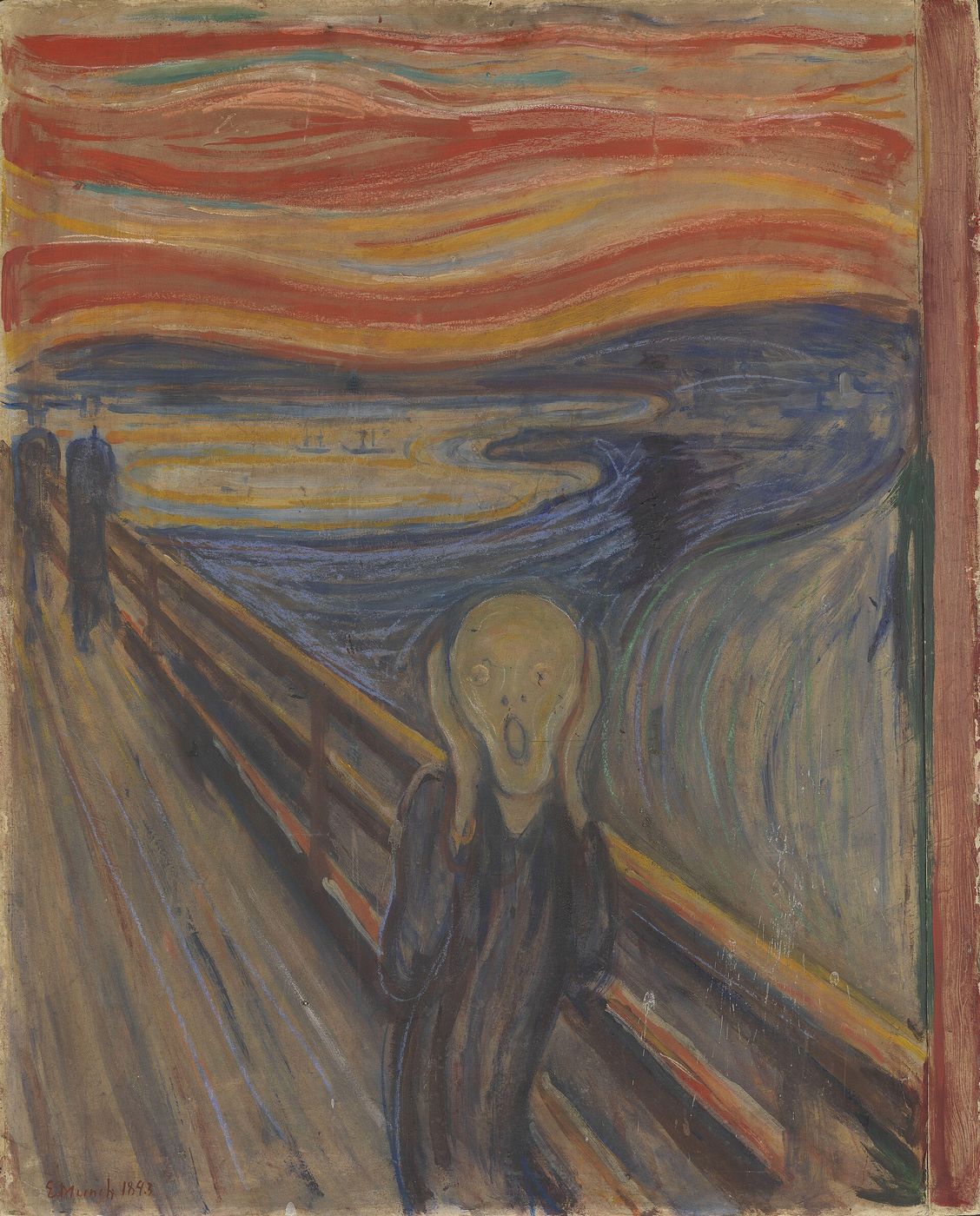
In a note written in Nice on 22 January 1892, Edvard Munch describes the experience that, a few years later, would become one of the best-known paintings in the world. He is walking along a road with two friends; the sun is setting; the sky suddenly turns blood red; while his friends walk on, he stays there, trembling with fear, and senses a great, endless scream passing through nature.1 Everyone’s first impression on looking at the painting is that the central figure is screaming. In Munch’s account, however, the figure does not scream; it hears the scream, and is trying to cover its ears with its hands. This may be the truest image of anxiety: a sound whose source, inside or outside, cannot be told, echoing in one’s own body and at the same time through the whole world.
The words themselves carry the bodily root of the experience. The German Angst, the Danish angest, the French angoisse and the English “anxiety” all lead back to the Latin angustia, narrowness, constriction, and to the verb angere, to choke or to squeeze; Turkish speaks of anxiety, in everyday speech, as a “narrowing” or a “tightening inside”.2 Anxiety is first a constriction lived in the chest, the throat, the breath. The root of the Turkish word for anxiety, kaygı, looks in another direction: in Old Turkish it meant sorrow, grief, care. What we now meet with the medical word “anxiety” is, in the memory of languages, the name both of a narrowness and of a grief. The anxious person seems both cornered and in mourning for something in advance.
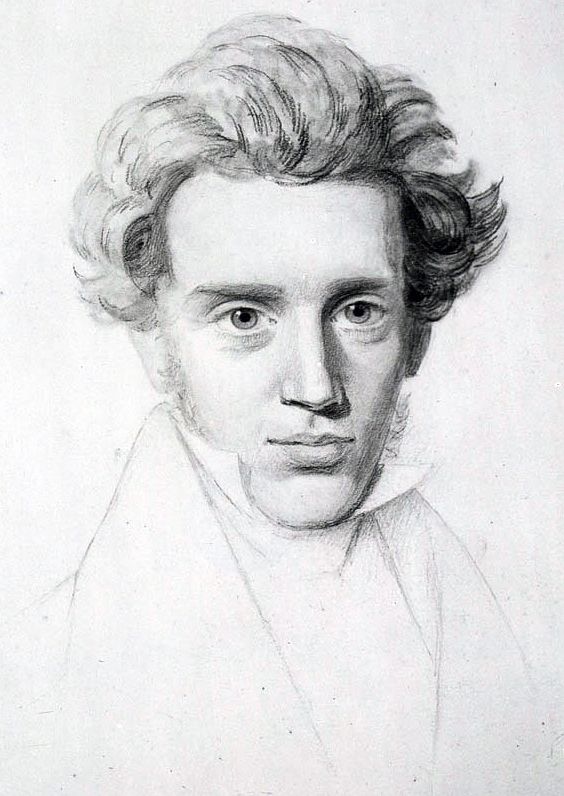
The first thinker to place anxiety at the centre of philosophy was Søren Kierkegaard, writing in Copenhagen half a century before Munch. Throughout his short life he himself lived with deep melancholy and a constant inner unrest, and he wrote that he had broken off his engagement to Regine Olsen so as not to make her share his darkness. In The Concept of Anxiety, published in 1844 under the pseudonym Vigilius Haufniensis, Kierkegaard compares anxiety to the dizziness of someone standing at the edge of an abyss: the cause of the dizziness is the eye that looks as much as the abyss; anxiety is the dizziness freedom feels when it looks down into its own possibilities.3 The most unsettling thing about this definition is that it ties anxiety not to a lack or a danger but to a possibility. One becomes anxious where one realises that one can do, be or choose something.
Kierkegaard develops the thought through a reading of the story of Adam that he places at the centre of the book. Adam in paradise is innocent, and for Kierkegaard innocence is ignorance: Adam cannot tell good from evil, because he does not yet know the distinction itself. When God forbids him to eat the fruit of the tree of knowledge, the prohibition awakens in Adam something that was not there before: the possibility of being able. Adam does not know what the prohibition means, does not know what death is; but he senses that he can do something, can cross a limit. Anxiety is the name of this intuition, of what Kierkegaard calls “the anxious possibility of being able”.4 Psychoanalysis knows this scene, in which prohibition awakens desire, very well. A prohibition does not only prevent something; it makes that thing desirable, thinkable, doable. Anxiety appears at the edge of the possibility the prohibition opens.

In Being and Time (1927), Martin Heidegger turns this thought into a distinction between fear and anxiety. Fear has a definite object, a threat approaching within the world that can be named. What anxiety faces is not anything within the world; in Heidegger’s words, what threatens is nowhere, and the answer to the question of what anxiety is about is “nothing and nowhere”.5 This is also the most familiar side of our everyday experience of anxiety: one cannot say what one is anxious about, only feel that something is coming. What psychoanalysis adds to this century-old philosophical question is the claim that this “nothing” may in fact be something, standing in a place conscious thought cannot reach.
Sixteen years after Heidegger, in Being and Nothingness (1943), Jean-Paul Sartre returns to Kierkegaard’s image of the abyss and takes it a step further. He asks us to imagine someone walking along a narrow mountain path without a guardrail. The dizziness this person feels, Sartre says, comes not from fear of falling but from knowing that they could throw themselves down: vertigo is anxiety in so far as I dread not falling into the precipice, but throwing myself into it.6 Fear turns towards a danger outside, a slipping stone, a slippery path; anxiety towards one’s own freedom, towards the possibility of a decision nothing can prevent. The sentence is a philosophical description of a fear often heard in the clinic: the thought “what if I did it” that suddenly appears in front of a window, at the edge of a railway platform, while holding a knife. The thought is usually not a wish; it is the dizziness of meeting freedom, possibility, the limit itself.
II
Freud theorised anxiety twice, in two very different ways. In his first theory, in writings of the mid-1890s, he thought of anxiety as the transformed form of sexual tension that finds no outlet: repressed or unsatisfied libido turned into anxiety.7 The richest clinical material of this first theory is the case published in 1909 and known in the history of psychoanalysis as “Little Hans”.
Freud’s paper of 1895 also contains one of the first detailed descriptions of what we now call a panic attack. Within the picture he names “anxiety neurosis”, Freud describes attacks of anxiety that strike suddenly, attached to no idea: palpitations, breathlessness, sweating, trembling, dizziness, fear of death or of going mad. The description matches surprisingly well the picture that psychiatry’s diagnostic manuals would include, a century later, under the name of panic disorder. Twenty-four years before Freud, in 1871, the Berlin psychiatrist Carl Westphal had described patients who were seized by intense anxiety when trying to walk across open spaces, empty squares or crowded streets, and had given the picture a name derived from the Greek agora, marketplace, place of assembly: agoraphobia.8 Westphal’s patients had one thing in common: they could not cross the open square alone, but could when they took someone’s arm. What soothed the anxiety was not a smaller square, but the presence of another person.
Five-year-old Hans has begun to be afraid of horses in the streets of Vienna. The fear is organised around particular details: horses drawing heavily loaded carts, and above all a horse falling down in the street and thrashing its legs. Freud sees the child only once; the analysis is conducted, under Freud’s supervision, by the boy’s father, who sends Freud detailed notes.9 The lasting lesson of the case is that the phobia is a protection against anxiety. Within Hans there is an anxiety that cannot be named and spreads everywhere; the phobia limits it by binding it to a single object, horses. As long as horses are avoided, the world remains liveable. This is why trying to remove a phobia by force, without understanding what it binds, may mean setting free the bound anxiety and spreading it again everywhere, to every street, every hour. A phobia is a suffering, but it is also a solution: a solution that maps anxiety, giving it a place and a boundary.
Freud described the relation between anxiety and speech perhaps most beautifully in a small footnote added to the Three Essays on the Theory of Sexuality of 1905. A three-year-old boy lying in a dark room calls out to his aunt in the next room and asks her to talk to him, because he is afraid of the dark. When his aunt asks what good that would do, since he cannot see her anyway, the child replies: when someone speaks, it gets light.10 Freud concludes from this that children’s fear of the dark is really an expression of longing for the absent loved one. But the sentence also sums up the whole method of psychoanalysis. What lights up the dark is not light but a voice: another person’s voice, telling that they are there, listening, speaking. Anxiety does not disappear when it is put into words; but the darkness becomes a darkness in which someone is speaking.
In 1926, in Inhibitions, Symptoms and Anxiety, Freud radically changes his own first theory. Anxiety is now not the result of repression but its cause. Faced with a wish rising from within and perceived as dangerous, the ego produces a signal anxiety; the signal announces that a danger is approaching and sets the mechanisms of defence in motion. Freud lists these dangers as a series following one another in the course of human life: the helplessness of birth, the loss of the mother and her care, the loss of love, the threat of castration and finally the punishment of the superego. Each is the echo of a situation of helplessness the subject once really lived through or might live through.11 In this new theory, anxiety is an alarm announcing that the repressed is about to return.
It should not be forgotten that Freud made this change partly in response to a debate. His close collaborator Otto Rank, in The Trauma of Birth (1924), had argued that birth is the first and fundamental source of all anxiety, that human beings relive throughout their lives the shock of separation from the womb, and that the neuroses are repetitions of this first trauma. Freud first welcomed the book with interest, then distanced himself from it more and more; his relationship with Rank broke down after this debate.12 In the 1926 book Freud accepts birth as the first instance of anxiety, a kind of sketch for all later experiences of anxiety; but he does not reduce anxiety to the repetition of a single trauma. The source of anxiety is less an event itself than the structure of every situation in which the subject finds itself helpless. In the same years Freud had also distinguished three German words: fear, Furcht, which has a definite object; fright, Schreck, produced by a danger that catches one unprepared; and anxiety, Angst, as a state of expecting a danger and preparing for it.13 In this distinction anxiety is less a weakness than a protection: a waiting that wards off fright, the terror for which there is no preparation at all.
III
In his tenth seminar, devoted entirely to anxiety in 1962–1963, Lacan carries Freud’s legacy in a new direction, and in its very first lessons states the formula that opposes the “objectless” anxiety of Heidegger and Freud: L’angoisse n’est pas sans objet, anxiety is not without an object.14 Anxiety has an object; only this object is not something that can be found and named in the world, like the object of fear. For Lacan, the object of anxiety is the object that causes desire, which he calls objet petit a.
Another provocative thesis of the seminar is that anxiety arises not from the lack of something but from the lack of lack. For desire to exist, there must be a gap, a lack. When the gap is filled, when the other surrounds us too closely, fills our whole space with their demand, or when what they want from us becomes unknowable, anxiety rises. Lacan makes this concrete with a little story told at the beginning of the seminar, which has become one of the most quoted images in psychoanalytic literature. Imagine yourself wearing a mask, but unable to see which mask you are wearing, facing a giant female praying mantis. The female mantis is known to be able to devour the male after mating. What is truly anxiety-provoking is not the other’s power but your inability to know what she sees you as, what kind of object you are reflected as in her eyes.
In the same seminar Lacan also reverses a common assumption about the source of anxiety. A large part of developmental psychology and of psychoanalysis tied the child’s anxiety to the mother’s absence: when the mother goes, the child becomes anxious. A few years before Lacan’s seminar, in a paper of 1960 entitled “Separation Anxiety”, the English psychoanalyst John Bowlby had described the child’s reactions to separation from the mother as phases of protest, despair and detachment, and placed these observations at the foundation of what would later be called attachment theory; the “strange situation” experiment developed by Mary Ainsworth in the 1970s measured the infant’s reactions to its mother’s brief departure and return.15 Lacan says the very opposite: what makes the child most anxious is not the mother’s absence but her never going away, her being always there, always on its back. The mother’s comings and goings, the possibility of absence, are the guarantee of presence; a presence in which absence is never possible is suffocating.16 This thought explains a situation often met in the clinic: that children, and adults, who have been looked after too much, whose every need was met before it could be voiced, who were never left alone, can carry a surprising anxiety. Anxiety rises where desire cannot find a gap in which to breathe. There is an unexpected closeness between Westphal’s patients, frozen in the square and able to walk only on someone’s arm, and Lacan’s mother who never gets off the child’s back: in both, anxiety concerns the setting of distance, whether there is an other who is neither too far nor too close.


This image is the core of the Lacanian thesis linking anxiety to the desire of the big Other. Anxiety appears where the question “What do you want of me?” remains unanswered, at the moment we cannot know our place before the other’s desire. The title of one of the seminar’s lessons carries Lacan’s most famous sentence about anxiety: anxiety is what does not deceive. Our thoughts can mislead us, the stories we tell ourselves can cover the truth; but anxiety appears close to the subject’s truth, at a moment when defences have not yet been built. This is why, in the Lacanian clinic, anxiety is treated less as a disturbance to be suppressed than as a trace to be followed.
IV
The text Lacan often returns to as he thinks about anxiety in the tenth seminar is Freud’s essay “The Uncanny”, published in 1919. Freud begins it with a lexicographer’s care, following the career of a German adjective. Heimlich means “belonging to the home, familiar, intimate”; but when the uses of the word are listed, the same adjective slides towards the meaning “secret, hidden, kept out of sight”, and finally coincides with its opposite, unheimlich. Freud’s conclusion is one of the most fruitful intuitions of psychoanalysis: the uncanny arises not from what is foreign, but from what was once familiar, was repressed, and returns at an unexpected moment.17
The main literary example Freud analyses is E. T. A. Hoffmann’s story “The Sandman”. The Sandman, the fairy-tale figure who tears out children’s eyes, returns in different guises throughout the life of the story’s hero, Nathanael, and finally drives him to madness and death. Freud disputes the explanation of his contemporary Ernst Jentsch, who tied uncanniness to objects of which one does not know whether they are alive or inanimate, in Hoffmann’s story the mechanical doll Olympia; for Freud the source of the story’s uncanniness is the fear of losing one’s eyes, a fear that often stands in for castration anxiety.18 In a footnote to the same essay Freud recounts a small scene of his own. Travelling in a sleeping car, he thought an elderly man in a dressing gown and travelling cap had come into his compartment; as he got up to put him right, he realised it was his own reflection in the mirror on the door, and noticed that he thoroughly disliked the image he had seen.
Lacan reads this structure of the uncanny as the key to anxiety. Anxiety appears when something appears in the gap where there should be lack, when what is familiar, like our own face in a mirror, suddenly looks back at us with a stranger’s gaze. The title of the fourth chapter of the tenth seminar gives the most concise formula of the thought: anxiety, between jouissance and desire.19 Desire requires a distance, a lack; jouissance is where that distance collapses, where the subject is threatened with becoming the object of the other’s enjoyment. Anxiety rises between these two poles, at the moment the distance is about to vanish. Seen this way, anxiety is not only a signal of danger, but also the mark of the limit at which the subject’s desire is trying to protect itself.
V
A panic attack is one of the most intense and frightening forms of anxiety. Palpitations, breathlessness, sweating, dizziness and fear of dying or losing control peak within a few minutes. Many people go to the emergency department with their first attack, thinking they are having a heart attack, and they are entirely right to do so: assessment by a doctor of whether the symptoms have a medical cause should always be the first step. When no medical cause is found, psychoanalytic work asks another question: at what moment of the person’s life did the attack appear, at the threshold of which word, which encounter, which decision? Clinical experience shows that panic attacks often begin at times when something in the person’s life is about to change, on the threshold of a marriage, a separation, a promotion, a move, a birth or a death. In Kierkegaard’s language, the attack often comes at the edge of a possibility.
Freud himself recounts such a moment in a letter written late in his life. In 1904, at forty-eight, he had travelled to Athens with his brother Alexander and climbed the Acropolis. When he reached the top a strange thought arose in him: so all this really does exist, just as we learnt at school! Thirty-two years later, in 1936, in the open letter he wrote for Romain Rolland’s seventieth birthday, Freud analyses the moment.20 He concludes that the momentary estrangement of reality on the Acropolis, the feeling that it could not be possible to be there, came from guilt: the son of a poor Jewish merchant had come to a place his father would never see, had surpassed him. This strange estrangement, appearing in the very middle of an achievement, of a wish fulfilled, also helps us understand why panic attacks so often come not at the bad moments of life but at the moment of a threshold, a reunion, an advance.
These intense moments of anxiety can also be read as clinical counterparts of what Lacan calls “the lack of lack”. Moments when the other comes too close, when the person cannot keep a distance of their own, when they feel like an object before the other’s desire, are the moments when anxiety rises most sharply. Seen this way, avoidance, obsessive checking or rituals are, like Hans’s phobia, ways of coping with anxiety, of building a fence around it. Psychoanalytic work does not try to remove these ways by force; it tries to understand what they were built as a defence against, which anxiety they are woven around.
Anxiety appears within the analytic session too, and there it has a particular value. An analysand about to say something suddenly falls silent, changes the subject, starts to laugh, looks at the clock, or, on the contrary, talks without stopping, fast, leaving no gap. These are often moments when speech is coming close to something repressed: a memory, a desire, a fear. What Freud called signal anxiety becomes visible here: anxiety announces that something is approaching. The easiest thing for the analyst to do at such moments is to soothe the analysand, to reassure them, to dispel the anxiety as quickly as possible. But an analyst who thinks of anxiety as a trace prefers, rather than dispelling it at once, to stay around it a little, and to notice with the analysand at the threshold of which word it appeared. A session that removes anxiety entirely may be comforting; but it often also sends back what the analysand was approaching.
VI
The psychoanalytic approach does not see anxiety as something to be ignored or suppressed; it treats it as a compass. In sessions one talks about when anxiety rises, in which relationships it appears, with which words it comes. As anxiety is put into words, the nameless threat slowly acquires a meaning and a history; Heidegger’s “nothing and nowhere” finds a place and a name within the subject’s own story. In this process the intensity of anxiety often diminishes; but the real change is that the person can form a less crushing, less blind relation to it. If anxiety markedly restricts daily life, psychoanalytic work can also be carried out alongside psychiatric assessment and medication where necessary; the two approaches are not rivals but often complement each other. If thoughts of harming yourself or someone else are present, the first step is to call your local emergency number (112 in the European Union and Turkey, 999 in the United Kingdom, 911 in North America) or to go to the nearest health service.
Munch’s figure stands on the bridge, ears covered, trying not to hear the scream passing through nature. The English poet W. H. Auden gave the long poem he published just after the Second World War the title The Age of Anxiety, and the name became one of the nicknames the second half of the twentieth century gave itself.21 Seventy-five years later, anxiety is perhaps more widespread, more visible and more talked about than ever. But its prevalence does not make it better understood; on the contrary, it strengthens the tendency to reduce it to a statistic, a diagnostic code, an inefficiency to be removed as soon as possible. Psychoanalysis suggests that the figure open its ears; not so that it drowns in the scream, but so that it can hear its own name in it. Like the child calling to his aunt in the dark, the person in anxiety first needs a voice, a place where someone else is speaking; and that voice, even if it does not dispel the darkness, can turn it into a place where one can breathe. Analytic work often begins exactly here: at the moment an unspeakable constriction becomes, for the first time, words someone else can hear. Anxiety, as Lacan said, does not deceive; it only speaks its own language, and learning that language takes time.
Notes
- Munch’s note of 22 January 1892 is kept in the archive of the Munch Museum in Oslo (MM T 2760). Several translations of the note exist; I paraphrase it here. ↩︎
- On the etymological link between anxiety and narrowness in the Indo-European languages, see F. Kluge, Etymologisches Wörterbuch der deutschen Sprache, entry “Angst”. When Freud linked the first experience of anxiety to the breathlessness of birth in 1926, he was pointing indirectly to the same link. ↩︎
- S. Kierkegaard, Begrebet Angest (1844). The book was published under the pseudonym Vigilius Haufniensis (“the watchman of Copenhagen”), dedicated to the memory of Poul Martin Møller. ↩︎
- Kierkegaard, Begrebet Angest (1844), chapter I, § 5. Kierkegaard also defines anxiety as “a sympathetic antipathy and an antipathetic sympathy”: one both flees and is drawn towards what makes one anxious. ↩︎
- M. Heidegger, Sein und Zeit (1927), § 40. ↩︎
- J.-P. Sartre, L’Être et le Néant, Paris: Gallimard, 1943, part I, chapter 1, V: « Le vertige est angoisse dans la mesure où je redoute non de tomber dans le précipice, mais de m’y jeter. » ↩︎
- S. Freud, “On the Grounds for Detaching a Particular Syndrome from Neurasthenia under the Description ‘Anxiety Neurosis’” (1895), SE III. Freud’s works are cited by their titles in the Standard Edition (SE), with volume numbers. ↩︎
- C. Westphal, “Die Agoraphobie: eine neuropathische Erscheinung”, Archiv für Psychiatrie und Nervenkrankheiten 3 (1871). Westphal’s paper rests on the observation of three male patients who were seized by intense anxiety when they had to cross an open square, but felt it much less in the company of a friend. ↩︎
- S. Freud, “Analysis of a Phobia in a Five-Year-Old Boy” (1909), SE X. ↩︎
- S. Freud, Drei Abhandlungen zur Sexualtheorie (1905), Gesammelte Werke V, note added to the section “Die Objektfindung” of the third essay. The child’s sentence reads in the German text: Wenn jemand spricht, wird es hell. Freud reports the observation to show that children’s anxiety is in fact an expression of longing for the absent person they love. ↩︎
- S. Freud, Inhibitions, Symptoms and Anxiety (1926), SE XX. ↩︎
- O. Rank, Das Trauma der Geburt und seine Bedeutung für die Psychoanalyse, Leipzig and Vienna: Internationaler Psychoanalytischer Verlag, 1924. In Hemmung, Symptom und Angst Freud accepts birth as the first instance, the prototype, of anxiety, but rejects Rank’s thesis tying all neuroses to this single trauma. ↩︎
- S. Freud, Jenseits des Lustprinzips (1920), Gesammelte Werke XIII; SE XVIII, chapter II. Freud argues here that anxiety is a preparedness that protects against fright, while traumatic neurosis arises precisely from an experience of fright in which this preparedness was lacking. ↩︎
- J. Lacan, Le Séminaire, Livre X: L’angoisse (1962–1963), Paris: Seuil, 2004; English: Anxiety, trans. A. R. Price (2014). ↩︎
- J. Bowlby, “Separation anxiety”, International Journal of Psycho-Analysis 41 (1960); M. D. S. Ainsworth et al., Patterns of Attachment: A Psychological Study of the Strange Situation, Hillsdale: Erlbaum, 1978. Attachment theory was born within psychoanalysis but in time became an experimental field of developmental psychology. ↩︎
- Lacan, Le Séminaire, Livre X: L’angoisse, lessons of December 1962. Lacan stresses here that what gives rise to anxiety is the interruption of the alternation between the mother’s presence and absence, the lack of lack itself. ↩︎
- S. Freud, “The Uncanny” (1919), SE XVII. ↩︎
- E. T. A. Hoffmann, Der Sandmann (1816); E. Jentsch, “Zur Psychologie des Unheimlichen” (1906). ↩︎
- Lacan, Séminaire X, title of chapter IV: “L’angoisse entre jouissance et désir”. ↩︎
- S. Freud, “A Disturbance of Memory on the Acropolis” (1936), Gesammelte Werke XVI; SE XXII. Freud describes the experience as a moment of derealisation, of “estrangement”, and links it to the guilt of going further than his father, of reaching a place his father could never have seen. ↩︎
- W. H. Auden, The Age of Anxiety: A Baroque Eclogue, New York: Random House, 1947. The poem recounts the night-long conversation, during the war years, of four strangers who meet in a bar in New York; it won the Pulitzer Prize for Poetry in 1948. ↩︎
References
- Ainsworth, M. D. S., et al. (1978). Patterns of attachment. Erlbaum.
- Auden, W. H. (1947). The age of anxiety: A baroque eclogue. Random House.
- Bowlby, J. (1960). Separation anxiety. International Journal of Psycho-Analysis, 41.
- Freud, S. (1895). On the grounds for detaching a particular syndrome from neurasthenia under the description “anxiety neurosis”. SE III.
- Freud, S. (1905). Three essays on the theory of sexuality. SE VII.
- Freud, S. (1909). Analysis of a phobia in a five-year-old boy. SE X.
- Freud, S. (1919). The uncanny. SE XVII.
- Freud, S. (1920). Beyond the pleasure principle. SE XVIII.
- Freud, S. (1926). Inhibitions, symptoms and anxiety. SE XX.
- Freud, S. (1936). A disturbance of memory on the Acropolis. SE XXII.
- Heidegger, M. (1927). Sein und Zeit. Niemeyer.
- Hoffmann, E. T. A. (1816). Der Sandmann.
- Jentsch, E. (1906). Zur Psychologie des Unheimlichen. Psychiatrisch-Neurologische Wochenschrift, 8.
- Kierkegaard, S. (1844). Begrebet Angest. Copenhagen.
- Kluge, F. Etymologisches Wörterbuch der deutschen Sprache. De Gruyter.
- Lacan, J. (2004). Le Séminaire, Livre X: L’angoisse (1962–1963). Seuil. [English: Anxiety (A. R. Price, Trans.). Polity, 2014.]
- Rank, O. (1924). Das Trauma der Geburt und seine Bedeutung für die Psychoanalyse. Internationaler Psychoanalytischer Verlag.
- Sartre, J.-P. (1943). L’Être et le Néant. Gallimard.
- Westphal, C. (1871). Die Agoraphobie: eine neuropathische Erscheinung. Archiv für Psychiatrie und Nervenkrankheiten, 3.