This essay first appeared in Turkish, and part of its argument turns on Turkish grammar; I have kept the Turkish forms and explained them. Quotations from the novel are my own translations from the Turkish. The English version is my own.

“Hayatımın en mutlu anıymış, bilmiyordum.”
Orhan Pamuk, The Museum of Innocence
“It was the happiest moment of my life, it turns out, and I did not know it.”
Jede Leidenschaft grenzt ja ans Chaos, die sammlerische aber an das der Erinnerungen.
Walter Benjamin, “Ich packe meine Bibliothek aus”
I
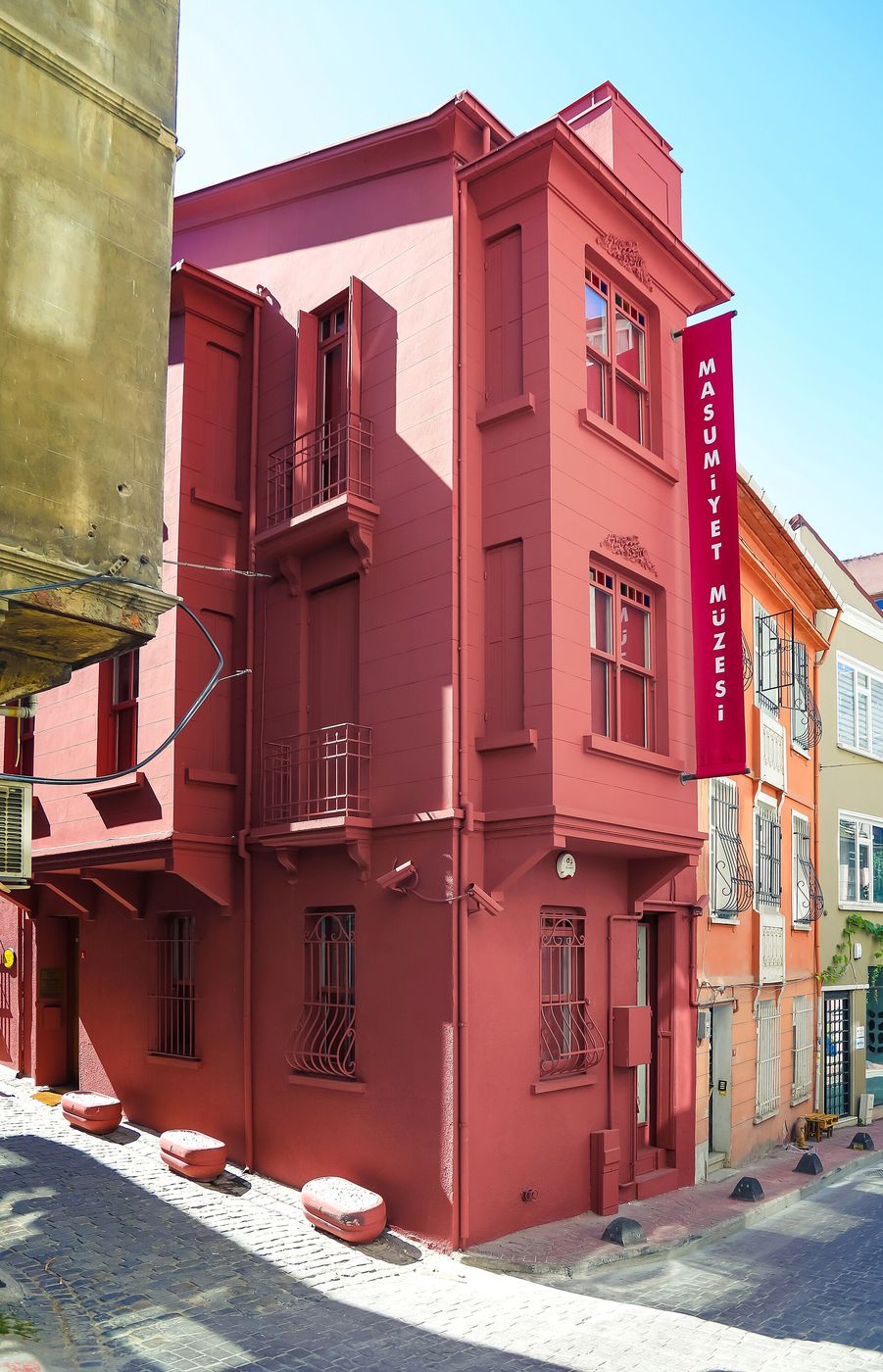
The novel’s first sentence is the key not only to the novel but to the museum founded with it: “Hayatımın en mutlu anıymış, bilmiyordum.” “It was the happiest moment of my life, it turns out, and I did not know it.” On a first reading one hears this sentence as an expression of sorrow, a retrospective regret, a lament for a missed happiness. Yet the weight of the sentence lies less in its meaning than in its grammar. Kemal Basmacı does not say that he is happy; he says that he has been happy, that he lived it without knowing it, and that he learns it only now. The novel does not tell us at once when this “now” is. Only much later do we understand that we are facing the voice of a man who has left the whole catastrophe of the story behind him and placed what he lived in the display cases of a museum. The first sentence thus speaks from the end of the novel; it is a last word placed at the very beginning of the narrative.1
The suffix -mış (by vowel harmony also -miş, -muş or -müş), which the Turkish grammatical tradition calls the “learned past” or the mood of report, marks that the speaker did not witness the event and knows of it indirectly, through an inference or through hearsay. Linguists have drawn attention to another, subtler function of the suffix: the surprise of the moment at which the speaker meets a piece of information they did not expect and were mentally unprepared for. The pioneering study of evidentiality in Turkish published by Dan Slobin and Ayhan Aksu in 1982, and the concept of mirativity that Scott DeLancey, drawing largely on that study, introduced into the linguistic literature in 1997, showed that this suffix is precisely the grammatical record of the moment of surprise.2 I cannot pass over here a small but dizzying coincidence: in the situation Slobin and Aksu chose to illustrate this use, the speaker opens the door, finds a visitor they did not at all expect, and the words that come out are “Kemal gelmiş!”, “Why, Kemal has come!”3 Pamuk’s Kemal enters the novel in just this way: as someone who opens the door of his own life and finds there a guest he did not at all expect, a belated happiness.
Psychoanalysis had come upon the structure linguistics found in the suffix -mış much earlier, under another name. In the Project for a Scientific Psychology, which Freud wrote in 1895, before psychoanalysis even had its name, and never published, he encounters a strange temporality while analysing the fear of a young woman he calls Emma of going into shops alone. An assault suffered in a shop at the age of eight is not traumatic at the moment it occurs; it acquires its traumatic value retroactively, when a second scene, lived in puberty and seemingly insignificant in itself, gives it a new meaning.4 Freud would call this backward-working causality Nachträglichkeit, and the concept would reach its most mature form in the Wolf Man case published in 1918, in the long analysis showing that the meaning of a scene witnessed by a child of one and a half was constituted only by a dream dreamed at the age of four.5 The concept’s installation at the centre of psychoanalytic thought under its French equivalent, après-coup, is, as is well known, the work first of Lacan and then of Laplanche and Pontalis. Strachey’s rendering in the Standard Edition, “deferred action”, had largely blurred the concept’s two-way movement, the fact that it names at once a postponement and a retroactive effect; Laplanche later proposed “afterwardsness” in its place.6
The sentence in which Lacan formulated this temporality in his Rome discourse of 1953 stands almost in a mirror relation to the first sentence of The Museum of Innocence. In Lacan’s sentence, constructed in the first person, what is realised in my history is not the past definite of what was, since it is no more, nor even the present perfect of what has been in what I am, but the future anterior of what I shall have been for what I am in the process of becoming.7 Analytic time is thus a past that opens forwards: the subject rewrites their past according to what they will become in the future. Kemal’s -mış is like a closed form of the same structure. Kemal, too, rewrites the past from the present; but where his rewriting arrives is less a future than a museum. Where the future anterior of analysis makes the subject’s movement possible, Kemal’s mirative past freezes that movement behind the glass of a display case. The real drama of the novel, in my view, is knotted in the tension between these two tenses, in the question of whether afterwardsness will become a liberation or a prison. When we reach the novel’s last sentence, we shall see that this question meets an unexpected grammatical answer.
II
The outlines of the story are well known. In the spring of 1975 Kemal, the thirty-year-old son of one of the wealthy textile families of Nişantaşı, is about to become engaged to Sibel, in every respect a “suitable” match in education, family and circle. In the boutique he enters to buy Sibel a handbag, he meets Füsun, an eighteen-year-old distant and poor relation of the family. Their meetings continue in a flat in the Merhamet Apartments, “Merhamet” meaning compassion or mercy, which belongs to Kemal’s family and is filled with old furniture. The novel never openly states the irony carried by the building’s name; but it lets it ring in the reader’s ear for hundreds of pages.
Kemal’s position in this first period is an almost textbook example of the structure Freud in 1912 called the most prevalent form of degradation in erotic life. Speaking of men who cannot unite the current of affection and the current of sensuality, Freud writes the sentence that would later be quoted countless times: Wo sie lieben, begehren sie nicht, und wo sie begehren, können sie nicht lieben; where they love they do not desire, and where they desire they cannot love.8 Sibel, as the approved woman one marries, is placed at the pole of affection; Füsun, positioned “below” in class and social terms, at the pole of desire. But what separates Pamuk’s novel from an ordinary love triangle is that Kemal’s view of maintaining this division as his right, the fantasy of giving up neither of the two women, is patiently and mercilessly dismantled in the novel’s first parts.
The social frame of this collapse should not be overlooked. The Istanbul bourgeoisie of the 1970s hangs between the sexual freedom promised by Westernisation and an old moral order in which virginity still determines a woman’s social value. The novel shows with a quiet but undeniable clarity that Sibel and Füsun do not pay the price of their relationship with the same man in the same way. Deniz Kandiyoti’s concept of “bargaining with patriarchy” is apt here: within the limits of the patriarchal order they live in, women develop different strategies to protect or improve their position, and which of these strategies is possible is not independent of class position.9 Sibel’s bargain and Füsun’s are not struck at the same table.
The fantasy collapses on the night of the engagement. Füsun comes to the party, sees Kemal beside Sibel, and from the next day disappears. Every day at the same hour Kemal goes to the Merhamet Apartments and waits. This is where the most psychoanalytically dense part of the novel begins; for desire gives away its structure most clearly where its object withdraws. While Füsun is there, there is a relationship. When Füsun is gone, only desire remains: objectless, without an address, and therefore no longer to be appeased by anything.
III
In Füsun’s absence Kemal begins to live, in the flat, with the objects she touched. He takes up a hair clip, a pen, a tea glass, presses it to his cheek, his neck, and feels his pain subside for a moment. The novel recounts these scenes without any recourse to irony, with the meticulousness of a medical textbook and the repetitiveness of a prayer book. The first concept that comes to the reader’s mind is no doubt fetishism, and this first impression is not entirely wrong. In his short and dense paper of 1927, Freud defines the fetish as the product of the subject’s refusal to accept the verdict of a perception, a lack, which they nevertheless perceive; that is, of the disavowal he calls Verleugnung. The fetish is the monument to this refusal: an object that makes it possible at once to know and not to know the lack.10 Octave Mannoni, some forty years later, in the essay in which he extends this logic to a whole theory of belief, fits it into one of the simplest sentences of French: Je sais bien, mais quand même… I know very well, but all the same…11 Kemal knows Füsun has gone; but her hair clip is here, all the same.
Yet to exhaust Kemal’s relation to objects with the concept of fetishism would be to miss the novel’s real vein. “Mourning and Melancholia”, which Freud wrote in 1915 and published in 1917, offers a much finer distinction here. For Freud, mourning is the libido’s submission to reality-testing’s verdict that “the loved object no longer exists”; but this submission does not happen all at once. Each memory, each expectation bound to the lost person is called up “bit by bit” (Stück für Stück), in Freud’s phrase, hypercathected, and only then detached.12 Mourning, in this sense, is a farewell made by touching the loss piece by piece, and what Kemal does is the literal reverse of this work: he too touches memories one by one; but instead of detaching each memory he touches, he binds it to an object, keeps it, and moves on to the next. The farewell that mourning carries out piece by piece becomes, in his hands, a preservation carried out piece by piece.
The formula by which Freud distinguishes melancholia from mourning comes naturally to mind here: Bei der Trauer ist die Welt arm und leer geworden, bei der Melancholie ist es das Ich selbst; in mourning it is the world which has become poor and empty, in melancholia it is the ego itself. The melancholic cannot give up the lost object, identifies with it, and, in Freud’s unforgettable image, the shadow of the object falls upon the ego. Kemal’s existence in the middle parts of the novel passes within this shadow. He withdraws progressively from his work, his family, the social life of his class; his life becomes an orbit narrowing around what remains of Füsun.
Yet it is Lacan, deliberately reversing Freud’s framework, who asks the real question about Kemal’s loss. In his tenth seminar, on anxiety, given in 1962–1963, Lacan finds Freud’s theory of mourning insufficient and makes this provocative statement: Nous ne sommes en deuil que de quelqu’un dont nous pouvons nous dire : j’étais son manque. We mourn only someone of whom we can say: I was their lack.13 Mourning, on this reading, concerns not the void the other leaves in us but the place we filled in the other’s desire, that is, our loss of the position of being the other’s lack. To reread The Museum of Innocence in the light of this sentence is unsettling. For the novel never brings to a definite answer the question of whether Kemal was Füsun’s lack. What Kemal mourns is perhaps not Füsun but that brief time in which he could believe he was a lack for her: the afternoons in the Merhamet Apartments, the innocence that gives the novel its name. From this angle the museum’s name can be read almost as a diagnosis: innocence, here, is the name of the time when one’s place in the other’s desire has not yet been doubted.
IV
To understand Kemal’s collection, we must leave psychoanalysis for a moment and turn to a short talk Walter Benjamin gave in the summer of 1931. Having moved his library to a new flat and in the middle of unpacking his crates, Benjamin, in what is perhaps one of the most beautiful texts ever written on collecting, makes the statement I have taken as an epigraph: every passion borders on the chaotic, but the collector’s passion borders on the chaos of memories. For Benjamin, ownership is for the true collector the most intimate relation one can have to objects; but this intimacy comes not from the objects coming alive in the collector but, on the contrary, from the collector dwelling in the objects: nicht daß sie in ihm lebendig wären, er selber ist es, der in ihnen wohnt. The talk ends, after building before its listeners a dwelling made of books, with a sentence saying that the collector, as is only fitting, disappears inside it.14
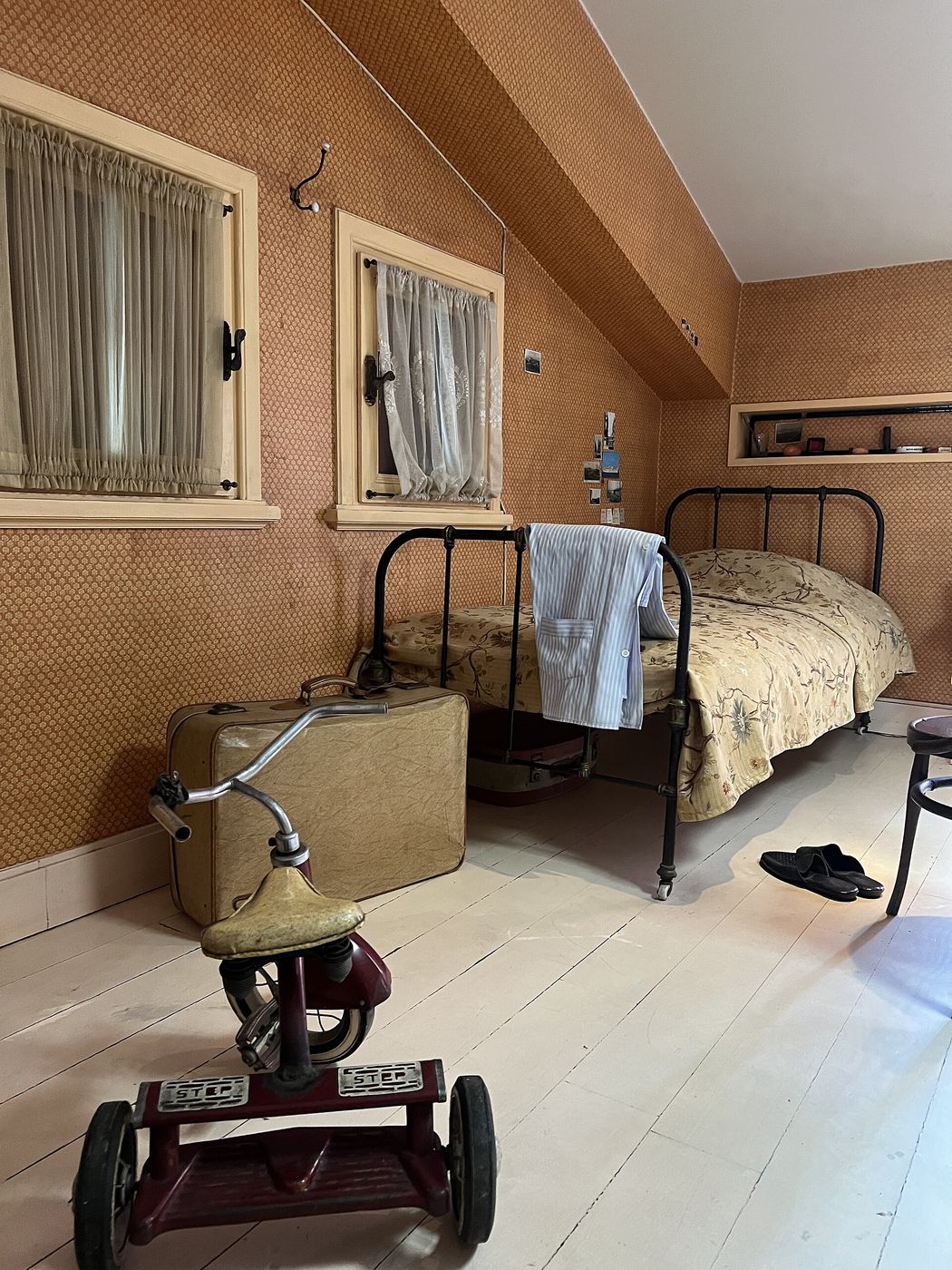

These sentences anticipate, almost like a prophecy, Kemal spending the last years of his life in the attic of his own museum, at the top of the old house of Füsun’s family, with his bed and his belongings. Visitors to the museum in Çukurcuma today find on the top floor a narrow iron bedstead, an old suitcase and a child’s tricycle that readers of the novel will recognise at once (Figure 2). The collector, as Benjamin said, has disappeared inside his collection. A subheading of the chapter Jean Baudrillard devoted to collecting in The System of Objects of 1968 sums up the logic of this disappearance on its own: Un discours à soi-même, a discourse addressed to oneself.15 The collection is the form in which the subject tells their own loss to themselves, again and again, without end.
This view also says something about the history of psychoanalysis itself. Over his lifetime Freud amassed a collection of some two thousand antiquities, filled his study with Egyptian, Greek and Roman figurines, and listened to his patients under the gaze of these small objects. The famous conversation in which he explained the unconscious to the Rat Man by comparing it to Pompeii also takes place in the shadow of this collection: what lay underground was preserved because it was buried; the moment it is brought to light, its destruction begins.16 Kemal’s museum reverses this image. What will preserve his objects will not be the darkness of the earth but the glass of the display case: the coming to light that in Pompeii is the moment decay begins becomes in Çukurcuma a kind of sealing.
The most pertinent answer to the question of whether anything separates this collection from fetish and melancholia comes, unexpectedly, from an anecdote Lacan tells in his seminar on ethics. Discussing sublimation in the winter of 1960, Lacan speaks of a collection he had seen in the house of the poet Jacques Prévert: empty matchboxes, fitted into one another so as to form a ribbon running along the mantelpiece and the wall.17 What caught Lacan’s attention was that the individual boxes had no value whatever, and that the whole effect of the collection arose from their arrangement in repetition, from the void this arrangement brought to light. The formula of sublimation most quoted today is found in the same seminar: sublimation raises an object to the dignity of the Thing, that is, into the place of that absolute privation which can never be possessed and whose contours can only be traced.
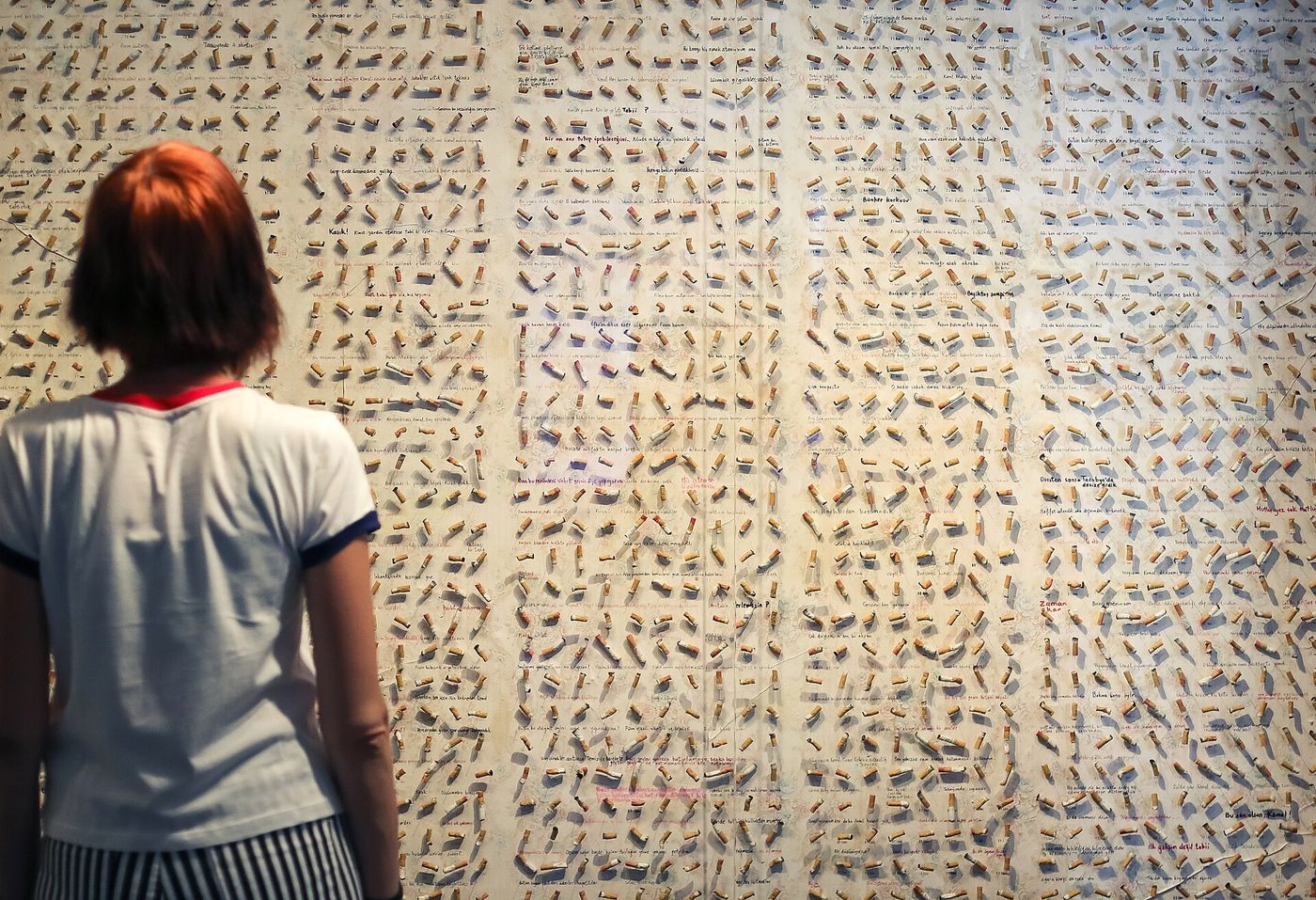

The wall of cigarette butts that greets visitors at the entrance of the museum is an almost exact counterpart of what Lacan saw on Prévert’s mantelpiece (Figure 3). Four thousand two hundred and thirteen butts, each on its own a nothing, the worthless remainder of an act of consumption; but set side by side, in row after row, they make visible an absence that none of them could carry alone. The cigarette butt is an almost didactic example of the object Lacan defined as the cause of desire, the objet petit a: not the person as a whole but a piece detached from them; the last trace of a lip, the remainder left by a gaze, a voice, a movement of the hand.18 Where Freud thought of the fetish as a veil, Lacan’s sublimation builds a frame, and Kemal’s story is, in my view, the story of the long and painful passage between these two operations. The hair clip he pressed to his cheek in the Merhamet Apartments was a fetish trying to veil an absence; the four thousand two hundred and thirteen butts ranged on the museum wall are a structure that traces the contours of absence.
V
When Füsun reappears a year later, she is married. Her husband Feridun is a young filmmaker who wants to make films; so that the film in which Füsun is to play the lead can be made, Kemal founds Limon Film and provides the capital himself. For the next eight years Kemal joins the evening meals in the house in Çukurcuma, at the table where Füsun’s parents and her husband also sit. The television is on, rakı is drunk, and a love that is never mentioned is staged anew every evening with the same ceremonial care.
These eight years recall the thesis of Denis de Rougemont’s famous book of 1939, which analyses the structure of Western love through the Tristan legend: passion feeds on obstacle; the lovers love not so much each other as love itself, and the obstacle that intensifies it.19 The lessons Lacan devoted in his seminar on ethics to the courtly love of the Middle Ages rebuild the same structure in psychoanalytic language: the inaccessible Lady is sublimated to the very extent that she is inaccessible, and the formula of sublimation I mentioned above finds its purest example here.20 Kemal’s dinner table is a scene of courtly love set in a neighbourhood house in twentieth-century Istanbul. That Kemal finances Feridun’s company is the most striking detail of this scene. The lover who supplies his rival with capital is investing, in both the figurative and the literal sense, in the obstacle’s continuation.
When the obstacles fall away, catastrophe comes. Füsun’s father dies, her marriage ends; Füsun makes it a condition that she be introduced to Kemal’s family, with a formal engagement and a wedding. Kemal, Füsun, Füsun’s mother Nesibe Hanım and the family’s chauffeur Çetin Bey set out by car for Paris. On the morning after the night spent in a hotel in Babaeski, that is, after the union awaited for nine years, Füsun is driving; the car crashes, Füsun dies, Kemal is badly injured. The novel leaves open whether the crash was an accident or something else, and the reader is left alone with the question. A psychoanalytic reading should not try to close it. But it can underline a structure: the desire fed by an obstacle for nine years crashes into a wall after the first night on which the obstacle is gone. What the proposition il n’y a pas de rapport sexuel, to which Lacan returned again and again in his late period, says cannot of course be something as crude as that people do not make love; what it says is that the fantasy of two halves uniting into a whole cannot be written.21 Even a union awaited for nine years cannot become a completion; in every encounter something is missed, and in the novel it is Füsun who pays for this miss with her life.
At this point the real question the novel, or rather Kemal’s narrative, conceals emerges: what did Füsun want? Füsun wants to become an actress; but throughout the novel this desire always circulates through other people’s money, approval and gaze. It is Kemal who tells us about Füsun, and Füsun’s voice is heard from inside the collection of the man who loves her. The museum, from this angle, is a structure that turns a woman’s life into the catalogue of a man’s desire. The novel’s greatness lies in both carrying out this transformation and allowing the reader to notice it. To be the object of desire can mean being unable to be the subject of one’s own desire; The Museum of Innocence is a novel that bears the full weight of this sentence.
VI
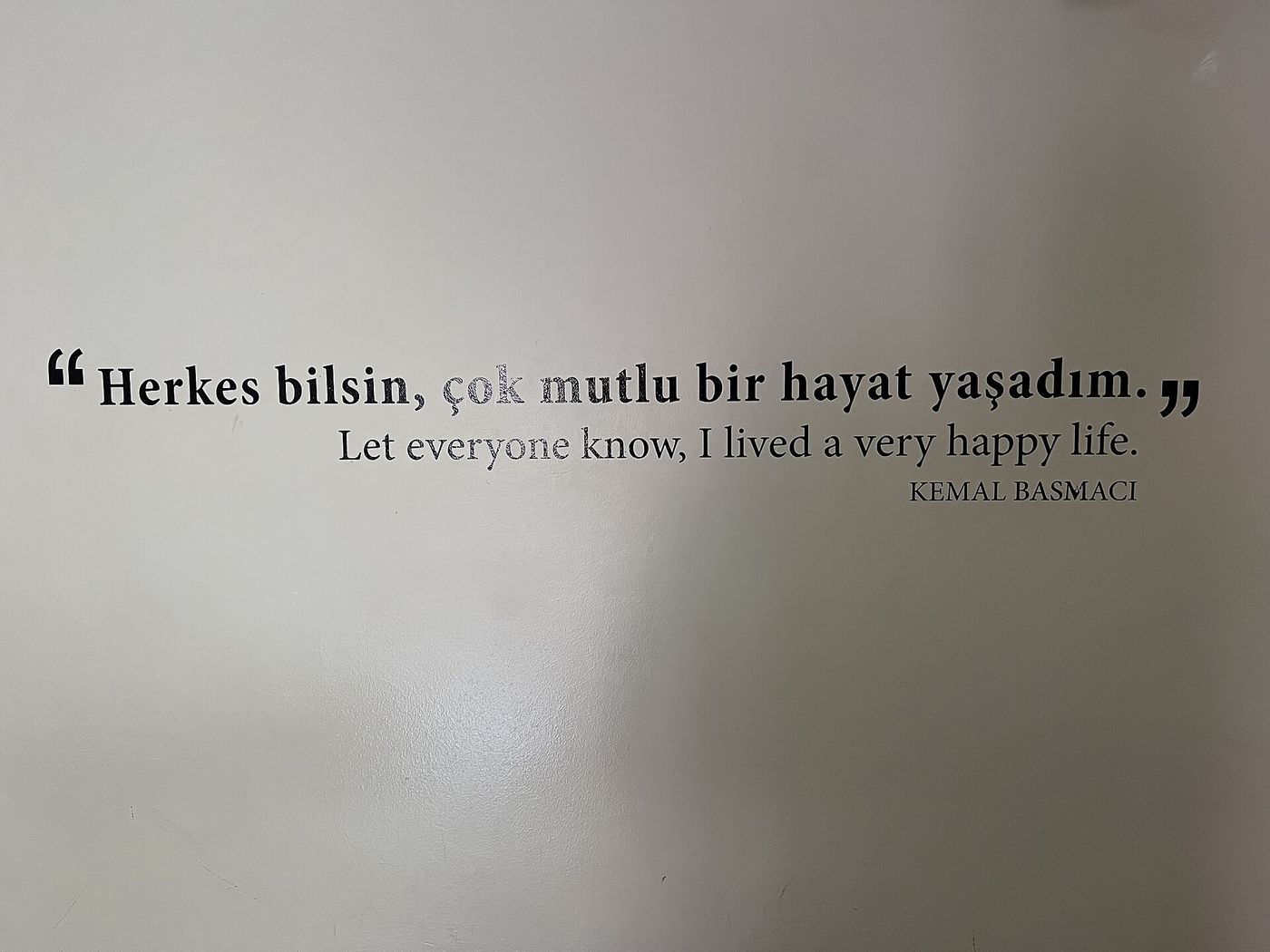
After he recovers, Kemal decides to turn the Keskins’ house in Çukurcuma into a museum; but he does not write his story himself. He goes to Orhan Pamuk and asks him to write the novel that will be the museum’s catalogue. In the novel’s last chapter the narrator changes: Pamuk recounts Kemal’s death, and the book closes, at Kemal’s request, with this sentence: “Herkes bilsin, çok mutlu bir hayat yaşadım.” “Let everyone know, I lived a very happy life.” The sentence is written today on the museum wall too (Figure 4).

A Modest Manifesto for Museums, which Pamuk wrote after opening the museum, provides a useful background for grasping the public meaning of this last sentence. The manifesto says that the great national museums present the history of a nation as if it were more important than the stories of individuals, likens the transformation of museums from palaces into national institutions to the passage from epic to novel, and ends by declaring that the future of museums lies in people’s own homes.22 The Museum of Innocence is the first application of this programme: the museum of an individual set against the history of a nation, and moreover the museum of a passion that has become, in the eyes of those around him, a catastrophe.
Let everyone know. To whom is this sentence addressed? The place Lacan calls the big Other, the witness by whom the subject hopes their truth will be recognised, here takes on the body of the museum visitor and the reader. Kemal’s happiness will become real only when a witness confirms it, and the museum is the space of this witnessing. In one of his late seminars Lacan reads James Joyce’s writing as an invention that holds together his disintegrating subjective world and earns him a name, and calls this invention the sinthome.23 The sinthome is less the name of a cure than of a singular solution that allows the subject to live with their symptom and to make a work of it. Kemal’s museum can be read as such a solution: it does not bring the loss back, but it allows a life and a name to be built around the loss. With this difference: Joyce wrote his own name; Kemal’s is written by someone else, a novelist.
I began this essay with a suffix; I want to end with one. The novel’s first sentence was built on -mış: “anıymış”, a past learned afterwards, indirectly, and with surprise. The last sentence is built on -dı: “yaşadım”, “I lived”. In Turkish this suffix reports that the speaker knows the event first-hand, witnessed it, and takes it on as their own knowledge.24 The novel has thus travelled a road from a mirative past to a witnessed past: the man who discovered his life with a stranger’s surprise finally declares it as his own life. It is hard to imagine a grammatical movement that better sums up the aim of psychoanalytic work. In his Rome discourse Lacan says that at the foundation of the method Freud called psychoanalysis lies the subject’s assumption of their own history, insofar as it is constituted by speech addressed to the other.25 The Museum of Innocence takes both halves of this formula seriously. Kemal’s witnessed past comes not from his own mouth but from someone else’s pen; to be able to say “I lived”, he needed a witness, a writer, a museum. Perhaps happiness, at least in the sense this novel teaches, is something that is not content with being lived but waits to be put into words before another.
Afterword
The nine-episode Netflix adaptation directed by Zeynep Günay, written by Ertan Kurtulan, with Selahattin Paşalı as Kemal and Eylül Lize Kandemir as Füsun, was released on 13 February 2026 and won the novel a new generation of readers.26 The question the adaptation puts to its viewers is the exact reverse side of the reading I have tried to set out above. In the novel we know Füsun and the objects only through Kemal’s words; the camera gives Füsun a face, a voice and a gaze of her own. How far can a woman constructed as the object of a collection overflow, on screen, the bounds of Kemal’s narrative? This is a question everyone who watches the adaptation can ask themselves, and perhaps should.
Notes
- The novel was published in 2008; the museum in Çukurcuma opened to visitors on 28 April 2012. In the same year Pamuk published the museum’s catalogue, The Innocence of Objects. This structure, in which novel and museum presuppose one another, requires that both sides of the work be thought together. ↩︎
- D. I. Slobin and A. A. Aksu, “Tense, aspect and modality in the use of the Turkish evidential” (1982); S. DeLancey, “Mirativity: The grammatical marking of unexpected information”, Linguistic Typology 1 (1997), pp. 33–52. Drawing on Slobin and Aksu, DeLancey shows that the Turkish inferential can, depending on context, also take on a mirative function. ↩︎
- Slobin and Aksu (1982), p. 187. In the example the speaker hears someone approaching, opens the door and sees a visitor they did not at all expect, Kemal; that they choose the form with -mış even though they witness the event directly shows that the suffix here serves not an evidential function but one that marks surprise. ↩︎
- S. Freud, Project for a Scientific Psychology (1895; first published 1950), SE I, Part II. That the case in which Freud first works out the concept of afterwardsness rests on two scenes set in a shop stands like an ironic rhyme when one considers that Kemal’s story, too, begins in a boutique. ↩︎
- S. Freud, “From the History of an Infantile Neurosis” (1918 [1914]), SE XVII. Freud’s works are cited by their titles in the Standard Edition (SE), with volume numbers. ↩︎
- J. Laplanche and J.-B. Pontalis, Vocabulaire de la psychanalyse (1967), entry “Après-coup”; English: The Language of Psycho-Analysis (1973), entry “Deferred action”. ↩︎
- J. Lacan, “Fonction et champ de la parole et du langage en psychanalyse” (1953), Écrits (1966), p. 300: “le futur antérieur de ce que j’aurai été pour ce que je suis en train de devenir.” ↩︎
- S. Freud, “On the Universal Tendency to Debasement in the Sphere of Love” (1912), SE XI. ↩︎
- D. Kandiyoti, “Bargaining with patriarchy”, Gender & Society 2/3 (1988), pp. 274–290. ↩︎
- S. Freud, “Fetishism” (1927), SE XXI. Freud carries this idea into a more general frame in the posthumously published “Splitting of the Ego in the Process of Defence” (1940 [1938], SE XXIII). ↩︎
- O. Mannoni, “Je sais bien, mais quand même…”, in Clefs pour l’imaginaire ou l’Autre Scène (1969). ↩︎
- S. Freud, “Mourning and Melancholia” (1917 [1915]), SE XIV. The three expressions I quote in the text come respectively from the passages describing the work of mourning, the distinction between mourning and melancholia, and the identification in melancholia: “Stück für Stück”; “Bei der Trauer ist die Welt arm und leer geworden, bei der Melancholie ist es das Ich selbst”; “Der Schatten des Objekts fiel so auf das Ich”. ↩︎
- J. Lacan, Le Séminaire, Livre X: L’angoisse (1962–1963), Paris: Seuil, 2004, p. 166; English: Anxiety, trans. A. R. Price (2014). ↩︎
- W. Benjamin, “Ich packe meine Bibliothek aus. Eine Rede über das Sammeln” (1931); English: “Unpacking My Library”, in Illuminations (1968). In the last sentence of the talk the collector disappears inside his dwelling of books “wie recht und billig”, as is only right. ↩︎
- J. Baudrillard, Le système des objets (1968), chapter “Le système marginal : la collection”; English: The System of Objects (1996). ↩︎
- Freud’s collection is preserved today in the Freud Museum in London, in the house where he spent his last year. For the Pompeii comparison see “Notes upon a Case of Obsessional Neurosis” (1909), SE X. ↩︎
- J. Lacan, Le Séminaire, Livre VII: L’éthique de la psychanalyse (1959–1960), Paris: Seuil, 1986; English: The Ethics of Psychoanalysis, trans. D. Porter (1992). For the formula of sublimation see p. 133: “elle élève un objet […] à la dignité de la Chose.” Prévert’s matchboxes appear in the same discussion. ↩︎
- From the tenth seminar onwards Lacan thinks of the objet petit a as a remainder (reste) left over from the subject’s entry into language, and counts as its main forms the breast, the faeces, the gaze and the voice. ↩︎
- D. de Rougemont, L’Amour et l’Occident (1939); English: Love in the Western World (1940). ↩︎
- Lacan, Seminar VII, especially the lesson “L’amour courtois en anamorphose” (“Courtly love as anamorphosis”). ↩︎
- The proposition is a formula Lacan returned to repeatedly from the late 1960s; for its most detailed treatment see Le Séminaire, Livre XX: Encore (1972–1973), Paris: Seuil, 1975; English: Encore, trans. B. Fink (1998). ↩︎
- O. Pamuk, A Modest Manifesto for Museums. The text, in eleven points, is published on the museum’s official website: masumiyetmuzesi.org. ↩︎
- J. Lacan, Le Séminaire, Livre XXIII: Le sinthome (1975–1976), Paris: Seuil, 2005; English: The Sinthome, trans. A. R. Price (2016). ↩︎
- On the evidential opposition between -dı and -mış in Turkish see A. Göksel and C. Kerslake, Turkish: A Comprehensive Grammar (2005); also Slobin and Aksu (1982). In the linguistic literature these suffixes are written with capitals, -DI and -mIş, to cover all the forms they take under vowel and consonant harmony. ↩︎
- Lacan, “Fonction et champ…”, Écrits: “l’assomption par le sujet de son histoire, en tant qu’elle est constituée par la parole adressée à l’autre.” ↩︎
- The series was produced by Ay Yapım; all nine episodes were released on the same day. ↩︎
References
- Baudrillard, J. (1968). Le système des objets. Gallimard.
- Benjamin, W. (1931). Ich packe meine Bibliothek aus. Eine Rede über das Sammeln. In Gesammelte Schriften (Vol. IV). Suhrkamp.
- DeLancey, S. (1997). Mirativity: The grammatical marking of unexpected information. Linguistic Typology, 1, 33–52.
- Freud, S. (1909). Notes upon a case of obsessional neurosis. SE X.
- Freud, S. (1912). On the universal tendency to debasement in the sphere of love. SE XI.
- Freud, S. (1917 [1915]). Mourning and melancholia. SE XIV.
- Freud, S. (1918 [1914]). From the history of an infantile neurosis. SE XVII.
- Freud, S. (1927). Fetishism. SE XXI.
- Freud, S. (1950 [1895]). Project for a scientific psychology. SE I.
- Göksel, A., & Kerslake, C. (2005). Turkish: A comprehensive grammar. Routledge.
- Kandiyoti, D. (1988). Bargaining with patriarchy. Gender & Society, 2(3), 274–290.
- Lacan, J. (1966). Fonction et champ de la parole et du langage en psychanalyse (1953). In Écrits (pp. 237–322). Seuil.
- Lacan, J. (1975). Le Séminaire, Livre XX: Encore (1972–1973). Seuil.
- Lacan, J. (1986). Le Séminaire, Livre VII: L’éthique de la psychanalyse (1959–1960). Seuil.
- Lacan, J. (2004). Le Séminaire, Livre X: L’angoisse (1962–1963). Seuil.
- Lacan, J. (2005). Le Séminaire, Livre XXIII: Le sinthome (1975–1976). Seuil.
- Laplanche, J., & Pontalis, J.-B. (1967). Vocabulaire de la psychanalyse. PUF.
- Mannoni, O. (1969). Je sais bien, mais quand même… In Clefs pour l’imaginaire ou l’Autre Scène. Seuil.
- Pamuk, O. (2008). Masumiyet Müzesi. İletişim. [English: The museum of innocence (M. Freely, Trans.). Knopf, 2009.]
- Pamuk, O. (2012). Şeylerin Masumiyeti. İletişim. [English: The innocence of objects. Abrams, 2012.]
- Pamuk, O. (n.d.). A modest manifesto for museums. masumiyetmuzesi.org.
- Rougemont, D. de (1939). L’Amour et l’Occident. Plon.
- Slobin, D. I., & Aksu, A. A. (1982). Tense, aspect and modality in the use of the Turkish evidential. In P. J. Hopper (Ed.), Tense-aspect: Between semantics and pragmatics (pp. 185–200). John Benjamins.