This essay first appeared in Turkish. The English version is my own.

Er reproduziert es nicht als Erinnerung, sondern als Tat.
Sigmund Freud, “Erinnern, Wiederholen und Durcharbeiten” (1914)
Repetition and recollection are the same movement, only in opposite directions.
Søren Kierkegaard, Repetition (1843)
I
Always attaching oneself to someone unavailable, always being left, always taking the role of rescuer, or always fleeing at the same point every time things get close. Repeating relationship patterns are among the most common reasons people seek psychological help, and their strangest feature is that the person usually sees the pattern quite clearly. They can predict how the next relationship will end, may have told their friends the same story several times over; and still they cannot stop themselves from taking the same road. That this knowledge is not enough to break the power of repetition shows that repetition is rooted somewhere much deeper than a conscious choice. The sentences that describe the experience resemble one another too: “I always choose the wrong people”, “There’s a curse on me”, “I suppose this is my fate”. Each of these sentences ties repetition to something that comes from outside: misfortune, a curse, fate. The view psychoanalysis offers is unsettling, but hopeful too: repetition has an author, and that author, in a place the person does not know, is the person themselves.
Freud describes this picture in 1920, in the third chapter of Beyond the Pleasure Principle, with unforgettable examples: the benefactor who, after a time, is repaid with ill will by everyone he has protected; the man all of whose friendships end in betrayal; the person who, one after another, raises someone to a position of authority and then brings them down; and the lover each of whose love affairs passes through the same phases and reaches the same end. The most striking of Freud’s examples is a woman who married three times, each of whose husbands fell ill soon after the wedding, and whom she had to nurse on their deathbeds.1 Freud calls the structure that makes these people’s lives look as if they were ruled by a “daemonic” power a “compulsion of destiny”, and adds that psychoanalysis can show that this fate is largely arranged, unconsciously, by the person themselves.
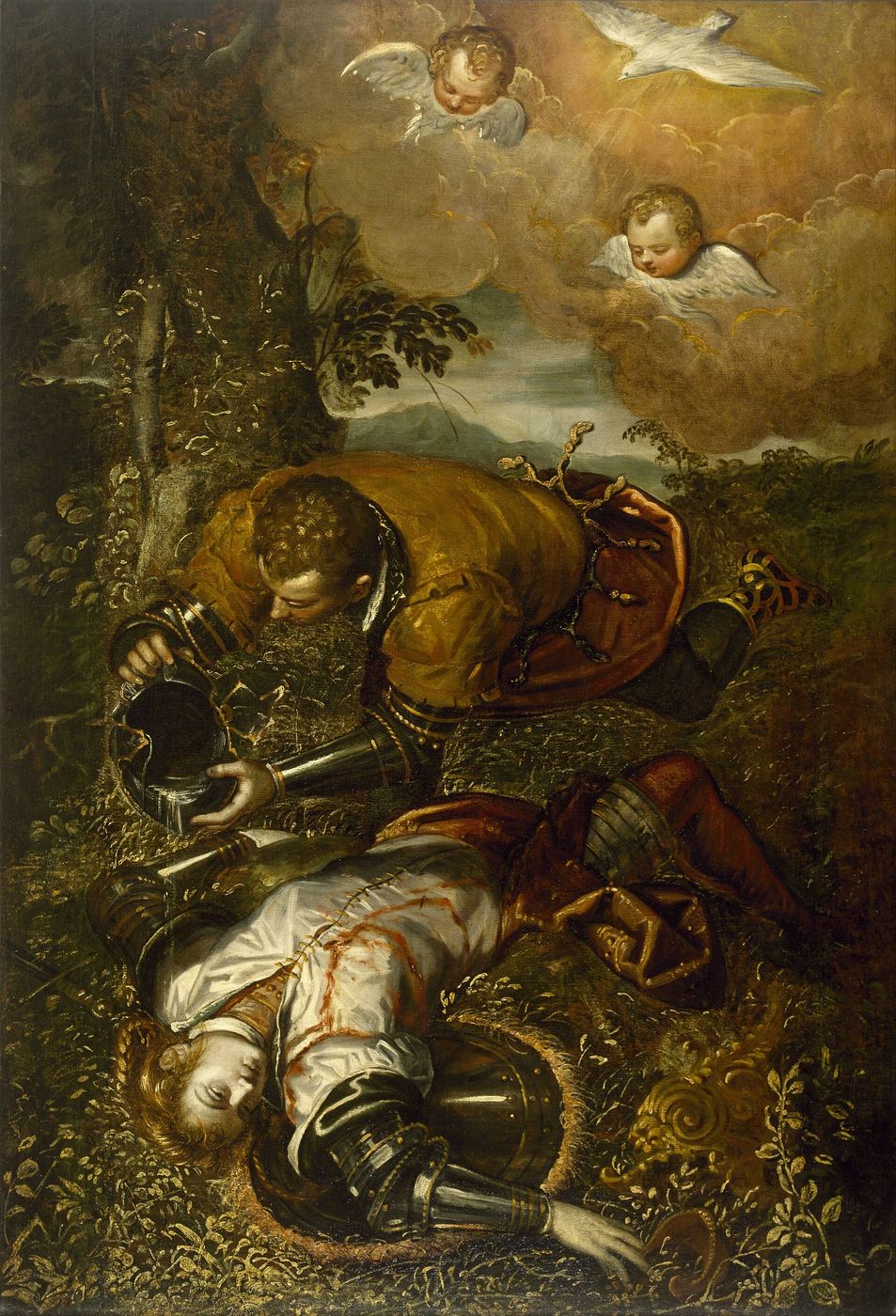
The literary example Freud cites in this context is a scene from Torquato Tasso’s epic Jerusalem Delivered, published in 1581. The crusader knight Tancred is in love with Clorinda, a warrior woman of the enemy army; but one night, not recognising the person inside the armour, he fights her and kills her. He recognises the dying Clorinda only when he takes off her helmet. Later, entering an enchanted forest, he strikes a tree with his sword; blood flows from the tree, and Clorinda’s voice says that her soul is imprisoned in it, and that her beloved has wounded her once again.2 The scene captures the horror of repetition perfectly: a catastrophe lived once happens again, unknowingly, unwillingly.
A year earlier Freud had described this uncanny face of repetition through a small incident of his own. Walking one hot summer afternoon through the deserted streets of a small Italian town he did not know, he found himself in a street whose windows showed painted women, and left it hurriedly. After wandering aimlessly for a while he suddenly found himself in the same street again. Again he left it, turning in another direction; and after a detour he arrived at the same place a third time. Freud writes that the feeling that came over him at that moment he could only call uncanny, and that he was glad to give up his exploratory walk and return to the piazza.3 Arriving again and again, unwillingly, at a place one does not want to be: Freud’s little memory sums up the structure of repeating relationships with the simplicity of a fairy tale. One believes one is fleeing somewhere; but all roads, through turnings chosen without knowing it, lead to the same street.
II
Freud had found the clinical meaning of repetition six years earlier, in 1914, in a short technical paper entitled Remembering, Repeating and Working-Through. There he observes that analysands do not remember certain parts of their past but live them again as actions: the analysand does not remember what has been forgotten and repressed, but acts it out; he reproduces it not as a memory but as an action, and of course does so without knowing that he is repeating it.4 What cannot be remembered is repeated; repetition is a way the unconscious remembers.
One of the paper’s most fruitful ideas is that transference serves as a “playground” for this repetition. The forms of relationship that repeat in the analysand’s life appear in the analytic relationship too; but this time in almost complete freedom, in a form that can be observed and spoken about. Freud says that the work of the treatment is to meet repetition in this space and slowly turn it into remembering and speech; and he calls this work of transformation Durcharbeiten, working-through. Working-through does not happen through understanding once; it is a patient labour that requires taking up the same resistance, the same repetition, again and again in different forms. At the end of the paper Freud admits that this work can be arduous for the analysand and a trial of patience for the analyst; but he adds at once that it is precisely this working-through that brings about the greatest changes in the analysand and distinguishes analytic treatment from every kind of treatment by suggestion.5 Seeing a pattern once is not enough to avoid living it again. One has to recognise the same pattern again in the next relationship, the next workplace, even in the relationship with the analyst, seeing it each time a little earlier, a little more clearly.
III
Beyond the Pleasure Principle was written to look for an answer to the question of why repetition turns towards painful experiences too, and the most famous scene of that search is a child’s game. Freud observes that his grandson, a year and a half old, when his mother left the house, would throw a wooden reel with a string tied to it over the edge of his cot so that it disappeared, uttering a long “o-o-o-o” as he did so, and then, pulling the string to bring the reel back, would greet it joyfully with “da”. In German fort means gone; da, there.6 The child is repeating in play his mother’s departure, that is, an experience that pains him. In Freud’s interpretation, the game is an attempt to master an experience suffered passively by staging it again actively; and the most striking thing about the game is that the “gone” part is played far more often than the “there” part.
The game also has a bitter epilogue. The child who threw the reel was Ernst, the elder son of Freud’s daughter Sophie. Sophie died in January 1920, at twenty-six, during the influenza pandemic sweeping the world; Beyond the Pleasure Principle was published that year. In a short footnote added to the book, Freud writes that when the child was five and three-quarters his mother died, and that now that she was really “gone” the child showed no signs of grief.7 The mother sent away and called back thousands of times in play would, this time, not come back. The child grew up to become a psychoanalyst and worked for many years on the first relationships between babies and their mothers. The string of the reel was perhaps never let go of, his whole life long.
In his 1964 seminar Lacan reads this game from a place different from Freud’s interpretation of mastery. For him the reel is less a toy standing in for the mother than a small part detached from the child yet still belonging to him; in throwing the reel the child plays not his mother but what is torn from him with her departure.8 The real invention of the game is the two syllables that accompany the movement of the reel. “O-o-o” and “da” are a pair of opposites: one marks absence, the other presence. With these two sounds the child enters the most basic structure of language, an order in which something can be named even where it is absent. The first form of repetition is, in this sense, the entry into language itself: what is lost is taken, through the alternating repetition of two syllables, into a language able to bear a loss. The mother’s departure cannot be changed; but it can now be said.
But Freud is not content with this explanation. The dreams of the war neuroses that take the person back to the traumatic scene every night, the childhood disappointments revived again and again in analytic treatment, and the examples of the compulsion of destiny suggest to him the existence of a more basic tendency operating beyond the pleasure principle. In the later chapters of the book he connects this tendency, speculatively, with the death drive. The biological claims of this speculation are disputed today; but its clinical core, the observation that human beings can insist on returning to what pains them, is among the most solid findings of psychoanalysis.
The historical background of this observation is the First World War. Thousands of soldiers came back from the trenches full of tremors, shaking, paralyses, mutism and dreams that returned them every night to the same scene: an explosion, a friend’s death. The fifth international psychoanalytic congress, held in Budapest in September 1918, was devoted entirely to the war neuroses; Ferenczi, Abraham and Ernst Simmel presented their experience in military hospitals, and the medical authorities of the European armies followed the congress through official observers.9 Freud’s search, two years later, for what lies beyond the pleasure principle was a search for an answer to the existence of these dreams. The dream, which he had defined as a wish-fulfilment, here repeated horror itself. The explanation Freud found was that traumatic dreams try to establish retrospectively the preparedness that anxiety failed to provide against fright: the mind tries, by living it again and again, to prepare itself afterwards for what once caught it unprepared.
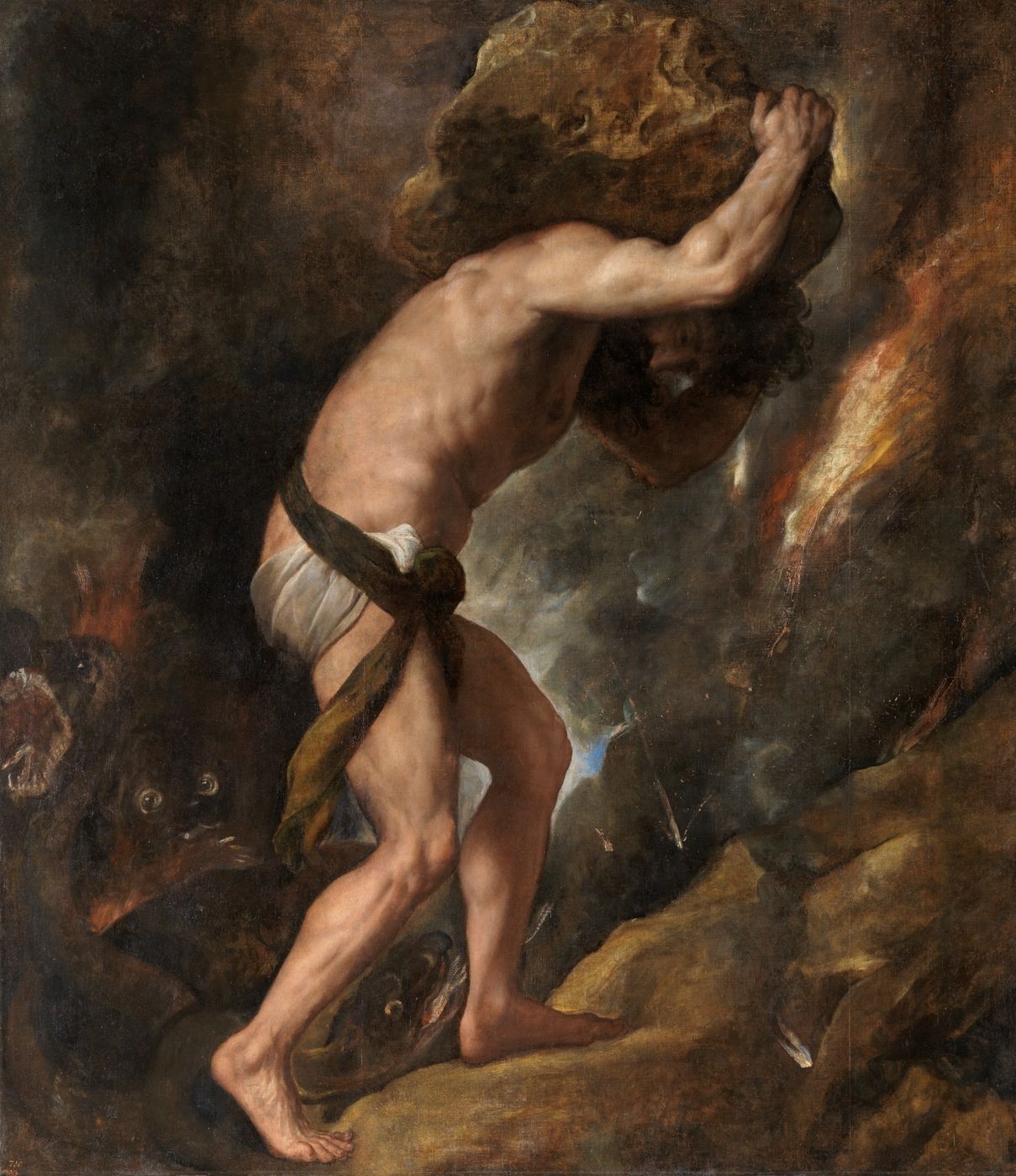

In the middle of the Second World War, in his essay of 1942, Albert Camus gave this old myth an unexpected ending. The gods had condemned Sisyphus to roll a rock to the top of a mountain and to begin again each time it rolled down; they had thought there was no more dreadful punishment than futile and hopeless labour. Camus turns his attention to the brief moment when the rock rolls down again and Sisyphus walks down to begin once more. The last sentence of the essay is an invitation: one must imagine Sisyphus happy.10 Psychoanalysis approaches the invitation with caution. Neurotic repetition is not a figure who, like Camus’s conscious and rebellious Sisyphus, takes up his own fate; it carries the rock without knowing what the rock is or why it carries it. But one side of Camus’s intuition is close to the aim of analysis: change begins not when the rock disappears, but when the one carrying it changes their relation to their own fate, when in that brief moment of walking down they can see what they are carrying.
IV
In 1910, in a paper on object choice in men, Freud had also examined a specific form of repeating love relationship. He observes there that some men can fall in love only when certain conditions are met: that the woman loved belong to another man, that is, that there be an “injured third party”, and that the woman have a sexually dubious reputation. These men live their loves with great passion and fidelity; but the loves follow one another in a long series, around the same conditions. Behind the series Freud finds the fantasy of rescuing the beloved woman and an old childhood scenario bound to the mother.11 The paper’s lasting lesson is that what attracts us is often not a person as a whole but a particular condition, a particular trait: a way of looking, a distance, a lack, a prohibition. That trait holds a very special place in our unconscious history.
The scenario that is repeated does not always come from the subject’s own childhood; sometimes it is inherited from the previous generation, from a story that was never told. In the 1970s the Hungarian-born French psychoanalysts Nicolas Abraham and Maria Torok proposed two concepts for thinking about this transmission. A grief, a shame, a secret that a parent lived through but could never put into words is kept within them like a tomb, a crypt; and the secret passes to the child as a “phantom” that the child knows nothing about, but that makes its effects felt in strange ways in their life.12 The phantom is not something the subject has repressed; it is someone else’s unspoken word. Someone confronted with an inexplicable repetition in their own life, always losing something at a certain age, always falling into the same kind of relationship, always falling ill on a certain date, sometimes discovers in analysis that the repetition is staging an untold story from their family: a grandmother’s child who died young, a father’s concealed bankruptcy, the unfinished mourning of an emigration. Repetition here is the next generation living, in its own body and its own life and without knowing it, what one generation could not say.
Lacan deepens this thought with the concept of fantasy. Fantasy is an unconscious scenario that organises the subject’s desire, a scenario about who we are and what we are in the other’s desire; Lacan writes it as the formula of the subject’s relation to the object that causes its desire. The person who is always left has perhaps constituted themselves as someone who can exist only in the absence of love; the person who always rescues believes they can find a place only when the other is lacking. These scenarios cause pain, but they also produce a kind of satisfaction. Lacan calls this paradoxical satisfaction jouissance: within what we complain about lies a hidden gain that binds us to it. This is why repetition is so stubborn; for what is repeated is not only a pain, but a pleasure woven into that pain.
V
In his eleventh seminar of 1964, The Four Fundamental Concepts of Psychoanalysis, Lacan returns to repetition as one of the four basic concepts of psychoanalysis, alongside the unconscious, transference and the drive, and thinks it in a new language. To do so he borrows two terms from a distinction Aristotle draws about causality in the Physics. Automaton is the return of signs, working on their own like a mechanism: the same sentences, the same roles, the same scenes. Tuché is chance, the encounter: an unexpected and unavoidable meeting with the Real. For Lacan, behind repetition lies an encounter missed every time; repetition is one more attempt at a meeting that has never fully taken place.13 Lacan’s rendering of Freud’s Wiederholungszwang, the compulsion to repeat, as “repetition automatism” in French also stresses this mechanical face.
Another thinker Lacan recalls in this lesson is Kierkegaard. In Repetition, published in 1843 under the pseudonym Constantin Constantius, Kierkegaard sets his own concept of repetition against Greek recollection: recollection works backwards, repetition forwards.14 In the most moving part of the book the narrator returns to Berlin to repeat a journey he once made, stays at the same lodgings, goes to the same theatre; but nothing is the same, and the only thing he learns on the journey is the impossibility of repetition. From a psychoanalytic point of view, the scene reveals the secret hope of neurotic repetition: one sets up the same scene again and again because one hopes that this time the ending will be different, that what was once missed will this time come about.
In Turkish literature, the darkest portrait of this hope is Yusuf Atılgan’s Anayurt Oteli (1973), translated into English as Motherland Hotel. Zebercet, the clerk of a small-town hotel, spends his life in an unchanging order, doing the same tasks at the same hours every day. One night a woman who arrives on the delayed Ankara train stays at the hotel and leaves the next morning. From then on Zebercet devotes his whole life to waiting for her return: he keeps the room she stayed in exactly as it was, leaves the bed unmade, gives the room to no one, goes into it every day to look at the traces she left. The woman does not come. Zebercet’s order turns little by little into the order of a repetition, a ritual, and finally a ruin.15 Atılgan’s novel is a local and shattering echo of Kierkegaard’s Berlin journey and of Freud’s compulsion of destiny. Zebercet waits for the repetition of an encounter lived once, perhaps of a promise never really made; and as long as what he waits for does not come, his way of waiting itself turns little by little into an unbearable repetition.
VI
Outside psychoanalysis, too, repetition has been one of the great questions of Western thought. In paragraph 341 of The Gay Science, published in 1882, Friedrich Nietzsche invites his reader to a thought experiment: what if one night a demon came to you in your loneliest loneliness and told you that you would have to live the life you are living now, and have lived, once more and innumerable times more, with nothing new in it, every pain and every joy returning in the same order?16 For Nietzsche the thought is the heaviest test of a person’s relation to their own life: to be someone who can say yes to eternal recurrence, who can affirm their life as it is. Psychoanalysis reads the test the other way round. Neurotic repetition is not the return of an affirmed life, but of a moment never fully lived; one repeats one’s life where one cannot say yes to it.
In Difference and Repetition, published in 1968, Gilles Deleuze reads Freud’s repetition compulsion, Nietzsche’s eternal return and Kierkegaard’s repetition within the same intellectual horizon, and argues that repetition, rather than the return of the same, is a movement that produces difference each time.17 Clinically, the thought is extremely fruitful: no repetition is ever exactly the same, and analytic work proceeds precisely by attending to these small differences, to the points where the same scenario is played each time a little differently.
A story Deleuze often recalls turns this idea into a literary game. In Jorge Luis Borges’s story “Pierre Menard, Author of the Quixote”, published in 1939, a French writer sets out to rewrite Cervantes’s novel word for word, without copying it, and manages to write a few chapters. The story’s narrator compares the two texts: the words are identical; but Menard’s text, because it was written in the twentieth century, three hundred years after Cervantes, carries quite different meanings, and is, the narrator says, almost infinitely richer.18 The same sentence, spoken at another time by another subject, is not the same sentence. So it is in analysis: the analysand tells the same story many times, lives the same relationship many times; but with each telling, in a place where the analyst is listening, the same words take on a slightly different weight. This small difference within repetition is where change begins.
Perhaps the best-known expression of the idea in popular culture is Harold Ramis’s 1993 film Groundhog Day. An arrogant and cynical television weatherman is condemned to live the same day, the second of February, in a small town, countless times. At first he exploits the repetition, then he falls into despair, tries again and again to kill himself, and every morning wakes in the same bed to the same song. The loop is broken only when he learns to be someone else within the same day, to turn towards others and towards his own desire in a different way. The film is almost a textbook example of a psychoanalytic thesis: repetition ends not when external conditions change, but when the subject’s relation to the same conditions changes. What Freud called working-through is living the same day again and again, but each time knowing a little more.
VII
Noticing a repeating pattern is the first step towards transforming it; but only the first step. One can deepen the awareness by asking oneself some questions. At what point do my relationships usually begin to break down? Do I always find myself in a similar role in them? Do the people I find attractive share a common condition, of the kind Freud speaks of? At the end of a relationship do I always say the same sentence to myself, and does that sentence feel familiar from earlier periods of my life? These questions make a person the narrator of their own story; but because what sustains repetition is not a conscious choice, answering them is often not enough on its own.
Today’s culture of relationships has added a new stage to this structure of repetition. Dating apps offer countless options on a screen, one after another, at the flick of a finger. At first sight one might think that this abundance would free people from their old patterns and break the tendency always to attach oneself to the same type. Clinical experience often shows the opposite: multiplying the options does not change repetition itself; it only speeds it up. From among hundreds of profiles one chooses, without noticing, the one who again carries the same distance, the same lack, the same way of looking; the relationship ends again at the same point, with the same sentence, and one moves on to the next profile. Repetition does not arise from a lack of choice but from a preference the unconscious makes before any choice; and that preference does not change with the number of options.
In psychoanalytic work, as Freud proposed in 1914, repetition is met on the playground of the transference relationship. Unlike the scenes of real life, this is a place where the price of repetition is not paid, where a relationship can be examined without being destroyed, without anyone being left or hurt. What repeats in relationships begins to appear in the analytic relationship too; but this time, rather than being staged, it can be spoken about, questioned and understood together with its history. The process does not change the person’s past, but it changes their relation to the past. The person can recognise the first steps of the road that always leads to the same place, and notice the moments when a different choice is possible. Between the repetition Kierkegaard found impossible and the compulsive repetition of neurosis, there is a third possibility that analysis tries to open: not the same thing lived again, but something new able to be born from within repetition. For Tancred to stop before his sword strikes the tree a second time, or at least to strike knowing whom he wounds. To do what Freud did when he arrived at the same street for the third time in the Italian town: turn back, go out to the piazza, and choose one’s way knowingly.
Notes
- S. Freud, Beyond the Pleasure Principle (1920), chapter III, SE XVIII. Freud’s works are cited by their titles in the Standard Edition (SE), with volume numbers. ↩︎
- T. Tasso, Gerusalemme liberata (1581), cantos XII and XIII. Freud cites the scene as the “most moving poetic picture” of the compulsion of destiny. Claudio Monteverdi set the night duel of Tancred and Clorinda in his dramatic madrigal Il combattimento di Tancredi e Clorinda, staged in Venice in 1624; the work is counted among the first pieces of music to imitate the rhythm of combat with instruments. ↩︎
- S. Freud, “The Uncanny” (1919), Gesammelte Werke XII; SE XVII, part II. In the same place Freud gives, as examples of this kind of uncanniness, the experience of someone lost in a misty forest who keeps returning to the same spot, or someone groping for the door in a dark room who keeps bumping into the same piece of furniture. ↩︎
- S. Freud, “Remembering, Repeating and Working-Through” (1914), SE XII. ↩︎
- Freud, “Erinnern, Wiederholen und Durcharbeiten” (1914), Gesammelte Werke X. In this section Freud stresses that young analysts make the mistake of believing that naming a resistance is enough to remove it, whereas the analysand must be given time to recognise the resistance, work through it and overcome it. ↩︎
- Freud, Beyond the Pleasure Principle, chapter II. ↩︎
- Freud, Jenseits des Lustprinzips (1920), chapter II, footnote. As an adult Ernst Halberstadt took the name W. Ernest Freud and worked as a child psychoanalyst in London; throughout his life he spoke of being the child in his grandfather’s famous observation. ↩︎
- J. Lacan, Le Séminaire, Livre XI, lesson “Tuché et automaton”; English: The Four Fundamental Concepts of Psychoanalysis, trans. A. Sheridan (1977). Lacan interprets the reel as a part that separates from the subject while still belonging to him, a first form of the object-cause of desire. ↩︎
- S. Ferenczi, K. Abraham, E. Simmel and E. Jones, Zur Psychoanalyse der Kriegsneurosen, Leipzig and Vienna: Internationaler Psychoanalytischer Verlag, 1919; Freud wrote an introduction to the book. With the end of the war, plans to set up psychoanalytic treatment centres in the armies were shelved. ↩︎
- A. Camus, Le Mythe de Sisyphe, Paris: Gallimard, 1942: « Il faut imaginer Sisyphe heureux. » For Camus, Sisyphus’s fate belongs to him; his rock is his thing. ↩︎
- S. Freud, “A Special Type of Choice of Object Made by Men” (1910), SE XI. Freud published the paper as the first of a series of three under the title “Contributions to the Psychology of Love”; the second is the 1912 paper on the debasement of erotic life, the third the 1918 paper on the taboo of virginity. ↩︎
- N. Abraham, “Notules sur le fantôme” (1975); N. Abraham and M. Torok, L’Écorce et le noyau, Paris: Aubier-Flammarion, 1978; English: The Shell and the Kernel, trans. N. Rand (1994). For Abraham, the phantom is not something the subject has repressed, but the trace of someone else’s, often a parent’s, unspoken secret, working within the subject like a stranger. ↩︎
- J. Lacan, Le Séminaire, Livre XI: Les quatre concepts fondamentaux de la psychanalyse (1964), Paris: Seuil, 1973, especially the lesson “Tuché et automaton”. ↩︎
- S. Kierkegaard, Gjentagelsen (1843). In the lesson “Tuché et automaton” of Le Séminaire, Livre XI, Lacan recalls Kierkegaard’s concept of repetition as a search for the new set against Greek recollection; Kierkegaard’s name also recurs often in Lacan’s seminar on anxiety. The translation of the epigraph is mine. ↩︎
- Y. Atılgan, Anayurt Oteli, Istanbul: Bilgi Yayınevi, 1973; English: Motherland Hotel, trans. F. Stark (2016). The novel also reached a wide audience through Ömer Kavur’s 1987 film. ↩︎
- F. Nietzsche, Die fröhliche Wissenschaft (1882), § 341. In Ecce Homo (1888) Nietzsche recounts that the thought of eternal recurrence came to him in August 1881, in Switzerland, on the shore of Lake Silvaplana, as he stood beside a huge pyramidal rock; the thought later moved to the centre of Thus Spoke Zarathustra. ↩︎
- G. Deleuze, Différence et répétition (1968); English: Difference and Repetition, trans. P. Patton (1994). Deleuze reads Freud’s repetition compulsion not as a mechanical return of the repressed, but as a movement that takes place each time through a disguise, a mask: what is repeated is not an original existing before the repetition itself. ↩︎
- J. L. Borges, “Pierre Menard, autor del Quijote” (1939), first published in the review Sur; later collected in Ficciones (1944). The narrator shows how a sentence in which Cervantes calls history “the mother of truth” carries a quite different philosophical claim when it comes from Menard’s pen. ↩︎
References
- Abraham, N., & Torok, M. (1978). L’Écorce et le noyau. Aubier-Flammarion. [English: The shell and the kernel (N. Rand, Trans.). University of Chicago Press, 1994.]
- Atılgan, Y. (1973). Anayurt Oteli. Bilgi Yayınevi. [English: Motherland hotel (F. Stark, Trans.). City Lights, 2016.]
- Borges, J. L. (1944). Pierre Menard, autor del Quijote (1939). In Ficciones. Sur.
- Camus, A. (1942). Le Mythe de Sisyphe. Gallimard.
- Deleuze, G. (1968). Différence et répétition. PUF. [English: Difference and repetition (P. Patton, Trans.). Columbia University Press, 1994.]
- Ferenczi, S., Abraham, K., Simmel, E., & Jones, E. (1919). Zur Psychoanalyse der Kriegsneurosen. Internationaler Psychoanalytischer Verlag.
- Freud, S. (1910). A special type of choice of object made by men. SE XI.
- Freud, S. (1914). Remembering, repeating and working-through. SE XII.
- Freud, S. (1919). The uncanny. SE XVII.
- Freud, S. (1920). Beyond the pleasure principle. SE XVIII.
- Kierkegaard, S. (1843). Gjentagelsen. Copenhagen.
- Lacan, J. (1973). Le Séminaire, Livre XI: Les quatre concepts fondamentaux de la psychanalyse (1964). Seuil. [English: The four fundamental concepts of psychoanalysis (A. Sheridan, Trans.). Norton, 1977.]
- Nietzsche, F. (1882). Die fröhliche Wissenschaft. Schmeitzner.
- Tasso, T. (1581). Gerusalemme liberata.