This essay first appeared in Turkish. The English version is my own.

I
The most common explanation of infidelity is that it begins where love ends: one cheats because one no longer loves. Sometimes this is true. But it does not explain a situation often met in the clinic: someone who says he loves his partner, fears losing her, has built a life with her and wants to keep it, and yet turns to someone else. This person often does not understand himself. “I don’t know why I did it” is one of the sentences most often spoken by the one who cheats, and it is often not an excuse but genuine bewilderment.
Freud described one form of this bewilderment in 1912, in his paper “On the Universal Tendency to Debasement in the Sphere of Love”. Freud observed that in the love life of some men two currents separate: the affectionate current and the sensual current. These men cannot feel sexual desire for the women they respect and love; and the women they desire they cannot love or value. Freud summed it up in one short sentence: where they love they do not desire, and where they desire they cannot love.1 For Freud the origin of this split lies in childhood’s first love object: the affection felt for the mother, or whoever stands in her place, has to separate from sexual desire because of the incest prohibition. When the beloved resembles this first object too closely, the shadow of the prohibition falls on her too.
Freud described this structure in men; but a clinician today sees it in women too, in different forms. The more secure, the more familiar, the more “home” a relationship becomes, the more desire may slip elsewhere, towards the unknown, the forbidden. Seen this way, infidelity may be not the place where love ends but the place where love and desire fail to meet.
II
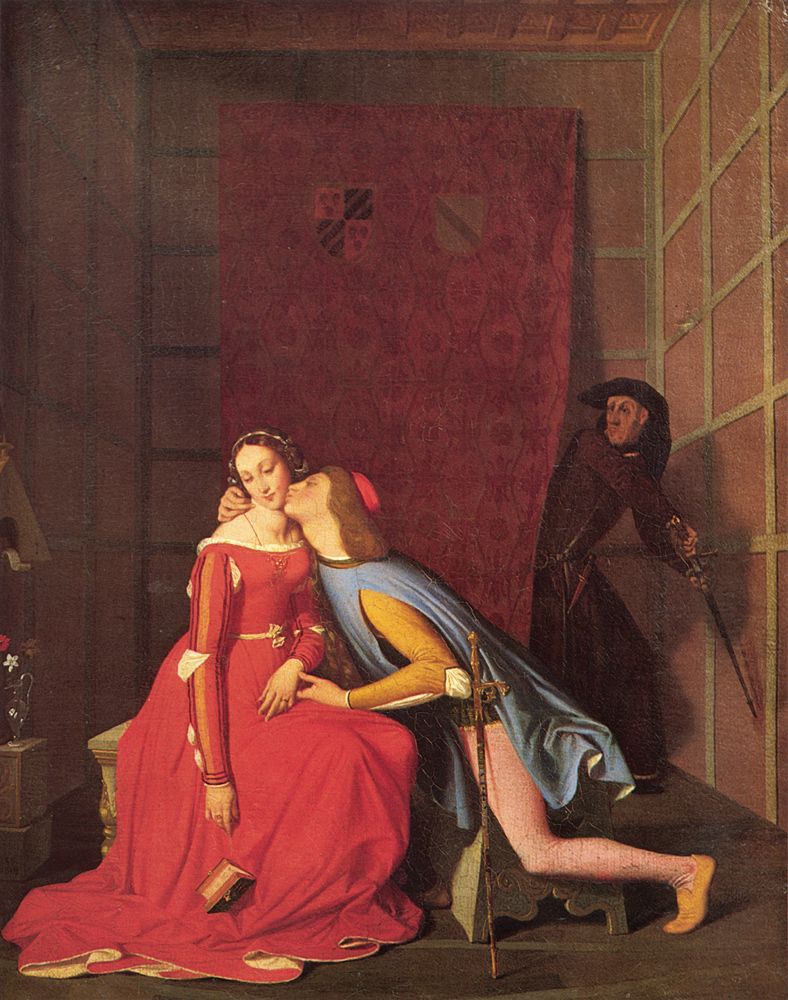
In the fifth canto of the Inferno, in the second circle where those damned for lust are swept about by the wind, Dante speaks with two shades: Francesca da Rimini and her husband’s brother, Paolo Malatesta. Francesca tells how their love began. One day the two of them, alone, were reading the story of Lancelot’s love for Queen Guinevere. When they reached the place where Lancelot and Guinevere kiss, Paolo, trembling, kissed her on the mouth. The sentence Francesca speaks to Dante is one of the most quoted in literature: the book and the one who wrote it were our go-between; that day we read no further.2
This scene shows something important about infidelity. Paolo and Francesca’s desire is not born spontaneously, of a natural attraction between them; it is born through a third, a book, the love story of others. The French thinker René Girard argued in his first book, published in 1961, that the great novels show that desire never aims directly at an object, but always passes through someone else’s desire, through a model.3 Lacan says it in his own language: man’s desire is the desire of the Other. What we desire is what someone else desires, or what someone else’s desire points to.
In many stories of infidelity there is this third place. Desire sometimes passes through the gaze of the betrayed partner himself: someone who notices his partner’s interest in another begins to desire that other. Sometimes it passes through the desire of a friend, a sibling, a rival. One of Freud’s most famous cases, the case of Dora, shows the complexity of this triangle: the young woman caught between her father’s mistress, Frau K., and Frau K.’s husband, Herr K., is attached not only to Herr K., as Freud supposed, but perhaps even more to Frau K., to the secret of her femininity.4 Infidelity is sometimes an effort to learn how another desires, how another is desired.
III
One of Lacan’s most quoted formulas is the sentence “there is no sexual relation”. It does not say that people do not make love. What it says is that two people, two desires, do not meet in a way that completes each other, that answers each other exactly. Each person relates to the other through his own fantasy, his own lost object. Love, for Lacan, is precisely what is built on this failure to meet; in a formula he often repeated, love is giving what you do not have.5
Seen in this light, infidelity is sometimes an attempt to close this lack. Within a long relationship one notices that the other does not complete one, that a lack remains; and that lack seems as if it could be made good in someone else, in a stranger. The intensity of the first months of the new relationship comes from the strength of this illusion: the new person has not yet shown a lack, because no life has yet been shared. But the illusion often ends in meeting again the very lack that was lived in the old relationship. Someone who repeats infidelity, who lives the same story from relationship to relationship, needs to ask what this repetition is saying.6
IV
For the one who is betrayed the experience is very different. Learning that one has been betrayed is a trauma: the past is suddenly rewritten, and ordinary memories, a dinner, a holiday, a phone call, abruptly take on another meaning. The betrayed person looks for information to complete this rewriting: when did it begin, how many times, where, why? Each new piece of information brings relief for a moment, then gives rise to a new question. This search has no end, because what is being sought is not information.
The betrayed person’s question “why?” is often another form of the question “why was I not enough?”. The most painful side of jealousy, as Freud also showed, is less anger at the rival than the shaking of one’s own worth. The betrayed person sees himself in the other’s eyes, beside the rival, as lacking. But this question does not close, even if the one who cheated gives his own answer, because the one who cheated often does not know the answer himself. The betrayed person’s recovery begins not with finding an answer to this question, but with understanding where the question itself comes from, where the tying of one’s own worth to someone else’s desire comes from.7
V
Whether a relationship continues after infidelity is a decision only the two people can make. Some relationships end, some continue and sometimes reach a more honest place than before. What psychoanalytic work offers here is not to make a decision but to open the questions beneath it. For the one who cheated: what did I fail to find in this relationship, and why did I think I could find it in someone else? Is this happening in my life for the first time? For the one who was betrayed: which old fear of mine about love and about being valued did this experience recall?
These questions are not easy, and they often cannot be asked alone. But they show that infidelity, whether committed or suffered, can be not an end in a person’s life but a question. Halit Ziya’s Aşk-ı Memnu, the novel of Turkish literature that asks this question most deeply, tells of Bihter’s encounter with her own desire in the wake of a forbidden love. And Dante’s Francesca, even in hell, in the wind, does not let go of Paolo. Both stories say the same thing: infidelity lies not outside love but in its darkest, least understood place.8
Notes
- S. Freud, “Über die allgemeinste Erniedrigung des Liebeslebens” (1912), Jahrbuch für psychoanalytische und psychopathologische Forschungen, 4: “Wo sie lieben, begehren sie nicht, und wo sie begehren, können sie nicht lieben.” ↩︎
- Dante Alighieri, La Divina Commedia, Inferno, V, 127–138: “Galeotto fu ’l libro e chi lo scrisse: / quel giorno più non vi leggemmo avante.” Galeotto is the Italian name of Galehaut, the knight who acted as go-between for Lancelot and Guinevere. ↩︎
- R. Girard, Mensonge romantique et vérité romanesque, Paris: Grasset, 1961. ↩︎
- S. Freud, “Bruchstück einer Hysterie-Analyse” (1905), Monatsschrift für Psychiatrie und Neurologie, 18. Lacan rereads this case by stressing that Dora’s interest in Frau K. carries the question “what is a woman?”. ↩︎
- Lacan uses this formula many times; for a detailed development see J. Lacan, Le Séminaire, Livre VIII: Le transfert (1960–1961), ed. J.-A. Miller, Paris: Seuil, 1991, the lessons on Plato’s Symposium. ↩︎
- On repeating relationship patterns, see the essay “Why Do I Keep Living the Same Relationship?” on this site. ↩︎
- On jealousy, see the essay “Jealousy” on this site. ↩︎
- See the psychoanalytic reading of Aşk-ı Memnu on this site. ↩︎
References
- Dante Alighieri (c. 1321). La Divina Commedia: Inferno.
- Freud, S. (1905). Bruchstück einer Hysterie-Analyse. Monatsschrift für Psychiatrie und Neurologie, 18.
- Freud, S. (1912). Über die allgemeinste Erniedrigung des Liebeslebens. Jahrbuch für psychoanalytische und psychopathologische Forschungen, 4.
- Girard, R. (1961). Mensonge romantique et vérité romanesque. Grasset.
- Halit Ziya Uşaklıgil (1900). Aşk-ı Memnu. Istanbul.
- Lacan, J. (1991). Le Séminaire, Livre VIII: Le transfert (1960–1961). Seuil.