This essay first appeared in Turkish. The English version is my own. Lacan’s texts are cited in the French originals, with English translations given where one exists. Freud’s works are cited by their titles in the Standard Edition (SE), with volume numbers. Following current practice I render Lacan’s moi as “ego” and je as “I”.
Car Je est un autre.
Arthur Rimbaud, letter to Paul Demeny, 15 May 1871
For I is another.
I
At the beginning of August 1936 the fourteenth congress of the International Psychoanalytical Association met in the Czechoslovak spa town of Marienbad. It was a summer in which war clouds were gathering again over Europe and the analysts of Vienna were thinking anxiously about their future; Freud, as since 1922, did not attend the congress. The thirty-five-year-old Jacques Lacan, a young French psychiatrist, mounted the rostrum to give a talk on the mirror stage. Ernest Jones, chairing the session, stopped him after ten minutes, saying his time was up. Lacan could not finish his talk, did not hand in the text for publication in the proceedings, and without waiting for the end of the congress left for Berlin to watch the Olympic Games.1
The scene is as instructive as the theory it was meant to present. A young analyst, before one of the institutional fathers of psychoanalysis, tries to set out a theory of the image, of recognition, of the illusion of wholeness, and is cut off. His talk is not acknowledged; his text is lost. Lacan’s conflicts with the psychoanalytic institutions over the next forty years, his war on the standard session length, his removal from the International Association, perhaps find their herald in this first interruption. The first presentation of the mirror stage ended in the refusal of a demand for recognition.
The text we read today is the second version, which Lacan presented thirteen years later, in July 1949, at the sixteenth international congress in Zurich: “The Mirror Stage as Formative of the Function of the I as Revealed in Psychoanalytic Experience.” Published the same year in the Revue française de psychanalyse, this short text was included in the Écrits in 1966 and became one of the most quoted psychoanalytic texts of the twentieth century.2 But between 1936 and 1949 the theory had a before and sources, and these hardly show in the text itself.
II
An infant’s meeting with the mirror had drawn the attention of scientists long before psychoanalysis. In the short paper he published in Mind in 1877, made up of notes on the early years of his son William, Charles Darwin records that the infant of four and a half months smiled repeatedly at his own image and at his father’s image in the mirror, took them for real beings, and was astonished when his father’s voice came from behind him.3 The German psychologist Wolfgang Köhler had likewise observed the relation of apes to mirrors in his famous experiments with chimpanzees in Tenerife during the First World War. Lacan begins his text of 1949 with a contrast built on Köhler’s observations: the chimpanzee loses interest in the image in the mirror the moment he grasps that it is empty, that there is nothing behind it. The human young, at an age when he is behind a chimpanzee in intelligence, recognises his image in the mirror and, unlike the chimpanzee, does not lose interest in it; he begins to play with it, to take it up with joy.
The most important silence in Lacan’s text concerns another name. The French psychologist Henri Wallon, in an article of 1931 and in his book Les Origines du caractère chez l’enfant of 1934, had studied in detail the child’s relation to the mirror and called it the “mirror test”. For Wallon the child learns slowly, by trial, that the image in the mirror is an image of himself, that is, how his own body looks from outside; this learning is a stage in the formation of a concept of the body, the “body proper”, in Wallon’s phrase.4 Lacan took this observation but gave it a meaning Wallon had never thought of, and never mentioned Wallon’s name in his text. In Roudinesco’s phrase, the history of the mirror stage is a history of an erasure.
The difference between Lacan and Wallon carries the whole originality of the text. For Wallon the mirror is a cognitive instrument that helps the child grasp reality better and learn how his own body looks from outside; the mirror experience is an advance. For Lacan the recognition in the mirror is not an advance but the beginning of an error, a basic and founding error. The moment the child recognises himself in the mirror he identifies with something that is not himself, an external image; and this identification forms the core of his ego, of what he will say “I” of throughout his life.
One source of Lacan’s interest in the mirror was the Paris psychiatric clinic where he spent his youth. In 1930 the French psychiatrist Paul Abély had described how some patients, especially at the onset of the picture then called early dementia, démence précoce, would stand in front of a mirror for hours examining their own faces, and called this behaviour the “mirror sign”, signe du miroir.5 These patients did recognise themselves in the mirror, but the recognition was not enough for them; they felt that something in their image had changed, that their faces had become strange to them, and tried to find the source of the strangeness. The psychiatric clinic had long ago observed the reverse of the infant’s joy before the mirror, the moment at which the unified image begins to come undone. Lacan’s theory makes it possible to think these two scenes, the infant’s joyful recognition and the patient’s anxious scrutiny, as the two ends of the same structure: the image forms the ego, and when the image dissolves the ego begins to dissolve too.
III
Twenty years after Lacan’s text science found a way of measuring recognition in the mirror. In a study published in Science in 1970, the American psychologist Gordon Gallup, after introducing chimpanzees to a mirror for a few days, anaesthetised them and painted a red dye on a place they could not see on waking, above the eyebrow and on the edge of the ear. When the chimpanzees woke and looked in the mirror they touched the dyed spots; they had understood that the image in the mirror was their own body.6 The experiment showed that the picture of the chimpanzee Lacan drew from Köhler was incomplete too: given enough time the chimpanzee can recognise his image as well.
These experiments are today among the cornerstones of developmental and comparative psychology and have shown that recognition in the mirror is not peculiar to human beings, that it is seen also in some great apes, dolphins, elephants and certain birds. But Lacan’s question differs from the question of these experiments. Gallup and Amsterdam ask when the child or the animal recognises the image in the mirror as himself. Lacan asks what this recognition does to the subject. How is an ego born from an image, and how does the trace of this origin persist in the adult’s life?
IV
Lacan’s text of 1949 begins with the description of a scene. An infant between six and eighteen months, who cannot yet walk or even stand upright, held in an adult’s arms or, as Lacan mentions, in a kind of baby-walker common in French homes of the time, a trotte-bébé, is brought before the mirror. The infant sees his image and greets it, in Lacan’s phrase, with a jubilant assumption: he leans forward, looks at the image, smiles at it, struggles to free himself from his support to see it better.
The reason for this joy lies, according to Lacan, in the special condition of the human young at birth. The human being, compared with other mammals, is born very early, before his development is complete. According to the “foetalisation” theory developed in the 1920s by the Dutch anatomist Louis Bolk, the human being is a species that retains the foetal characteristics of its ancestors into adulthood, that in a way always remains immature.7 For months the infant cannot control his body or coordinate his movements; he lives his body not as a whole but as a scattered sum of disconnected sensations, involuntary movements, hunger and satisfaction. The image in the mirror, by contrast, shows him something he does not fully possess: a unified body, with defined limits, standing on its own. The image anticipates a maturity the infant has not yet reached. The infant sees himself as more whole, more powerful, more complete than he is.
To show that the effect of the image is not peculiar to human beings Lacan gives two odd examples from biology. For the ovaries of a female pigeon to mature she must see another pigeon; but a real pigeon is not necessary: seeing her own image in a mirror placed in her cage is enough. The migratory locust’s passing from the solitary form to the gregarious form can likewise be triggered at a certain stage of its development by seeing the image of an individual of its own kind.8 In these examples the image forms the body itself. For Lacan the same happens in the human being, at the level not of the body but of the ego: the image in the mirror forms the ego.
V
But this formation carries a price. The wholeness the infant sees in the mirror does not belong to his own experience; it comes from outside, from an image, from another. The infant recognises himself in another place, on a surface that is not himself. This is why Lacan says that the mirror stage clothes the infant, in his own words, in the armour of an alienating identity. The ego is this armour: a structure in which the subject recognises himself as a whole, as a name, a face, a character, but in which this recognition always rests on an image coming from outside and therefore always remains somewhat strange.
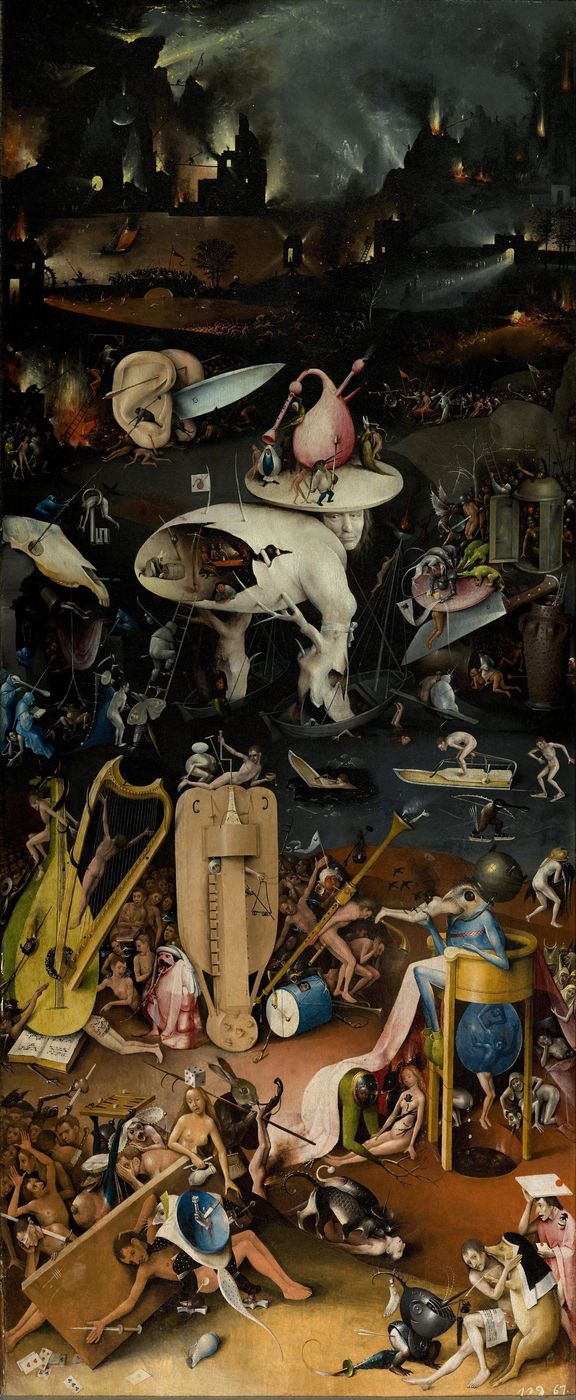
Beneath this armour, for Lacan, the experience that preceded the mirror stage, the fragmented body, in French corps morcelé, goes on living. In analytic experience this fragmented body appears in some dreams, in images that arise when the subject’s own wholeness is threatened: severed limbs, organs spilling out of the body, parts moving by themselves. Lacan finds the most striking expression of these images in the history of painting in Hieronymus Bosch. The scene of hell on the right wing of Bosch’s Garden of Earthly Delights triptych, with its knife between ears, its hollowed-out human body standing on tree trunks, its limbs nailed to musical instruments, is like a catalogue of this fragmentation.

In the same text Lacan also describes the ego’s symbol in dreams: a fortress surrounded by walls, even a stadium. This structure has two opposed fields of struggle, running from its inner arena to its ramparts and the rubble and marshes around it. The ego is a fortress, a defensive structure the subject builds against his own fragmentation, against the scatteredness of his body. The stronger the fortress looks, the greater, it may be thought, the threat that besieges it. Lacan relates this image especially to the defensive structures of obsessional neurosis; in the clinic one often meets subjects who defend their ego with excessive rigidity, who see an attack in every criticism and a threat in every difference.
VI
The most important clinical consequence of the mirror stage is that at the origin of the ego lies a misrecognition, in French méconnaissance. The subject takes his ego for himself; but the ego is the product of an identification with an image, and therefore carries not the subject’s truth but a reflection of it. A year earlier, in his address “Aggressivity in Psychoanalysis” given in Brussels in 1948, Lacan had shown another consequence of this misrecognition: aggressivity.9
Because the ego is formed in an image, in the image of another, its relation to the other is from the start a relation of rivalry. I and other are two rivals trying to share the same image, the same place. Lacan draws attention to a strange phenomenon of this structure that can be observed in childhood: transitivism. A small child who hits another says “he hit me”; when he sees another child fall he cries. The boundary between I and other has not yet been drawn; the two children, like each other’s mirrors, appropriate each other’s movements, feelings and pains. The scene Augustine recounts in the Confessions, of an infant not yet able to speak turning pale with jealousy on seeing his foster-brother at his mother’s breast, is the example Lacan often turns to for this structure.10
This aggressivity persists in adulthood. Excessive resemblance, another who does the same job, loves the same woman, wants the same place, often gives rise to the deepest hostilities. What Freud called the narcissism of minor differences, the fact that communities that most resemble one another are most bitterly hostile to one another, is a social appearance of this mirror relation.11 That the other should resemble me closely means that he can take my place, can steal my image from me.
This view also had a consequence for the history of psychoanalysis itself. Ego psychology, developed in the 1940s and 1950s in the United States under the leadership of Heinz Hartmann, Ernst Kris and Rudolph Loewenstein, argued that the ego has an autonomous sphere independent of conflict and that the aim of analysis is to strengthen it, to make the ego better able to adapt to reality.12 Lacan accused this approach of forgetting the lesson of the mirror stage. If the ego is the product of a misrecognition, to strengthen it is to reinforce the subject’s captivity to his own image. In his address “The Freudian Thing”, given in Vienna in 1955, he reread Freud’s famous sentence, Wo Es war, soll Ich werden, freeing it from its usual translation, “Where id was, there ego shall be”: where It was, I, the French subject “je”, must come to be.13 For Lacan the aim of analysis is not the strengthening of the ego, in French the moi, but that the speaking subject, the je, be able to speak from beneath the ego’s imaginary armour, from the place of his own desire.
VII
The most important addition Lacan made to the mirror stage in later years was to place a third term within this dual relation. In his first seminar of 1953–1954 he describes an experiment he took from an optics book by the French physicist Henri Bouasse: the experiment of the inverted bouquet. A bunch of flowers placed upside down inside a box is hidden from view, beside a vase set on top of the box. A concave mirror placed facing the box forms a real image of the bouquet, and an observer looking from the right point sees the bouquet in the vase, upright and whole. But this is possible only from a certain angle, so long as the observer stands in the right place.14
From this experiment Lacan concludes that the wholeness of the ego depends on the place from which the subject looks. And in 1960, in his comment on a report by Daniel Lagache, returning to the mirror scene itself, he draws attention to a detail that Wallon and he himself had earlier overlooked. The infant in front of the mirror, after seeing his image, often turns his head and looks at the adult who is carrying him. This look seeks confirmation: Is this me? The adult’s answer, a word, a smile, a name, “Yes, that’s you”, is more decisive than the image itself.15
This look turns the mirror stage from an imaginary scene into a symbolic one. The infant does not take up the image alone; he takes it up with the confirmation of an other, of the Big Other who calls him by a name, gives him a place. Lacan writes this distinction with two terms: the ideal ego, the image the subject sees in the mirror, loves and wants to be; and the ego ideal, the name of the place from which the gaze that confirms that image sees him as worthy of love. The first is an image, the second a signifier. When a person looks at himself in the mirror he is in fact looking for the place of another gaze that is looking at him: who sees me, from where, and how?
This question itself sometimes becomes a strange experience. The Austrian physicist Ernst Mach recounted that one day, boarding a bus very tired, he saw someone come in and thought, “What a shabby-looking schoolmaster that is”, and then realised that it was his own reflection in a large mirror opposite.16 Freud too recounts a similar scene from his own life. Two great men of science did not at first recognise their own images, took them for strangers and disliked the stranger. The image in the mirror gives away its strangeness the moment it is looked at with another’s eyes.
VIII
The British psychoanalyst Donald Winnicott, in a paper of 1967, referred directly to Lacan’s mirror stage and made an important addition to it. In the first sentences of the paper he states that Lacan’s text influenced him, but that Lacan did not relate the mother’s face to the mirror. For Winnicott the precursor of the mirror in individual emotional development is the mother’s face. What does the infant see when he looks at his mother’s face? Winnicott’s answer is plain and deep: in the ordinary case, what the infant sees is himself. The mother looks at the infant, and the expression of her face is related to what she sees there, that is, the infant himself.17
The clinical consequences of this simple observation are great. When the mother’s face does not reflect the infant, because she is preoccupied with her own anxieties, depression or rigidity, the infant sees in his mother’s face not himself but his mother’s mood. For Winnicott such infants may in later life become adults who read a kind of weather in other people’s faces and try to adjust their own being to others’ moods. Winnicott’s contribution gives a warmth, a relationship, a history to what Lacan describes as an abstract structure. But it also clearly shows the difference between the two thinkers. For Winnicott a good mirror is possible and necessary for development. For Lacan every mirror, even the best, is a source of alienation too; the subject can never find himself entirely in any mirror.
IX
The history of painting knew this double face of the mirror, perhaps, before psychoanalysis. In 1524 the twenty-one-year-old Parmigianino looked at himself in a barber’s convex mirror and decided to paint what he saw. According to Giorgio Vasari’s account in the Lives of the Artists, he had a turner make a wooden ball the size of the mirror, had it cut in half, and on this surface bearing the mirror’s curvature painted everything he saw in the mirror just as it was: the slightly bowed walls of the room, the light coming through the window, his own young face, and, in the foreground, his hand, growing larger the nearer it came to the edge of the mirror.18
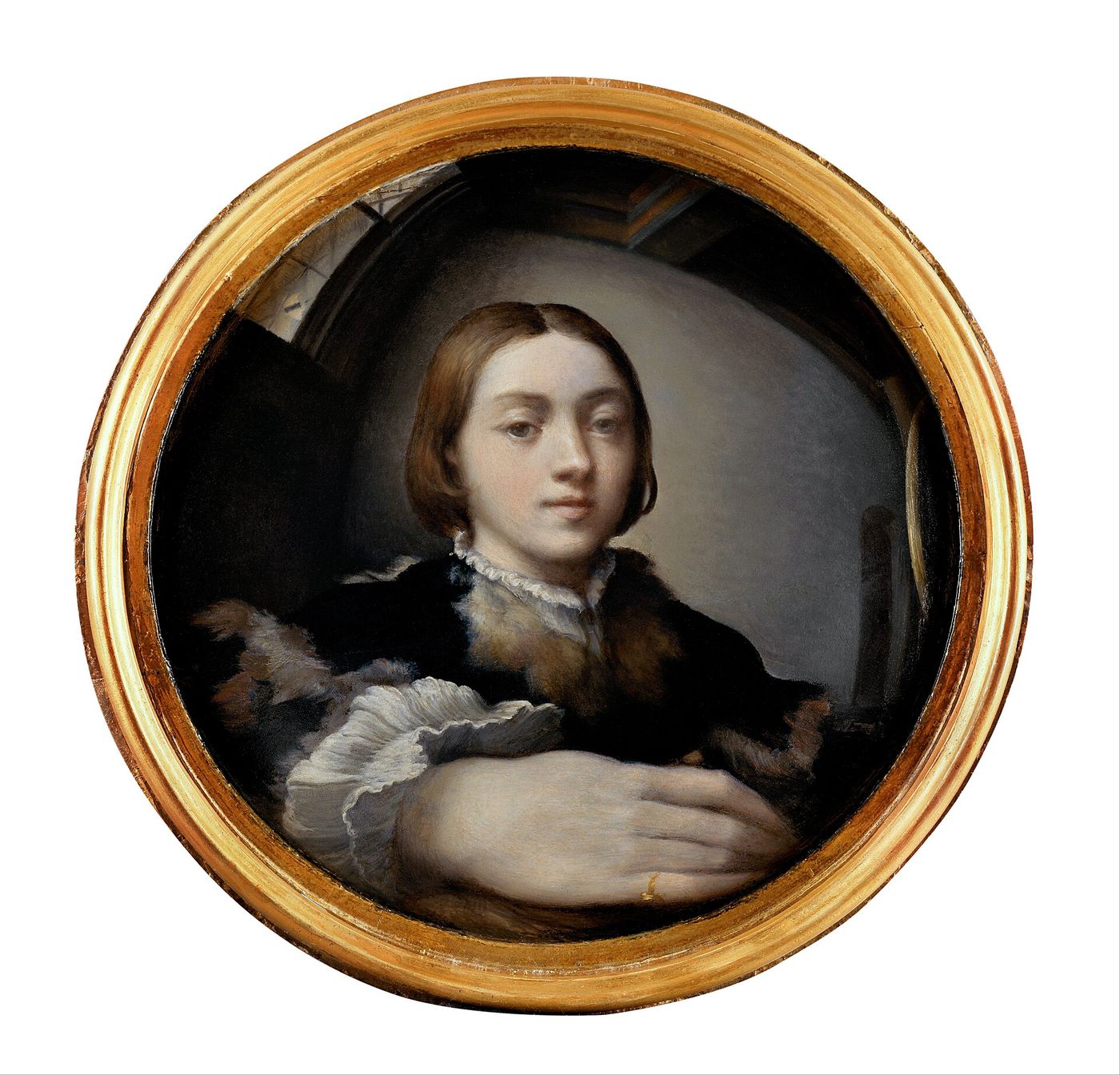

In this painting the mirror promises a wholeness and at the same moment spoils it. The face, at the centre of the sphere, is calm, regular, almost angelic; but the hand, the thing nearest the viewer, is extraordinarily enlarged, deformed, as if cut off from the rest of the body. At the centre of the mirror there is an ideal, at its edges a fragmentation. Parmigianino’s picture shows on the same surface the two faces of the mirror stage, the flawless wholeness of the face and the reality of the body breaking up at the edges.
The most famous mirror in the history of painting is in Velázquez’s Las Meninas of 1656. Before the canvas, the painter himself, brush in hand, looking at us; in the middle, the little princess Margarita surrounded by her maids of honour; on the back wall, in a small, blurred mirror, the image of the king and queen. We who stand before the picture are standing at the place the mirror reflects us: in the place of the king and queen. Michel Foucault begins The Order of Things, published in 1966, with a long analysis of this painting, arguing that the picture shows that the subject it represents, the looking subject, cannot represent itself.19
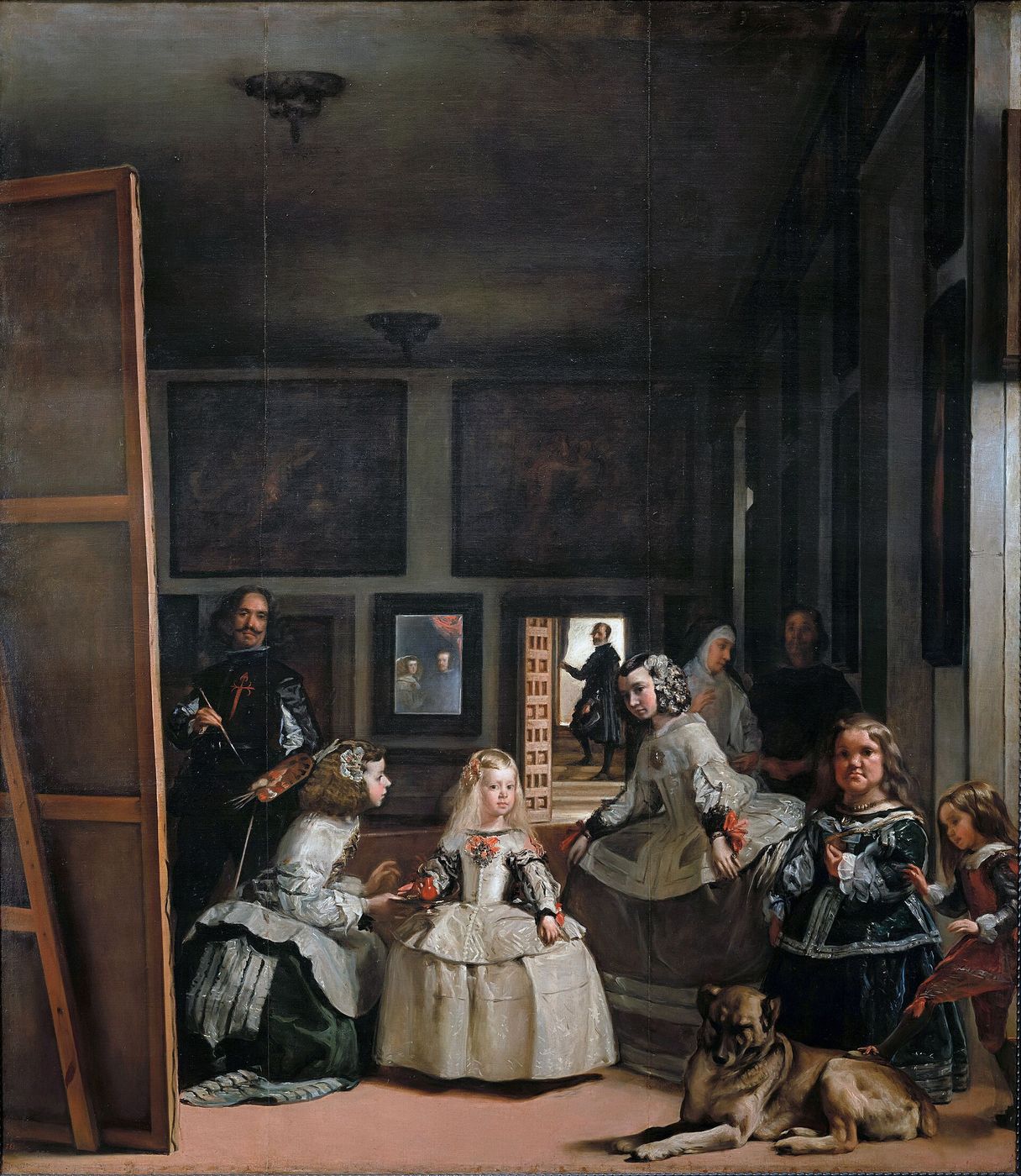

When Lacan took up the painting in his own seminar the same year he read it from a different place than Foucault. Lacan’s interest lay less in the mirror itself than in where the gaze stands. The picture puts us in the king’s place, but does not show us ourselves; a blurred couple appears in the mirror, and standing in their place we cannot see ourselves anywhere. The looker has a place inside the picture as an emptiness. The concept of the gaze Lacan developed in 1964 is the name of this emptiness: the point in the field of vision that sees us but that we can never see. When we look at ourselves in the mirror we see our own eye with our eye; but the other place that determines our gaze, how we look, we can never see.
X
Seventy-five years after Lacan’s text, mirrors have gone into our pockets. The front cameras of telephones make it possible to see our own face dozens of times a day, to photograph it, to send it to others. When the Oxford Dictionaries chose “selfie” as word of the year in 2013, it was already clear that the experience had become mass. The reason for rereading the mirror stage in this age is plain. The scene Lacan described, the infant looking in the mirror and turning to the adult who carries him, has become a daily routine: we look at ourselves, take a photograph, put it on a screen and wait for others’ approval, liking, comment. The adult’s gaze saying “Yes, that’s you” has been replaced by the sum of countless unknown gazes.
A small but instructive detail of this experience is that many people dislike their own photographs. In an experiment in 1977 psychologists showed that participants preferred the mirror image of their own faces, the reversed face they see every day in the mirror, to their real faces; while their close friends preferred, on the contrary, their real faces.20 A person takes as himself not the face others see but the face the mirror shows him. A photograph gives the small shock of looking at oneself with another’s eyes.
This age has another peculiarity. Lacan’s mirror, however deceptive, reflected the body itself. Today’s digital mirrors do not merely reflect the image, they correct it: filters smooth the skin, slim the face, enlarge the eyes. The orthopaedic wholeness Lacan attributed to the mirror image is now a technically produced wholeness. In 2018 cosmetic surgeons began to report that patients were bringing in, in ever greater numbers, not photographs of celebrities but their own filtered photographs, saying they wanted to look like that face.21 The infant saw in the mirror a wholeness he did not yet possess; the adult today sees on the screen a face he could never have and wants to look like it. The gap between image and body, the alienation the mirror stage set up, takes a new form here.
The mirror stage began as a developmental stage; Lacan soon turned it into a structure that lasts through the subject’s life. The meeting with the image in the mirror is not an event that happens once; it is played again every morning when we look in the mirror, in every photograph, in every gaze. The work of analysis is not to break this image or to put a truer image in its place. Analysis makes room for the subject to realise his captivity to his own image, that the image came from another, and that he is more than the image can carry. As Rimbaud said in the letters he wrote at sixteen, in May 1871, to his former teacher Georges Izambard and to his poet friend Paul Demeny: I is another. The verb is conjugated in the third person singular. This grammatical error carries the whole lesson of psychoanalysis.
Notes
- E. Roudinesco, Jacques Lacan: Esquisse d’une vie, histoire d’un système de pensée, Paris: Fayard, 1993; English: Jacques Lacan, trans. B. Bray (1997). In the proceedings of the congress Lacan’s talk is recorded only under its English title, “The Looking-glass Phase”; the text of 1936 itself is lost. Thirty years later, in the introductory piece to the Écrits, “De nos antécédents”, Lacan briefly recalls the interruption. ↩︎
- J. Lacan, “Le stade du miroir comme formateur de la fonction du Je telle qu’elle nous est révélée dans l’expérience psychanalytique” (1949), Écrits, Paris: Seuil, 1966; English in Écrits, trans. B. Fink (2006). The text takes up only seven pages in the roughly eight hundred of the Écrits. ↩︎
- C. Darwin, “A Biographical Sketch of an Infant”, Mind 2/7 (1877). Darwin had kept the notes since the birth of his son William Erasmus Darwin, in 1839, but decided to publish them only thirty-seven years later, after reading a paper by Hippolyte Taine on the acquisition of language in infancy. ↩︎
- H. Wallon, “Comment se développe chez l’enfant la notion du corps propre”, Journal de psychologie (1931); Les Origines du caractère chez l’enfant, Paris: Boivin, 1934. It was Wallon, editor of the volume, who commissioned from Lacan the long entry “Les complexes familiaux”, which Lacan wrote in 1938 for the eighth volume of the Encyclopédie française. ↩︎
- P. Abély, “Le signe du miroir dans les psychoses et plus spécialement dans la démence précoce”, Annales médico-psychologiques 88 (1930). In these years Lacan was continuing his psychiatric training at the Sainte-Anne Hospital and at the special infirmary of the Paris police prefecture; in 1932 he defended his doctoral thesis on paranoia. ↩︎
- G. G. Gallup, “Chimpanzees: Self-Recognition”, Science 167 (1970). In the same years Beulah Amsterdam applied this “mark test” to small children and showed that most children notice a mark on their face in the mirror and touch their own face only between eighteen months and two years: B. Amsterdam, “Mirror self-image reactions before age two”, Developmental Psychobiology 5 (1972). ↩︎
- L. Bolk, Das Problem der Menschwerdung, Jena: Fischer, 1926. Lacan invokes Bolk’s theory of foetalisation openly in texts of the 1940s, beginning with the entry “Les complexes familiaux” of 1938; the human being’s “specific prematuration of birth”, prématuration spécifique de la naissance, is the biological basis of the theory of the mirror stage. ↩︎
- The studies Lacan cites are L. Harrison Matthews’s experiments of 1939 on pigeons and R. Chauvin’s observations published in 1941 on the desert locust. Lacan uses these examples to show that an image can have a formative effect on the shaping of an organism, a “morphogenic” effect in the language of Gestalt theory. ↩︎
- J. Lacan, “L’agressivité en psychanalyse” (1948), Écrits, Paris: Seuil, 1966. The address was given in May 1948 at the eleventh congress of French-speaking psychoanalysts, held in Brussels. ↩︎
- Augustine, Confessiones, I, 7, 11. Lacan evokes this scene both in the entry on family complexes of 1938 and in the address on aggressivity of 1948; the infant’s jealousy is tied not to an object taken from him but to seeing his own image in the other. ↩︎
- S. Freud, Civilization and Its Discontents (1930), SE XXI (German: Das Unbehagen in der Kultur, Gesammelte Werke XIV). Freud first used the expression “narcissism of minor differences” in the paper on the taboo of virginity published in 1918, and in 1930 extended it to explain the hostility felt between neighbouring and kindred communities. ↩︎
- H. Hartmann, Ich-Psychologie und Anpassungsproblem (1939); English: Ego Psychology and the Problem of Adaptation (1958). That Loewenstein, Lacan’s own training analyst, was among the founders of this current suggests that there was also a personal side to Lacan’s critique of ego psychology. ↩︎
- J. Lacan, “La chose freudienne” (1955), Écrits, Paris: Seuil, 1966. Freud’s sentence is at the end of lecture 31 of the New Introductory Lectures on Psycho-Analysis (1933). In Lacan’s reading the sentence describes not the ego’s conquest of the unconscious but the subject’s coming into being, in the place of his own unconscious, as the subject of his own speech. ↩︎
- J. Lacan, Le Séminaire, Livre I: Les écrits techniques de Freud (1953–1954), Paris: Seuil, 1975; English: Freud’s Papers on Technique, trans. J. Forrester (1988). Lacan says he took the experiment from H. Bouasse’s book Optique et photométrie dites géométriques. The diagram was developed in 1960, in the comment Lacan wrote on a report by Daniel Lagache, by adding a plane mirror. ↩︎
- J. Lacan, “Remarque sur le rapport de Daniel Lagache” (1960), Écrits, Paris: Seuil, 1966. Lacan interprets the infant’s turning, before the mirror, to the one carrying him as an appeal to a witness, as the sign of a symbolic point, the Big Other, that confirms the imaginary identification. ↩︎
- E. Mach, Beiträge zur Analyse der Empfindungen (1886). Freud relates this anecdote, together with a similar experience of his own, mistaking his reflection in the door mirror of a sleeping-car for a strange old man, in a footnote to his paper “The Uncanny” (1919). ↩︎
- D. W. Winnicott, “Mirror-role of Mother and Family in Child Development” (1967); Playing and Reality, London: Tavistock, 1971. Winnicott opens his paper by acknowledging that Lacan’s text “Le stade du miroir” had undoubtedly influenced him. ↩︎
- G. Vasari, Le Vite de’ più eccellenti pittori, scultori e architettori (1550; enlarged edition 1568), life of Parmigianino. According to Vasari Parmigianino took the picture to Rome as a gift for Pope Clement VII, and it later passed to Pietro Aretino. The long poem “Self-Portrait in a Convex Mirror” by the American poet John Ashbery, published in 1975 and awarded the Pulitzer Prize the next year, was written on this painting. ↩︎
- M. Foucault, Les Mots et les choses, Paris: Gallimard, 1966, chapter one, “Las Meninas”; English: The Order of Things (1970). In the spring of the same year Lacan examines the painting at length from the standpoint of his theory of the gaze in the lessons of May and June 1966 of his thirteenth seminar, L’objet de la psychanalyse; it is reported that Foucault was among the audience at one of these lessons. ↩︎
- T. H. Mita, M. Dermer and J. Knight, “Reversed facial images and the mere-exposure hypothesis”, Journal of Personality and Social Psychology 35/8 (1977). The authors explain the result by the “mere-exposure effect”, the fact that people like best the image they meet most often. ↩︎
- S. Rajanala, M. B. C. Maymone and N. A. Vashi, “Selfies—Living in the Era of Filtered Photographs”, JAMA Facial Plastic Surgery 20/6 (2018). The authors use the expression “Snapchat dysmorphia” to describe this tendency observed in patients who want to look like their own corrected image. ↩︎
References
- Amsterdam, B. (1972). Mirror self-image reactions before age two. Developmental Psychobiology, 5.
- Bolk, L. (1926). Das Problem der Menschwerdung. Fischer.
- Darwin, C. (1877). A biographical sketch of an infant. Mind, 2(7).
- Foucault, M. (1966). Les Mots et les choses. Gallimard.
- Freud, S. (1919). The uncanny. SE XVII.
- Freud, S. (1930). Civilization and its discontents. SE XXI.
- Gallup, G. G. (1970). Chimpanzees: Self-recognition. Science, 167.
- Lacan, J. (1966). Le stade du miroir comme formateur de la fonction du Je (1949). In Écrits. Seuil.
- Lacan, J. (1966). L’agressivité en psychanalyse (1948). In Écrits. Seuil.
- Lacan, J. (1966). Remarque sur le rapport de Daniel Lagache (1960). In Écrits. Seuil.
- Lacan, J. (1975). Le Séminaire, Livre I: Les écrits techniques de Freud (1953–1954). Seuil.
- Lacan, J. (2001). Les complexes familiaux dans la formation de l’individu (1938). In Autres écrits. Seuil.
- Mach, E. (1886). Beiträge zur Analyse der Empfindungen. Fischer.
- Rajanala, S., Maymone, M. B. C., & Vashi, N. A. (2018). Selfies—Living in the era of filtered photographs. JAMA Facial Plastic Surgery, 20(6).
- Roudinesco, E. (1993). Jacques Lacan: Esquisse d’une vie, histoire d’un système de pensée. Fayard.
- Vasari, G. (1568). Le Vite de’ più eccellenti pittori, scultori e architettori. Giunti.
- Wallon, H. (1934). Les Origines du caractère chez l’enfant. Boivin.
- Winnicott, D. W. (1971). Mirror-role of mother and family in child development (1967). In Playing and reality. Tavistock.