This essay first appeared in Turkish. The English version is my own.
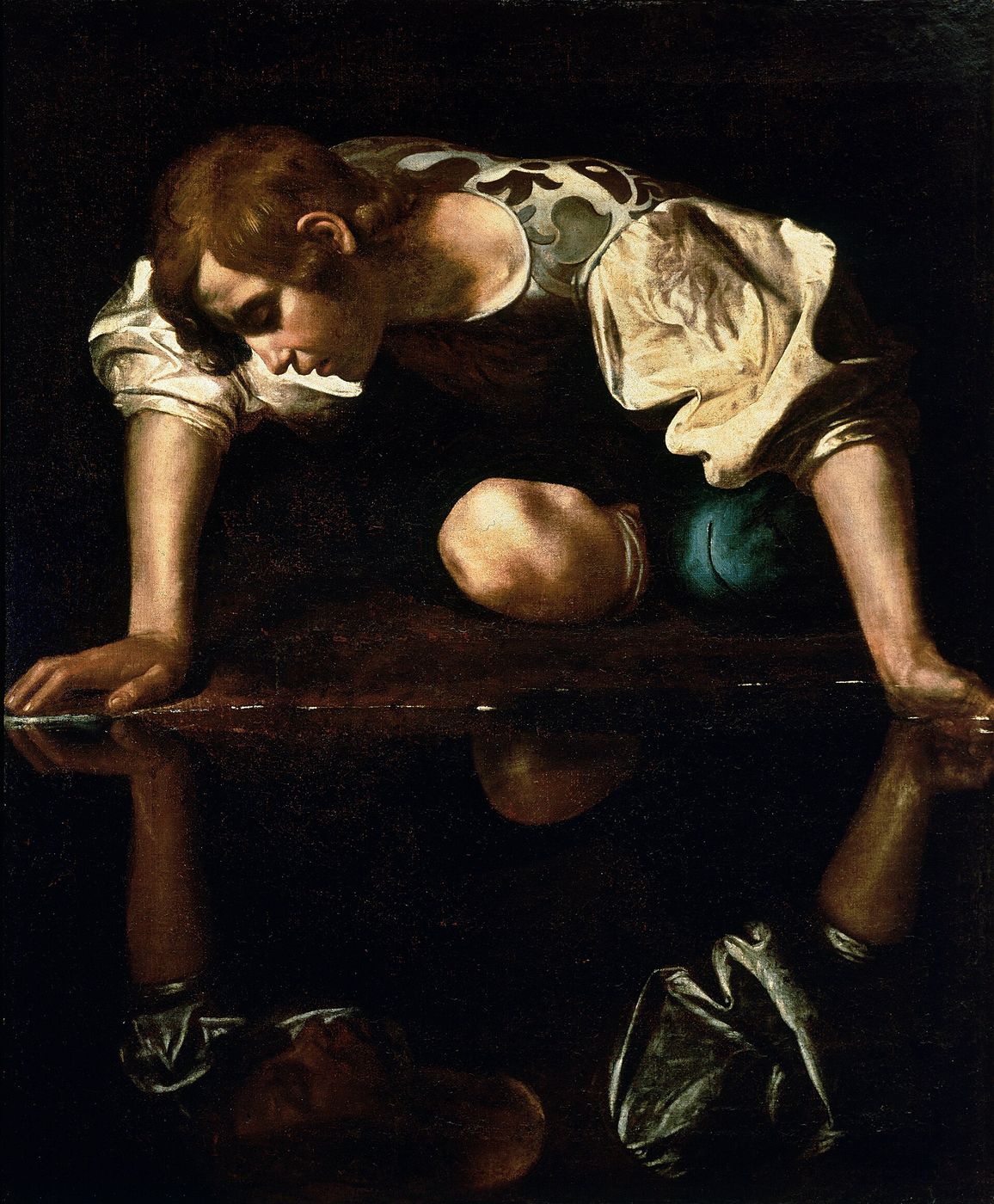

Iste ego sum: sensi, nec me mea fallit imago.
Ovid, Metamorphoses III, 463
His Majesty the Baby.
Sigmund Freud, “Zur Einführung des Narzißmus” (1914)
I
In the third book of the Metamorphoses, Ovid opens the story of Narcissus, surprisingly, with a prophecy. The first to consult Tiresias, blinded by Juno and given in compensation by Jupiter the power to see the future, is the water nymph Liriope. She asks whether her son Narcissus will live a long life, and the seer’s answer reverses one of the oldest commands of Western thought: si se non noverit, “if he does not come to know himself”.1 Gnōthi seauton, “know thyself”, inscribed at the entrance of the temple at Delphi, is the founding call of philosophy. Ovid’s seer says the opposite: this child will live only so long as he does not know himself. Before it is a story of self-love, as is usually thought, the myth is a story of a fatal recognition.
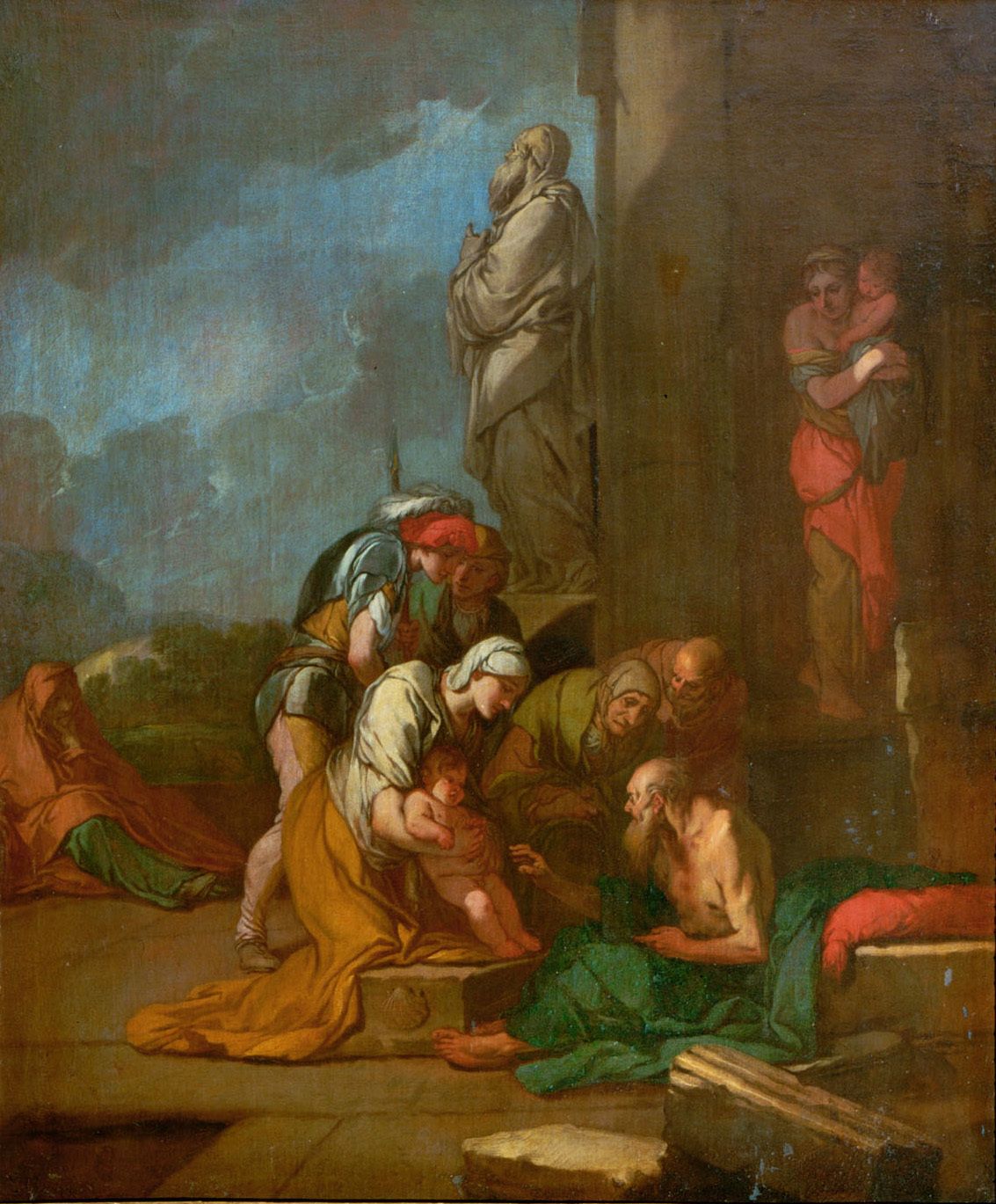

The story’s second protagonist is Echo, and her curse too is a curse of language. Juno had punished Echo, who used to detain her with long conversations so as to cover Jupiter’s meetings with the nymphs, by depriving her of the power to speak her own words: Echo can now only give back the last words of what she hears. When Narcissus, having lost his companions in the forest, calls out “Is anyone here?”, the only answer Echo can give is the last word of the question; and when he says “Let us meet here”, Echo joyfully repeats the same word, with all the double meaning the Latin verb coeamus carries.2 Narcissus rejects her. Echo withdraws into caves, her body wastes away, her bones turn to stone, and only her voice remains.
Then comes the famous scene. Sixteen-year-old Narcissus, bending over a clear spring to quench his thirst, sees a face in the water and falls in love with it. In Ovid’s telling, for a long time Narcissus does not know the face is his own; he tries to embrace it, speaks to it, sees its lips move but hears no voice. Then, at the turning point of the myth, he grasps the truth: Iste ego sum: sensi, nec me mea fallit imago; that one is me, I have understood, my image no longer deceives me. But the recognition does not save him. Three lines later he utters one of the sharpest paradoxes of desire in Western literature: quod cupio mecum est: inopem me copia fecit; what I desire is with me, my plenty has made me poor.3 Narcissus wastes away at the water’s edge, and in his place is found a flower with a yellow centre and white petals.
Another version of the myth circulating in the ancient world throws a very different light on this scene of recognition. Pausanias, the geographer who travelled through Greece in the second century and wrote down what he saw, describing the spring of Narcissus in Boeotia, says he does not find it credible that anyone could be foolish enough not to tell his reflection from himself, and reports a less familiar version. Narcissus had a twin sister who looked exactly like him; the two wore the same clothes and went hunting together. Narcissus was in love with his sister. When she died young, he began to go to the spring and gaze at his reflection; he knew it was his own face he saw there, but he consoled himself by seeing in it the face of his sister.4 In this version, Narcissus’s reflection is not an image of self-love but of mourning: the face of a lost beloved is sought in one’s own. Nor does Ovid’s own story end with Narcissus’s death. Even when he has gone down to the underworld, Narcissus goes on gazing at his reflection in the waters of the Styx.5 Not even death breaks the gaze. Captivity to the image outlives life itself. Psychoanalysis knows the link between these two versions very well. As Freud would later see, the loss of a loved object is sometimes met by the subject’s setting up an image of that object within his own ego.
Read together, the two halves of the myth give an almost complete dramaturgy of what psychoanalysis would conceptualise in the twentieth century. On one side, a subject deprived of his own image in the very measure that he possesses it, unable to part from the image the moment he recognises it; on the other, a subject with no speech of her own, able to exist only as the echo of another’s words. Narcissus carries the poverty of the image, Echo the poverty of speech. One can see nothing but his own face, the other can say nothing but someone else’s words; and both waste away in the same forest without ever reaching each other. Almost all of today’s “narcissist” stories are told from Echo’s place; and at the end of this essay I will return to why that place matters so much.
II
The mythological figure became a clinical concept at the end of the nineteenth century. In 1898 the English sexologist Havelock Ellis described the tendency to take oneself as a sexual object as a “Narcissus-like” tendency; the following year the German psychiatrist Paul Näcke, summarising Ellis’s observation, used the term Narcismus as the name of a sexual perversion.6 Freud first used the concept in 1910, in a footnote added to the Three Essays on the Theory of Sexuality and in his study of Leonardo da Vinci, to explain a particular form of object choice; in the Schreber study of 1911 he placed narcissism as a stage of development between auto-erotism and object love.
The Leonardo study is the most interesting example of this first use. Starting from the little he knew of Leonardo da Vinci’s childhood, and in particular from the assumption that the painter spent his first years away from his father, alone with his mother, Freud interprets Leonardo’s love for young men as a narcissistic object choice: Leonardo loves boys as his mother once loved him; in them he loves his own image as the child he was.7 The framework of this interpretation, which treats homosexuality as a “deviation”, is rightly criticised today. But it hides an intuition that would nourish every later theory of narcissism: a person sometimes loves another because in that other they see themselves, the self they are, or once were, or would like to be. Narcissism appears here within a form of love, as the very place towards which love is directed.
The real transformation of the concept came in 1914, with Freud’s paper On Narcissism: An Introduction. Here Freud stops treating narcissism as a perversion and redefines it as the libidinal complement to the egoism of the instinct of self-preservation, that is, as a universal dimension of human development. The best-remembered image of the paper is the amoeba Freud uses to describe the relation between libido directed at the ego and libido directed at objects: like the pseudopodia an amoeba puts out from its body and draws back again, libido goes out towards objects and, when necessary, returns to the ego. Freud calls the investment in the self of the infant’s earliest period primary narcissism; libido withdrawn from objects and returned to the ego in the face of life’s disappointments forms secondary narcissism.8
The lines Freud writes about primary narcissism are among the most ironic and accurate ever written about parenthood. Parents’ attitude to their children, he says, is an overvaluation that is nothing but the revival of their own narcissism, long since abandoned: the child shall not be subject to illness, death or the renunciation of pleasure; the laws of nature and of society shall be suspended in its favour. Freud sums up the picture in three words he set into his German text in English: His Majesty the Baby. Another lasting contribution of the paper is the ego ideal. For Freud, what a person sets up before himself as an ideal is a substitute for the lost narcissism of his childhood; the adult now seeks, in a goal ahead of him, the perfection that he himself once was.
The same paper says something about the economy of love. The person in love transfers part of the libidinal investment of the ego to the beloved, exalting the beloved by impoverishing himself. This is why unrequited love wounds so deeply: what is lost is not only a person but the part of the self entrusted to them. Freud also distinguishes two types of object choice: one loves either on the model of the figures who fed and protected one, or one loves one’s own image, what one is, was or would like to be, someone who was once part of oneself. A passage that is disturbing to read today appears at exactly this point: Freud speaks of the fascination that certain apparently self-sufficient women, children, cats and large beasts of prey, even great criminals and humorists in literature, exert on others. The sexist bias of the passage is obvious and must be criticised. But it contains an observation that, I think, also illuminates today’s debate: those who have had to give up part of their narcissism feel both admiration and envy towards those who seem to have kept it whole. The mixed fascination with the everyday figure of the “narcissist” bears the traces of this old economy.
Freud’s close friend, the philosopher and psychoanalyst Lou Andreas-Salomé, argued in a paper published in 1921 that narcissism is not only a turning towards oneself but also an opening to the world. For her, narcissism runs in two directions: on one side the ego’s love of itself, on the other a remnant of the first feeling of unity the ego had, in infancy, with a whole world it could not yet distinguish from itself.9 The creativity of the artist, the lover’s feeling of loving the world as a whole, the sense of boundlessness before nature, carry the traces of that first unity. Andreas-Salomé’s idea reminds us that narcissism can be not only a pathology but also a source of creativity and love. Someone in whom narcissism had entirely disappeared might also have lost the strength to make something of himself, to give himself to a work, a love, a world.
III
Lacan takes this thought to a far more radical point. According to his text on the mirror stage, first presented at the international psychoanalytic congress at Marienbad in 1936 and rewritten in Zurich in 1949, the infant between six and eighteen months, still unable to coordinate its body and living in a fragmented experience, meets its own unified image in the mirror and joyfully assumes it. In this assumption the ego is constituted outside, in an image. In Lacan’s words, this identification is the armour of an alienating identity that will mark the subject’s entire mental development.10 Seen this way, narcissism is not first a personality trait some people have; it is the very structure of the ego. From the beginning, the ego is founded on love for a reflection.
A year earlier, in 1948, in his Brussels lecture Aggressiveness in Psychoanalysis, Lacan had shown another face of this structure. Narcissistic identification and aggressiveness are counterparts: the semblable standing in the place I want to occupy is the one I both admire and hate. Lacan finds the most striking examples of this relation in the behaviour of small children, and recalls the phenomenon developmental psychology calls transitivism: the child who hits a friend says he was hit; the child who sees another fall cries.11 In the imaginary order, the boundary between ego and other is far more permeable than we think.
This observation carries an unexpected warning for today’s “narcissist” debates. Calling the other a narcissist within a relationship is often a move made in the very middle of the imaginary order: in the other we see someone who threatens our own image, who diminishes us, who stands where we would like to be. It is no accident that break-ups in which both parties accuse each other with the same word are so common. As Lacan says in his second seminar, the ego is not the subject but an object; and the meeting of two egos can turn into an endless play of reflections, like two mirrors set facing each other.12 This is also the source of Lacan’s harsh criticism of an American ego psychology that aimed to strengthen the ego: strengthening the ego can mean reinforcing the subject’s captivity to his own image.
IV
In the 1970s two major theories of narcissism argued with each other in American psychoanalysis, and their debate directly shaped today’s psychiatric diagnostic systems. In The Analysis of the Self (1971), Heinz Kohut treats narcissism as a developmental need. The child needs an environment that mirrors it, delights in its existence and offers a figure it can idealise; Kohut calls these figures selfobjects. When these needs are not met, a fragile self forms, and the person remains dependent all their life on the approval of others. Kohut’s paper of 1972, in which he developed the concept of narcissistic rage, shows how this fragility can turn into destructive rage at the smallest injury.13
Kohut’s clinical contribution lay in describing the transferences these people form in analysis. He distinguishes two main forms. In the mirror transference, the analysand expects the analyst to reflect, confirm and delight in them; in the idealising transference, the analysand sees the analyst as a flawless, powerful, admirable figure, and holds themselves together by sharing in the analyst’s greatness.14 For Kohut, the analyst should not interpret and dismantle these transferences at once, but carry them for a while and, through the inevitable small disappointments, help the analysand slowly build a self of their own. The Lacanian tradition looks at this approach critically: an analyst functioning as a mirror may bind the analysand even more tightly to their own image. But the two traditions meet at one point: an analyst working with narcissistic fragility should neither demolish in haste nor consent to endless mirroring.
Otto Kernberg, in a book published in 1975, paints a very different picture. For Kernberg, pathological narcissism is a defence built against intense envy and rage. The person constructs a grandiose self-image that needs no one, uses others to feed this image, and devalues them the moment they are needed. If Kohut’s narcissist is a wounded child, Kernberg’s is like a fortress that lets no one see the wound.15 The influence of the two theories is clearly visible in the entry of narcissistic personality disorder into the American psychiatric diagnostic manual, DSM-III, for the first time in 1980. Kernberg’s treatment proposals also differ clearly from Kohut’s. For him, the analyst should name and interpret openly, within the transference, here and now, the analysand’s grandiose self-image and the envy beneath it; carrying the grandiose image for a long time can mean reinforcing it. In the following decades Kernberg and his colleagues turned this approach into a structured, research-tested method they called transference-focused psychotherapy.16 The debate between Kohut and Kernberg was therefore not only theoretical but clinical: does a wounded child first need a mirroring face, or must a door first be opened in a self-protecting fortress?
Current research suggests that these two pictures are less two mutually exclusive theories than two faces of the same structure. Aaron Pincus and Mark Lukowitsky’s comprehensive review of 2010 distinguishes two basic presentations of narcissism, grandiose and vulnerable, and notes that the pathological narcissism clinicians observe is far more widespread than strict diagnostic criteria capture.17 Grandiose narcissism appears as a confident, showy and contemptuous picture; vulnerable narcissism as shame, hypersensitivity, an inability to bear criticism and withdrawal. What many of those who worry today “Am I a narcissist too?” experience is precisely the silent ache of this second presentation. Since Christopher Lasch’s 1979 book named a whole culture “the culture of narcissism”, the concept’s overflow from the clinic into a diagnosis of the age has fed on the same ambiguity.18
This diagnosis of the age flared up again over the last twenty years. In The Narcissism Epidemic, published in 2009, the psychologists Jean Twenge and W. Keith Campbell argued that American university students’ scores on narcissism scales had risen over the decades, and linked the rise to social media, celebrity culture and the rhetoric of “loving yourself”.19 The claim was sharply disputed in later work; some studies using different data sets found no clear increase. But the debate itself says something: narcissism has become less a personality trait of an individual than a word carrying an era’s anxiety about itself. In a culture where screens offer a permanent mirror and every post awaits approval, Narcissus’s spring is everywhere; and everyone is, to some extent, afraid of being someone bent over their own reflection.
V
The everyday “narcissist” carries a very small part of this long history and covers a much wider field: ordinary selfishness, emotional coldness, indifference, lying, manipulation, open abuse, and sometimes simply a painful break-up. This breadth has both a value and a cost, and both must be taken seriously.
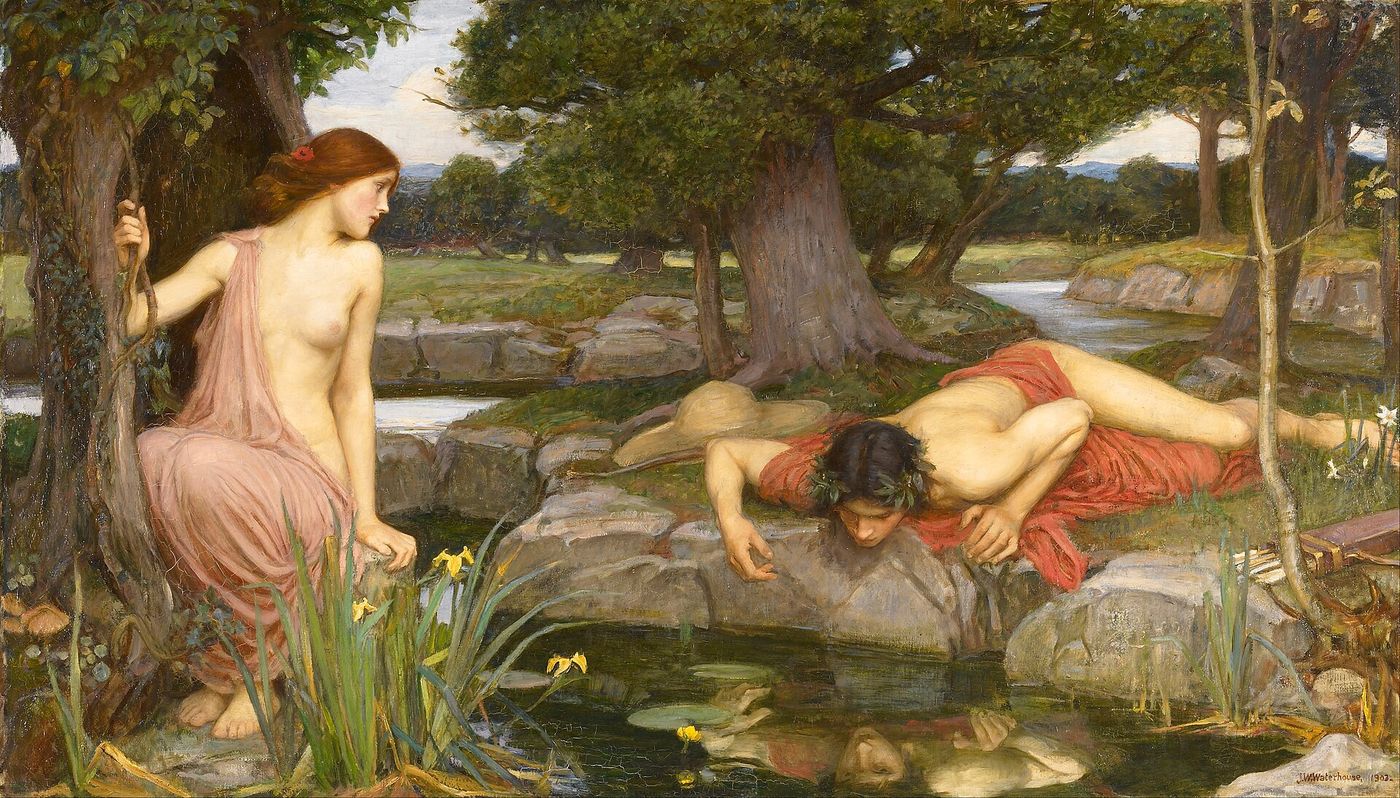

Its value is this: the label gives a name to an experience that has long gone unnamed. For someone who has begun, within a relationship, to doubt their own perception, and has not found the word to say what they are living through, the name can be a point of support. In the language of the myth, the label gives Echo a voice. From a psychoanalytic point of view this is not to be belittled; for Echo’s real tragedy is not that Narcissus rejects her, but that before that she was deprived of her own speech. Being able to tell one’s experience in one’s own words is the first condition of recovery.
Its cost lies in the structure of the story the label builds. In this story the other becomes a monster and the teller only a victim; and perhaps the most important question of the story is closed without being asked. Ovid’s text asks that question, unexpectedly, from Echo’s side: Echo was set alight the moment she first saw Narcissus in the forest, before he rejected her. Her love comes before her rejection; and her speech exists, from the very beginning, as the echo of his. Where the same form of relationship appears again and again in a life, the issue is no longer only the other person. Why Echo falls in love with Narcissus, that is, why someone is drawn to relationships in which they can hear their own voice only as the echo of another’s, is a question worth asking. Asking it does not mean placing the responsibility for the pain on the person; it means opening a place for them in their own story.
Here one must be clear. Leaving a relationship that involves abuse, manipulation, control or violence is always legitimate, and it does not require diagnosing the other person. You do not need to diagnose someone in order to leave them; a diagnosis is, at best, a belated explanation that helps one understand what went on in the relationship. Narcissistic personality disorder is a diagnosis that requires detailed clinical assessment and is found at fairly low rates in population studies; to make it from a distance, in the pain of a relationship, does justice neither to the diagnosis nor to the pain.
VI
Freud thought that narcissistic structures were closed to analytic work. In his Introductory Lectures on Psycho-Analysis of 1916–1917 he says that someone who has withdrawn their libido entirely from objects cannot form a transference to the analyst and therefore remains unaffected; among these “narcissistic neuroses” he counts the psychoses and melancholia.20 The idea linking melancholia to narcissism Freud had developed in the same years, in the paper comparing mourning and melancholia. In mourning, the world becomes poor and empty; in melancholia, the ego itself. The melancholic accuses, devalues and punishes himself mercilessly; but Freud notices that, listened to carefully, these accusations are really directed at another person, lost, loved and at the same time resented. The lost object has not been let go; it has been taken into the ego, and the ego has identified with it. In Freud’s unforgettable phrase, the shadow of the object has fallen upon the ego.21 Pausanias’s Narcissus, the young man seeking his dead sister in the face in the water, is like the mythical counterpart of this sentence. Later generations largely overcame Freud’s pessimism. Today narcissistic fragility is among the most frequent material of the psychoanalytic clinic.
In analytic work, narcissism often appears as an inability to bear not knowing. An interpretation is heard as a wounding criticism, a silence is lived as indifference, everything the analyst says can be felt as an attack on the subject’s image. These reactions are less an obstacle than the work itself; for the subject’s relation to their own image becomes, for the first time, something that can be spoken about in someone else’s presence. From a Lacanian point of view, the analyst’s task is not to offer the analysand a better mirror. It is to allow the analysand’s speech to go beyond the limits the image draws, so that the question “How do I look?” can slowly give way to the question “What do I want?”
I began this essay with Tiresias’s prophecy: Narcissus will live so long as he does not know himself. The myth says that self-knowledge is fatal; psychoanalysis wagers that another kind of recognition is possible. The recognition that killed Narcissus took place in a mirror: he saw his image, understood that it was himself, and could not part from it. Echo had nothing but another’s words. What psychoanalytic work seeks is a third possibility between these two poverties: a recognition that does not rest on a mirror, and a voice that is not an echo. Pausanias’s Narcissus reminds us where this possibility passes: what is sought in the face in the water is often not ourselves but someone we have lost. When that loss can be mourned, the water becomes simply water again, and one can go on one’s way without bending over it. To be able to recognise one’s own desire in one’s own speech, addressed to someone else.
Notes
- Ovid, Metamorphoses III, 348. Line numbers follow R. J. Tarrant’s Oxford edition (2004). The blinding of Tiresias and his gift of prophecy are told in the lines just before. ↩︎
- Metamorphoses III, 359–392. The shifts of meaning that Echo’s replies create in the Latin text are the main reason the myth can be read as a myth about language. ↩︎
- Metamorphoses III, 463 and 466. ↩︎
- Pausanias, Description of Greece, IX, 31, 7–8. Pausanias adds his own view plainly: that someone old enough to fall in love should be unable to tell a person from his reflection seems to him entirely unreasonable. ↩︎
- Ovid, Metamorphoses III, 504–505: tum quoque se, postquam est inferna sede receptus, / in Stygia spectabat aqua. Immediately after these lines we are told that the water nymphs, his sisters, mourned for him and cut their hair. ↩︎
- H. Ellis, “Auto-erotism: A psychological study”, Alienist and Neurologist 19 (1898); P. Näcke, “Die sexuellen Perversitäten in der Irrenanstalt”, Psychiatrische en Neurologische Bladen 3 (1899). Freud opens his 1914 paper by recalling that the term was chosen by Näcke. ↩︎
- S. Freud, Leonardo da Vinci and a Memory of His Childhood (1910), Gesammelte Werke VIII; SE XI. Some of the biographical assumptions of Freud’s study, especially the interpretations resting on the memory of the vulture, were later sharply criticised as based on a translation error; the bird in Leonardo’s notebook is a kite, not a vulture. ↩︎
- S. Freud, “On Narcissism: An Introduction” (1914), SE XIV. Freud’s works are cited by their titles in the Standard Edition (SE), with volume numbers. ↩︎
- L. Andreas-Salomé, “Narzißmus als Doppelrichtung”, Imago 7 (1921). Known as a close friend of Nietzsche and Rilke, Andreas-Salomé joined Freud’s circle in 1912 and worked as a psychoanalyst in Göttingen. ↩︎
- J. Lacan, “Le stade du miroir comme formateur de la fonction du Je” (1949), Écrits (1966), pp. 93–100. ↩︎
- J. Lacan, “L’agressivité en psychanalyse” (1948), Écrits, pp. 101–124. Lacan discusses transitivism drawing on Charlotte Bühler’s observations. ↩︎
- J. Lacan, Le Séminaire, Livre II: Le moi dans la théorie de Freud et dans la technique de la psychanalyse (1954–1955), Paris: Seuil, 1978; English: The Ego in Freud’s Theory and in the Technique of Psychoanalysis, trans. S. Tomaselli (1988). ↩︎
- H. Kohut, The Analysis of the Self (1971); “Thoughts on narcissism and narcissistic rage”, The Psychoanalytic Study of the Child 27 (1972). ↩︎
- H. Kohut, The Analysis of the Self, New York: International Universities Press, 1971, chapters 2 and 5. Kohut proposes that these transferences should be accepted for a time rather than interpreted away, and gradually transformed through the analyst’s inevitable small failures. ↩︎
- O. Kernberg, Borderline Conditions and Pathological Narcissism (1975). ↩︎
- J. F. Clarkin, F. E. Yeomans and O. F. Kernberg, Psychotherapy for Borderline Personality: Focusing on Object Relations, Washington, DC: American Psychiatric Publishing, 2006. The method was first developed for borderline personality organisation and later adapted to narcissistic personality organisation. ↩︎
- A. L. Pincus and M. R. Lukowitsky, “Pathological narcissism and narcissistic personality disorder”, Annual Review of Clinical Psychology 6 (2010), pp. 421–446. ↩︎
- C. Lasch, The Culture of Narcissism (1979). ↩︎
- J. M. Twenge and W. K. Campbell, The Narcissism Epidemic: Living in the Age of Entitlement, New York: Free Press, 2009. The finding has been disputed in later research; some studies using different data sets have argued that there is no marked generational increase. ↩︎
- S. Freud, Introductory Lectures on Psycho-Analysis (1916–1917), especially lectures 26 and 27, SE XVI. ↩︎
- S. Freud, “Mourning and Melancholia” (1917), Gesammelte Werke X; SE XIV. Freud’s sentence reads: Der Schatten des Objekts fiel so auf das Ich. ↩︎
References
- Andreas-Salomé, L. (1921). Narzißmus als Doppelrichtung. Imago, 7.
- Clarkin, J. F., Yeomans, F. E., & Kernberg, O. F. (2006). Psychotherapy for borderline personality: Focusing on object relations. American Psychiatric Publishing.
- Ellis, H. (1898). Auto-erotism: A psychological study. Alienist and Neurologist, 19.
- Freud, S. (1910). Leonardo da Vinci and a memory of his childhood. SE XI.
- Freud, S. (1914). On narcissism: An introduction. SE XIV.
- Freud, S. (1916–1917). Introductory lectures on psycho-analysis. SE XV–XVI.
- Freud, S. (1917). Mourning and melancholia. SE XIV.
- Kernberg, O. (1975). Borderline conditions and pathological narcissism. Jason Aronson.
- Kohut, H. (1971). The analysis of the self. International Universities Press.
- Kohut, H. (1972). Thoughts on narcissism and narcissistic rage. The Psychoanalytic Study of the Child, 27.
- Lacan, J. (1966). Le stade du miroir comme formateur de la fonction du Je; L’agressivité en psychanalyse. In Écrits. Seuil. [English: Écrits (B. Fink, Trans.). Norton, 2006.]
- Lacan, J. (1978). Le Séminaire, Livre II (1954–1955). Seuil. [English: The ego in Freud’s theory and in the technique of psychoanalysis (S. Tomaselli, Trans.). Norton, 1988.]
- Lasch, C. (1979). The culture of narcissism. W. W. Norton.
- Ovid. Metamorphoses, Book III. R. J. Tarrant (Ed.). Clarendon Press, 2004.
- Pausanias. Description of Greece, Book IX.
- Pincus, A. L., & Lukowitsky, M. R. (2010). Pathological narcissism and narcissistic personality disorder. Annual Review of Clinical Psychology, 6, 421–446.
- Twenge, J. M., & Campbell, W. K. (2009). The narcissism epidemic: Living in the age of entitlement. Free Press.