This essay first appeared in Turkish. The English version is my own. A passage on the bond between mothers and daughters in Turkey has been kept.

I
Problems between mother and daughter are often voiced in two complaints that seem opposed. One is a complaint about closeness: my mother interferes in everything, still treats me like a child, won’t let me live my own life, I lose myself when I’m with her. The other is a complaint about distance: my mother never understood me, never showed me her love, I never got from her what I wanted. What is surprising is that these two complaints are often found together, in the same person, about the same relationship. The daughter who wants to be free of her mother still, at the same time, expects something from her.
Psychoanalysis shows that this contradiction is not a personality problem or a communication disorder, but comes from the structure of the bond between mother and daughter. Understanding this structure requires neither blaming the mother nor blaming the daughter. To understand is to see that both are caught, beyond their own wishes, in something.
II
For a long time Freud built his thinking on female sexuality by taking the boy’s development as the model. But in his 1931 paper “Female Sexuality” he wrote that he had noticed a great gap in his own theory. He saw that before turning to the father, the girl is attached to the mother for a long and intense period, and that this first attachment shapes all her later relationships. Freud described this discovery with an image taken from archaeology: the discovery of this phase came as a surprise, like the discovery, behind the civilisation of Greece, of the Minoan-Mycenaean civilisation.1
Two years later, in his lecture “Femininity”, Freud added that the girl’s turning away from the mother is often not a gentle transition, but full of hostility, reproach and disappointment. The girl blames her mother for not giving her enough milk, not loving her enough, preferring her siblings to her.2 Behind these reproaches Freud saw something deeper: the girl’s expecting from her mother something the mother cannot give. What this “something” is became, after Freud, one of the questions psychoanalysis has debated most.
III
Lacan answered this question in a dense text written in 1972, with a harsh word. He described the relationship between mother and daughter, for most women, as a “ravage” (ravage); the daughter, for Lacan, seems to expect from her mother, as a woman, more substance, more being, than from her father.3 To understand this sentence one must recall something else Lacan said about femininity: there is no signifier that defines woman as a whole, as a universal. A boy can learn what it means to be a man from a model offered by the father, the law, the phallic function; for a girl, the question “what is it to be a woman?” has no such ready answer.4
The daughter first expects the answer to this question from her mother. Her mother is a woman; so she must know the secret of being a woman. But the mother cannot give this secret, because she does not possess it herself; she too expected the same thing from her own mother and did not receive it. What Lacan calls “ravage” is the trace this unmet expectation leaves: the daughter expects from her mother a being, an identity, a substance, and what she receives always falls short. This lack is lived as reproach, as anger, or, on the contrary, as never being able to leave the mother’s side, as trying never to lose her approval.
IV
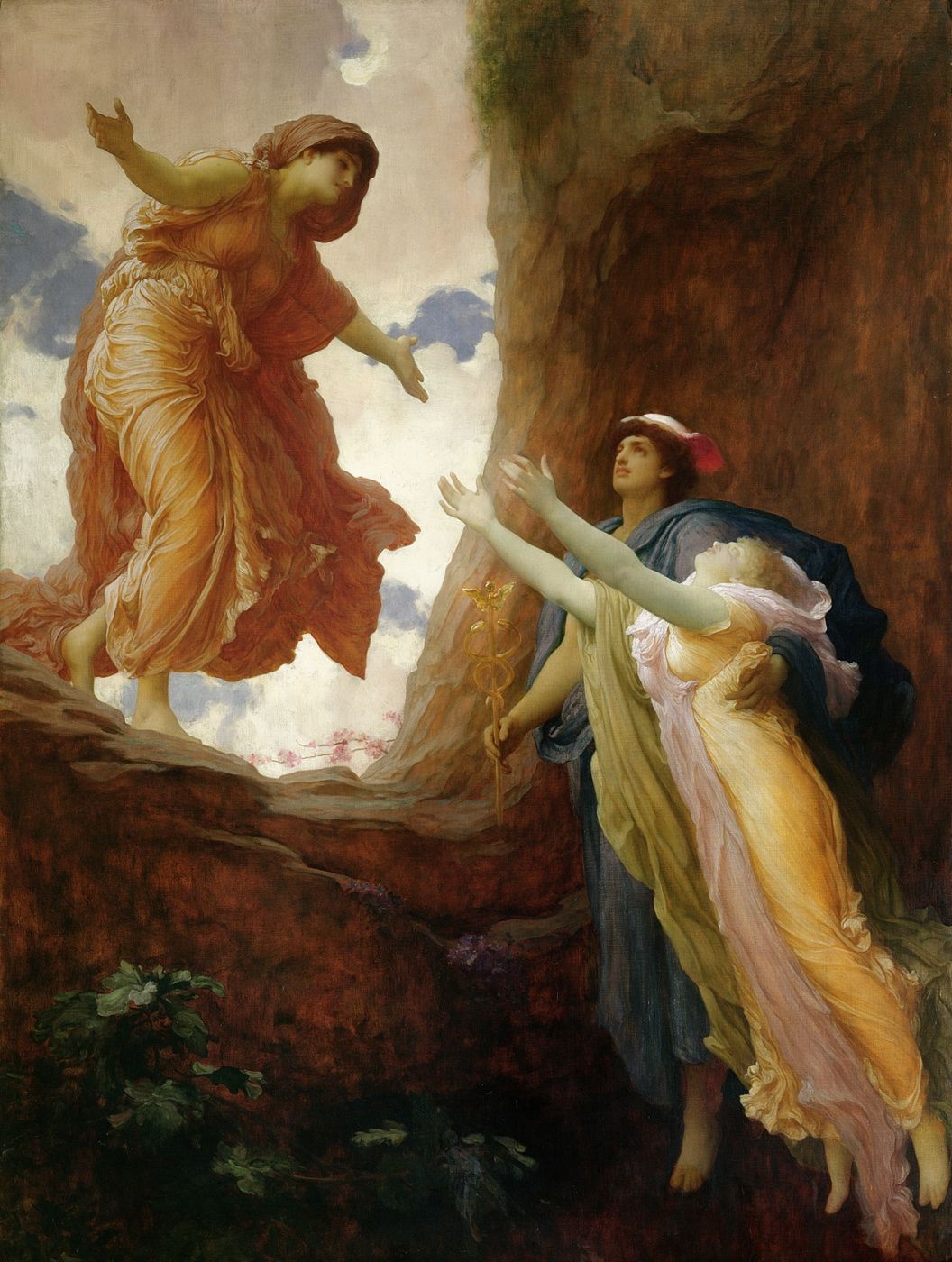
Greek mythology offers one of the oldest and most beautiful accounts of this bond between mother and daughter. Persephone, daughter of Demeter, goddess of the harvest, is abducted one day while gathering flowers by Hades, god of the underworld. Demeter wanders the world searching for her daughter; her grief is so great that the earth dries up, the crops do not grow, and people begin to die of hunger. At last the gods intervene and decide that Persephone shall return to her mother. But in the underworld Persephone has eaten a few pomegranate seeds, and whoever eats the food of the underworld is bound to it. A compromise is found: Persephone will spend part of the year in the underworld, with her husband, and part on the earth, with her mother. When Persephone returns to the earth, spring comes; when she descends to the underworld, winter.5
The myth shows how hard the separation between mother and daughter is, and that it is a loss for both. Demeter’s grief is great enough to wither the world. But the myth says something more: even when she returns to her mother, Persephone is no longer as she was. She has eaten the food of another world, formed another bond, and this bond does not fit entirely with the world her mother offers her. Separation is not breaking entirely with the mother’s world but learning to live between two worlds. The pomegranate seeds are like the symbol of the daughter’s own desire, a desire her mother does not know, does not approve, but which is now part of her.
V
In Turkey, as in many cultures, the bond between mother and daughter is also carried with a particular weight. The mother is often a figure who has lived for her children by giving up her own life, who has used her sacrifice as a language of love. For the daughter this sacrifice is lived as a debt: when her mother gave up so much for her, how can she live a life her mother does not want? Following her own desire seems a betrayal of her mother. And the mother, sometimes without realising it, wants to live in her daughter’s life the life she could not live herself; her daughter’s success, marriage, children become a repair of her own lack.
The weight of this bond changes once more when the daughter becomes a mother. Many women say that when their own child was born, the anger they felt towards their mother gave way to understanding, or, on the contrary, that they were horrified to realise they were doing to their own child something their mother had done to them. The relationship between mother and daughter is thus lived not between two people but between generations, in a chain reaching back to the mother’s mother and to hers. A woman thinking about her relationship with her own mother often realises that her mother too was a daughter, that she too expected something from her own mother and did not receive it.
VI
In the 1950s the English psychoanalyst Donald Winnicott proposed the concept of the “good-enough mother”. The good-enough mother is not the perfect mother; on the contrary, she is the mother who at first answers the child’s needs with an almost complete adaptation, but who, over time, gradually fails, in a way that lets the child grow.6 For Winnicott, the child’s ability to build a world of its own depends on these small failures of the mother. A perfect mother would not let the child desire, feel a lack, learn that it must look for something itself.
This thought says something important about the relationship between mother and daughter. The lack the daughter receives from her mother is as much a possibility as a wound. What the mother could not give opens room for the daughter’s own search, for finding her own femininity, her own desire, in her own way. A daughter separates from her mother by accepting that her mother did not give her everything, and forgiving her for this, but also by no longer expecting everything from her.
This separation is not easy, and it often cannot be done alone. Psychoanalytic work offers a woman a place where she can speak about her mother without feeling she is betraying her, neither idealising nor demonising her. In this speaking something unexpected often happens: the woman begins to hear what it is that she really expected from her mother, and where in her own life, in her relationships, in her loves, this expectation is repeated. Like Persephone, she learns to live between two worlds, her mother’s world and her own. Getting along with one’s mother perhaps begins with no longer expecting everything from her.
Notes
- S. Freud, “Über die weibliche Sexualität” (1931), Internationale Zeitschrift für Psychoanalyse, 17. In the same paper Freud notes that in women the attachment to the father often conceals a continuing attachment to the mother, and that many women repeat with their husbands their relationship with their mother. ↩︎
- S. Freud, Neue Folge der Vorlesungen zur Einführung in die Psychoanalyse (1933), lecture thirty-three, “Die Weiblichkeit”. ↩︎
- J. Lacan, “L’étourdit” (1972), first published in Scilicet, 4, 1973; Autres écrits, Paris: Seuil, 2001: “le ravage qu’est chez la femme, pour la plupart, le rapport à sa mère, d’où elle semble bien attendre comme femme plus de substance que de son père”. ↩︎
- On this thesis and Lacan’s formulas of sexuation, see the essay “The Formulas of Sexuation” on this site. ↩︎
- The oldest and most detailed account of the myth is the Homeric Hymn to Demeter, dated to the seventh or sixth century BC. ↩︎
- D. W. Winnicott, “Transitional objects and transitional phenomena” (1953), International Journal of Psycho-Analysis, 34. The concept was taken up again in Playing and Reality (London: Tavistock, 1971). ↩︎
References
- Homeric Hymn to Demeter (7th–6th century BC).
- Freud, S. (1931). Über die weibliche Sexualität. Internationale Zeitschrift für Psychoanalyse, 17.
- Freud, S. (1933). Neue Folge der Vorlesungen zur Einführung in die Psychoanalyse. Internationaler Psychoanalytischer Verlag.
- Lacan, J. (2001). L’étourdit. In Autres écrits. Seuil.
- Winnicott, D. W. (1953). Transitional objects and transitional phenomena. International Journal of Psycho-Analysis, 34, 89–97.
- Winnicott, D. W. (1971). Playing and reality. Tavistock.