This essay first appeared in Turkish. The English version is my own.

I
Breakups always hurt. But when a breakup is spoken, even in the cruellest way, something happens: an end is set. The sentence “I don’t want to be with you any more” can be devastating; but it is a sentence. It puts a full stop to a story with a beginning, a middle and an end. The one who is left can be angry at this sentence, find it wrong, object to it; but he can put it somewhere.
In ghosting this sentence is missing. The story ends not with a full stop but with a void. And when a person meets a void, he cannot help filling it. Unanswered messages, silence, the message read but not answered, create an expectation of meaning, and while nothing comes from the other side this expectation is filled from within. What did I do? What did I say? Did I misunderstand something? Is there someone else? Did they never care? Each question gives rise to the next, and none reaches an answer.
II
Lacan placed a question at the centre of the human being’s relation to the Other: what does he want from me? In a text written in 1960 he wrote this question in Italian, with a sentence taken from the French writer Jacques Cazotte’s novel of 1772, Le Diable amoureux, The Devil in Love: Che vuoi? What do you want?1 For Lacan human desire is always bound to the desire of the Other: we learn who we are, what we are worth, largely by trying to understand what others want from us. The Other’s desire is therefore an enigma, and this enigma is a source of anxiety.
Ghosting reduces this enigma to its purest, barest form. The other person no longer says anything; their desire has become entirely unreadable. In an ordinary relationship the other’s desire, however uncertain, shows itself in words, behaviour, signs; and we interpret it and answer it. In silence there is nothing left to interpret, and the enigma turns back to the oldest questions within us: am I worth loving? Is everyone who leaves me right to leave? The depth of the wound ghosting opens often comes not from that relationship itself but from these old questions.
III
In “Mourning and Melancholia”, published in 1917, Freud showed that a loss can be lived in two different ways. In mourning, one knows whom one has lost; one suffers, but slowly, going over memories one by one, one withdraws the energy bound to the lost object and opens to new bonds. In melancholia things are different. In one of Freud’s striking observations, the melancholic may know whom he has lost but not what he has lost in them.2 The loss remains unconscious, and anger turns not against the lost person but against the self: the melancholic sees himself as worthless, guilty, unworthy of love.
Ghosting leaves a person somewhere between these two states. You know you have lost the person; but you cannot know what you have lost, or why. Because there is no explanation, the work of mourning cannot begin: without the end of the story being written, it is hard to go over the memories and put them in their place. And the void of explanation is often filled by the reproaches a person addresses to himself. The sentences most often heard after ghosting are the sentences of melancholia: there must be something wrong with me. It always happens like this. No one stays. These sentences are answers to the silence of the one who left, answers a person builds against himself.
IV
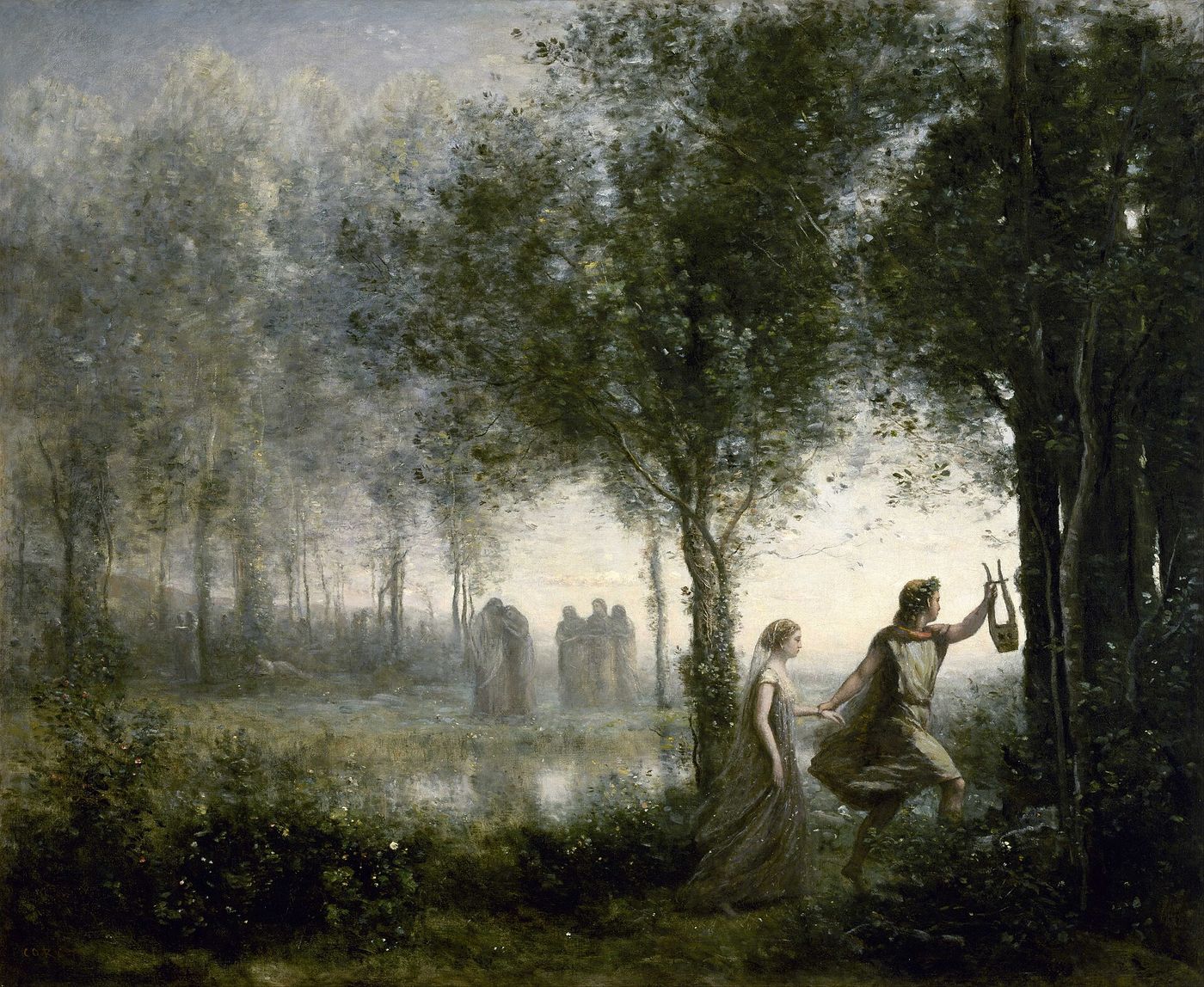
In Greek mythology the poet Orpheus, when his wife Eurydice dies of a snakebite, descends into the underworld to bring her back. With his song he so moves the gods of the dead that Hades and Persephone agree to give Eurydice back to him, on one condition: he must not look back until they reach the surface. Orpheus ahead, Eurydice behind, they climb through dark paths. But very near the exit Orpheus cannot bear it and looks back. Eurydice vanishes a second time, and this time for ever.
The myth tells with surprising precision what happens after ghosting. The unbearable urge to look at the one who has vanished, to reach them one last time, to wring an explanation from them, often deepens the loss. One more message is sent, social media accounts are checked, mutual friends are asked questions. Each look, like Orpheus’s, pushes the vanished one a little further away, or rather shows once again that they are really gone. The tragedy of Orpheus is not that he loses his beloved, but that he cannot let her go.
Digital communication has added a new layer to this experience. The “seen” tick, the online status, a story that has been viewed, show that the other person is still there, but not answering you. This is the most painful form of the gaze: you know the other sees you, but you cannot know from where, or how, they see you. A sentence of Lacan’s on the gaze takes on a new meaning here: you do not see me from where I am looking at you.3 The sign on the screen carries not the gaze but only its trace.
V
Something must also be said about those who ghost, because they too are often in pain. Ending a relationship in words is an act: it requires facing the other’s reaction, their anger, their tears, one’s own guilt. The one who vanishes silently often flees this confrontation. Sometimes this flight is selfishness, indifference. But sometimes it is the inability to bear witnessing the other’s pain, to carry the responsibility for a separation, even the repetition of having once been silently left oneself. Someone who keeps vanishing silently from relationships should ask why, for him, it is not possible any other way.
VI
Recovering from ghosting begins not with getting an explanation from the one who left, but with accepting that the explanation will not come. This acceptance is the hardest part, because the explanation seems the only place where one could rebuild one’s own worth. But the silence of the one who left is often about them, not about you: their inability to say a sentence, their inability to bear a confrontation. To read the silence as a judgement, a verdict on your worthlessness, is to give it an authority it does not deserve.
Some small steps can help. Notice when thoughts of the one who left intensify, at which moments they become unbearable. Write the goodbye that was never said as a letter that will not be sent: a loss can become mourning only once it is put into words. And above all, ask about the connection between this experience and other losses in your life, other silences, the traces of an absence, a waiting, a going unanswered lived in childhood. Ghosting often hurts so much because an old wound is reopened.
If this pain goes on for weeks or months, if it affects sleep, appetite, work, other relationships, or if it repeats in the same way in every new relationship, rather than trying to carry it alone one should talk to a professional. What psychoanalytic work offers at this point is a place where you can take the floor in the face of the silence: a place where you can say not what the one who left did not say, but what has not yet been said in your own story.
Notes
- J. Lacan, “Subversion du sujet et dialectique du désir dans l’inconscient freudien” (1960), Écrits, Paris: Seuil, 1966. Lacan ties this question, which sits on the upper level of the graph of desire, to the question the devil asks in Cazotte’s novel, appearing as a terrifying head when he is summoned. ↩︎
- S. Freud, “Trauer und Melancholie” (1917), Internationale Zeitschrift für ärztliche Psychoanalyse, 4. ↩︎
- On this formula of Lacan’s and on the structure of the gaze, see the essay “The Object Gaze: Lacan, Foucault and Las Meninas” on this site. ↩︎
References
- Cazotte, J. (1772). Le Diable amoureux. Paris.
- Freud, S. (1917). Trauer und Melancholie. Internationale Zeitschrift für ärztliche Psychoanalyse, 4.
- Lacan, J. (1966). Subversion du sujet et dialectique du désir dans l’inconscient freudien. In Écrits. Seuil.
- Ovid. Metamorphoses, Book X.