This essay first appeared in Turkish. The English version is my own. Lacan’s seminar of 18 May 1966 is cited from a text based on the stenography; Foucault and Lacan are cited in the French originals.
Tu ne me vois pas d’où je te regarde.
Jacques Lacan, seminar, 18 May 1966

I
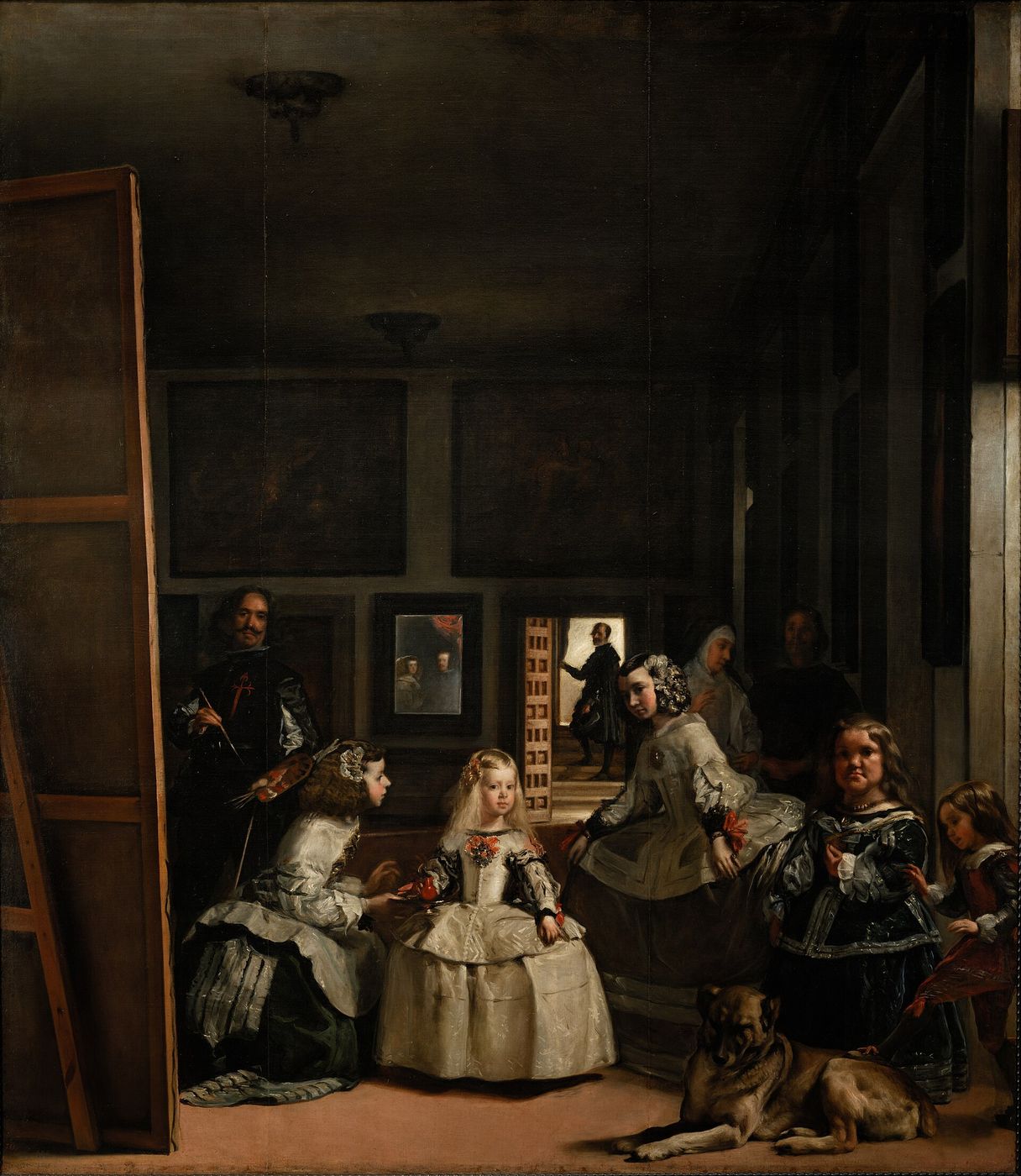
In the spring of 1966 two books in Paris heralded a climate of thought in which, two years later, nothing would be as before. In April Gallimard published Michel Foucault’s Les Mots et les choses, The Order of Things; unexpectedly for a book of philosophy, it soon became a publishing event. In November Lacan’s Écrits would appear. Foucault’s book opened with the analysis of a painting that works like the key to all the chapters that follow: “Les suivantes”, the maids of honour, Velázquez’s painting of 1656 known by its Spanish name, Las Meninas. In it Foucault saw an image of the order of representation of the classical age, the seventeenth and eighteenth centuries: there was a place at which the painter looks, at which everyone in the painting looks, but which itself appears only faintly in the mirror on the back wall; it was the place of the king and queen, the sovereign centre around which representation is ordered. The chapter ends with its most quoted formula: in this painting by Velázquez there is perhaps the representation, as it were, of classical representation.1
In the same months Lacan was giving his thirteenth seminar at the École normale supérieure: L’objet de la psychanalyse, the object of psychoanalysis. Its question was to elaborate, in different registers, the concept Lacan had begun to build in the preceding years, the objet a, the object that causes desire, what falls from the body and remains as a residue. One of these objects was the gaze, which Lacan had treated at length in 1964 in his eleventh seminar, The Four Fundamental Concepts of Psychoanalysis. Some of his listeners had read the first chapter of Foucault’s book and pointed it out to Lacan as a remarkable point of intersection between two fields of research. On 11 May 1966 Lacan projected a slide of Las Meninas onto the screen and tied the painting to his own question, the structure of the gaze. A week later Foucault was among the listeners.2
II
The stenography of the 18 May lesson is the record of a scene before it is a theoretical debate. Lacan opens by greeting Foucault and says he considers his coming to the seminar a great honour. The lesson, he adds, will be less a display of his usual exercises before him than an attempt to show him the real aim of these meetings, an aim of formation. The floor then passes to the psychoanalyst André Green. Green recalls that at the previous lesson the slide had been very badly projected, and that for lack of light some details of the painting had become invisible: what disappeared was precisely the painter himself and the couple whispering in the background. Green proposes to read this effacement not as a technical fault but like a slip or a forgetting, like a formation of the unconscious. Lacan has the curtains drawn and the painting projected again, explaining that the fault lay in the bulb, that the slide he had obtained from the École du Louvre was excellent, and that he had gone to apologise for having cursed it unjustly.
This small scene is like a miniature of the debate the lesson will open. A painting appears on a screen under particular conditions of light; what is seen depends on the position of the one who looks, on the faults of the apparatus and on the desire of the one who looks. Green’s question anticipates the thesis Lacan will build in the lesson: what matters in the painting is less the figures that appear than the gaps within the image, the effacements, the places where the gaze is caught and lost.
In the stenography, Lacan’s words to Foucault proceed in a tone in which high praise and criticism, courtesy and insistence, are interwoven. Looking at the chapter headings of Foucault’s book, speaking, exchanging, representing, Lacan names an absence that struck him: there is no counting. At the heart of the seventeenth century, Lacan says, there is a thinker who went unrecognised, was even mocked, but who should be remembered as one of the most brilliant minds of all: Girard Desargues, the founder of projective geometry. This geometry, left outside Foucault’s analysis of the age, is the instrument Lacan will use to read the painting. At one point Lacan compares the relation between the unconscious and the cogito in psychoanalysis with the concept of the “unthought” (impensé) in Foucault’s book, and asks Foucault whether he is distorting what he says. In the stenography, almost the only words Foucault spoke at the seminar that day are his short answer to this question: you are not deforming, you are reforming.3
III
The centre of Lacan’s thesis is a small but decisive correction to Foucault’s formula. For Foucault, Las Meninas is the representation of representation: a picture of the classical age’s infinite system of reciprocal reference between words and things. For Lacan, the painting is not the representation of all the modes of representation but, in a term he borrowed from Freud and used insistently, the representative of representation: the Vorstellungsrepräsentanz.4
The difference between the two formulas is far more than wordplay. Foucault’s formula reads the painting as the image of an episteme, an order of knowledge; the painting represents the way an age represents itself. In this reading everything remains on the plane of visibility: the painting is a mirror that shows us the working of representation, and the void at its centre, the king’s place, is the point of the endless back-and-forth between represented and representing, of the exchange of places between the one who looks and the one looked at. Lacan’s formula reads the painting as something that holds the place of a representation, that stands in for it. In Freud the representative of representation is what is repressed; the term that falls into the unconscious and there, without itself ever appearing directly, organises the other representations. What Lacan finds in Las Meninas is not an age’s system of representation, but the structure of a lack within the field of vision, of something invisible, of a point at which the subject itself is caught.
Lacan makes this difference concrete through the painting’s most debated element: at the left edge, its back turned to us, the canvas more than three metres high. According to the common reading of art historians, and of Foucault, the painter is painting on this canvas the portrait of the king and queen who appear in the mirror. In the stenography Lacan rejects this reading in an almost mocking tone: can one really think that Velázquez used a huge canvas of the same size, with the same frame, to paint the two little figures in the background? For Lacan the painting within the painting is the painting itself, the one we are looking at. On the canvas turned away from us, the painter is painting the scene he is in, the picture before which we stand. But then the only representation represented within the painting is a representation that cannot show itself, that has turned its back on us. Representation works precisely where it does not show itself, like a card turned face down, as a void that forces the viewer to lay down his own card.
IV
To show the structure of this void Lacan returns to the projective geometry he had patiently explained to his listeners in the earlier lessons of the seminar. In a perspective drawing, since the Renaissance, there is an eye point, a ground plane and a picture plane; the horizontal plane through the eye point cuts the picture plane along the horizon line, and parallel lines converge at a vanishing point on this horizon. Lacan stresses that this point should not be called the “eye point” but a “subject point”: it is a subject necessary for the construction of perspective, yet not itself inscribed anywhere in the picture, appearing within it only as a trace, as any point whatsoever on the horizon line. Desargues’s geometry, for Lacan, shows a second thing: the plane that passes through the subject point parallel to the picture plane can in no way be inscribed in the picture; it corresponds to a line at infinity in the picture, and the second pole of the subject lies at that point at infinity.5
The counterpart of this abstract structure in the painting is, for Lacan, the distance between the painter and his canvas. Velázquez stands within the painting, brush in hand, but at a distance from which he cannot reach his canvas; even with his long brush he cannot touch it. He is said to have stepped back to see better; Lacan grants this, but says that what matters is this distance, the interval between the picture plane and the subject point. The painting is made to make us feel this interval. On the back wall, on the threshold of an open door, a man goes towards the light, towards the outside, towards an opening; Lacan reads this figure as another opening set parallel to the interval in the foreground. The painting’s captivating, at times unsettling, effect comes from its not being an ordinary perspective painting, from its attempt to draw into itself, by extending its limits, the distance between the subject point and the plane of the picture, the place where the viewer stands.
Here Lacan meets the thesis on the gaze he had developed since the eleventh seminar. The painting is a trap for the gaze. Standing before a picture with the ease of someone strolling through an exhibition, we believe nothing is happening to us; yet we are caught like a fly on flypaper. What the painter does is make us enter the painting. Lacan finds the place of this capture in the one element of the painting that falls, vanishes, cannot be grasped: the gaze as objet a. The gaze can never be caught in the mirror; for the gaze, in the image Lacan uses in the lesson, is the window we ourselves constitute by opening our eyes. In Foucault’s reading the key to the painting is the mirror; in Lacan’s, the window. The mirror is the plane of imaginary reciprocity, where the viewer returns to his own image. The window is where the gaze itself opens, as a hole in the field of vision, as the invisible place of the subject.

V
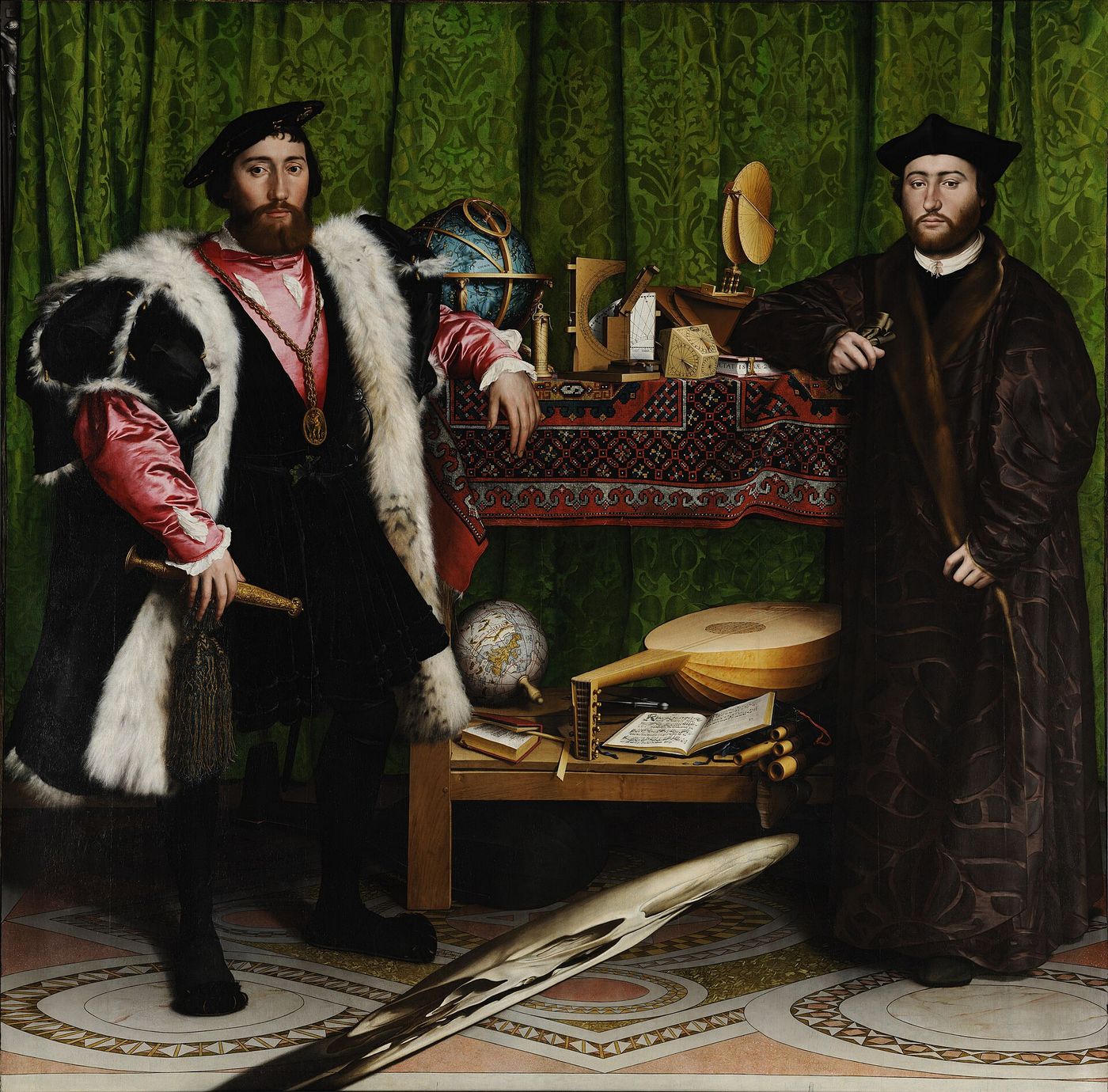
This thesis continues a reading of two years before. In the spring of 1964, in the eleventh seminar, Lacan had used Holbein’s The Ambassadors to show the structure of the gaze. In the foreground, at the feet of the two ambassadors, there is an anamorphic form that looks like a meaningless smear when seen from the front but turns into a skull when seen from the side, as one leaves the painting. For Lacan this skull is where the gaze itself becomes visible within the painting: what catches us, the looking subjects, as we look, and reduces us to nothing. In the same seminar Lacan formulated the basic disappointment of the love relation through this structure of the gaze: you never look at me from the place from which I see you.6
On 18 May 1966 Lacan has Velázquez speak another variation of this formula. Before the painting stands someone begging the painter, saying “let me see”; for Lacan one must begin from this voice, this demand. The painter’s answer to it is the sentence of the epigraph: you do not see me from where I am looking at you. Lacan calls this the fundamental formula that makes explicit, in every relation of looking, in exhibitionism as in voyeurism, the structure of the scopic drive. What is at stake is what Lacan emphasised on the basis of Freud’s 1915 paper “Instincts and their Vicissitudes”: the scopic drive traces a circuit from seeing to being seen, from going out to returning, and the object of this circuit is not the eye but the gaze.7
In this formula the distinction between gaze and vision appears in full clarity. Vision is a relation in which a subject sees an object, a relation that looks reciprocal and symmetrical; the mirror is its image. The gaze breaks this symmetry. I see you, but you do not see me from where I am looking; and the place from which I look is invisible to me as well. In the lesson Lacan recalls that he will not fall into the trap of reciprocity, that he has long said the relation between the subject and the Other is not reciprocal. The three pieces that make up the fantasy, two subjects and an objet a, are the structure of this non-reciprocity, and in it one of the pieces is always lost.
VI
The question of how far Lacan was right against Foucault has been reopened with the publication of the lesson. According to Miller’s account, Lacan wanted to show Foucault that he had understood nothing of the painting; but this reading is in tension with the praising, at times almost diffident, tone of the stenography, and reviewers of the new edition have also seen it as a caricature.8 It is more fruitful to see the two readings as answers to two different questions. Foucault’s question is historical: how does an age order knowledge, language and the place of the subject, and at which point does that order come apart? Lacan’s question is structural: where in the field of vision is the subject caught, and what is the object of this capture? In the lesson Lacan asks Foucault openly: is it possible to write a history of subjectivity, and have not the same structural problems always been posed in the same way to the speaking being in every age? The question exposes the tension between the historical and the structural, between Foucault’s archaeology and psychoanalysis’s claim to universality, and it is not closed today.
But what is most interesting about this lesson today is perhaps hidden in one of Lacan’s jokes. At the previous lesson, speaking of the mysterious function of the mirror in the painting, Lacan had ended by saying that this mirror, whose nature we cannot tell, strangely resembles our television screen. On 18 May he admits it was a witticism. Sixty years later the witticism reads like a forecast. Today all of us, every day, sit before screens that reflect our own image while others look at us through them. In a video call, beside the face of the person we are speaking to, our own face sits in a small window: like the mirror of Las Meninas, an image that stays outside the scene yet orders it.
The psychoanalytic clinic meets the effects of this structure every day. The anxiety of being seen, shame, freezing under the gaze, the need to monitor one’s own image constantly, translate Lacan’s formula into clinical language: a person can never see the place from which he is seen, and that invisible place is what makes him most anxious. In an analysis conducted online, the fact that the analysand sees his own face on the screen is therefore more than a technical detail to be solved; it is a mirror set within the session, an element that joins the circulation of the gaze and of being seen. Lacan’s thesis of 1966 is still one of the sharpest instruments for understanding why this mirror is never neutral: the image seen on the screen does not catch the gaze; the gaze lies not within the screen but in the interval the screen opens in us, in our being looked at from where we do not see.
VII
Lacan ended the lesson of 18 May by passing round among his listeners a reproduction of a painting from a Balthus exhibition then open at the Pavillon de Marsan. When he first saw the painting in this context, he said, in a moment whose attribution to his lucidity or to his delirium he left his listeners to decide, he had said: “That is Las Meninas.” He left them homework for the vacation: why is this painting Las Meninas?
This homework is perhaps one of the finest examples of Lacan’s teaching style. Lacan gives no answer; he hands a question, a lack, over to his listeners. That one painting is another painting comes not from a resemblance visible on its surface but from its structure, from the order of the points at which it catches and loses the gaze. Sixty years later, with the publication of the thirteenth seminar, the homework is once again before its readers. Every reader who moves between the established text of the seminar and the stenography, who looks at the reproduction of the painting, who tries to understand Desargues’s geometry, is doing what Lacan asked of his listeners that year: looking, in what is seen, for what is not seen, for the place of the one who looks.
Two interactive models accompany this essay: The Perspective Room of Las Meninas, in which you can move the subject point and follow the vanishing point, and The Cross-Cap, which shows the cut separating the objet a from the divided subject.
Notes
- M. Foucault, Les Mots et les choses: Une archéologie des sciences humaines, Paris: Gallimard, 1966, chapter one, “Les suivantes”. Foucault’s formula: “Peut-être y a-t-il, dans ce tableau de Vélasquez, comme la représentation de la représentation classique”. ↩︎
- J. Lacan, Le Séminaire, Livre XIII: L’objet de la psychanalyse (1965–1966), ed. J.-A. Miller, Paris: Seuil, 2026. For the lesson of 18 May 1966 this essay uses the text based on the stenography that circulates as a revised “restoration” of C. Gallagher’s English translation; Seuil’s established text may differ in wording. On the importance of this distinction see the essay “The Established Text” on this site. ↩︎
- In the transcriptions based on the stenography, Foucault answers Lacan’s question whether he is not distorting (déformer) his words with a verb from the same root: “you are reforming” (reformer). Lacan accepts the answer at once. ↩︎
- Freud uses the term in his metapsychological papers of 1915, in particular “Die Verdrängung” (Repression) and “Das Unbewußte” (The Unconscious), to name the representative of the drive in the psychical field. Lacan insisted on translating it into French as représentant de la représentation, and in the eleventh seminar treated it as the true object of repression. ↩︎
- In the same lesson Lacan names Alberti, Jean Pélerin (Viator) and Dürer as the founders of perspective, and stresses that perspective has nothing to do with the perception of depth or binocular vision, but with the mode in which the painter, as subject, places himself in the picture. He compares the early painters’ placing themselves in the picture as donors with the painter’s entry into the picture, in the age of perspective, as an absence. ↩︎
- J. Lacan, Le Séminaire, Livre XI: Les quatre concepts fondamentaux de la psychanalyse (1964), ed. J.-A. Miller, Paris: Seuil, 1973, the lessons of February and March 1964 gathered under the heading “Du regard comme objet petit a”. In the same lessons Lacan defines the painting as something that tames the gaze, invites one to lay it down: a dompte-regard. ↩︎
- S. Freud, “Triebe und Triebschicksale” (1915). In this paper Freud studies the transformation between the active and passive forms of scopophilia (Schaulust) through the pair of voyeurism and exhibitionism. In the lesson of 18 May Lacan says he relies on this paper not simply because it is a “sacred” text of Freud’s, but because it is one of his supreme texts. ↩︎
- D. Pinaud, “La deuxième vie de Lacan (Le Séminaire. Livre XIII)”, Diacritik, 28 January 2026. Pinaud calls the verdict Miller relays a caricature and writes that the reality is more subtle. ↩︎
References
- Foucault, M. (1966). Les Mots et les choses: Une archéologie des sciences humaines. Gallimard.
- Freud, S. (1915). Triebe und Triebschicksale. Internationale Zeitschrift für ärztliche Psychoanalyse, 3.
- Freud, S. (1915). Die Verdrängung. Internationale Zeitschrift für ärztliche Psychoanalyse, 3.
- Lacan, J. (1973). Le Séminaire, Livre XI: Les quatre concepts fondamentaux de la psychanalyse (1964). Seuil.
- Lacan, J. (2026). Le Séminaire, Livre XIII: L’objet de la psychanalyse (1965–1966). Seuil.
- Pinaud, D. (2026, January 28). La deuxième vie de Lacan (Le Séminaire. Livre XIII). Diacritik.