- Language
- Turkish · English · French
- Time difference
- 2 hours in winter, 1 in summer
- First session
- Free
- Emergency
- 112 · Telefonseelsorge 142
Living in Freud’s city
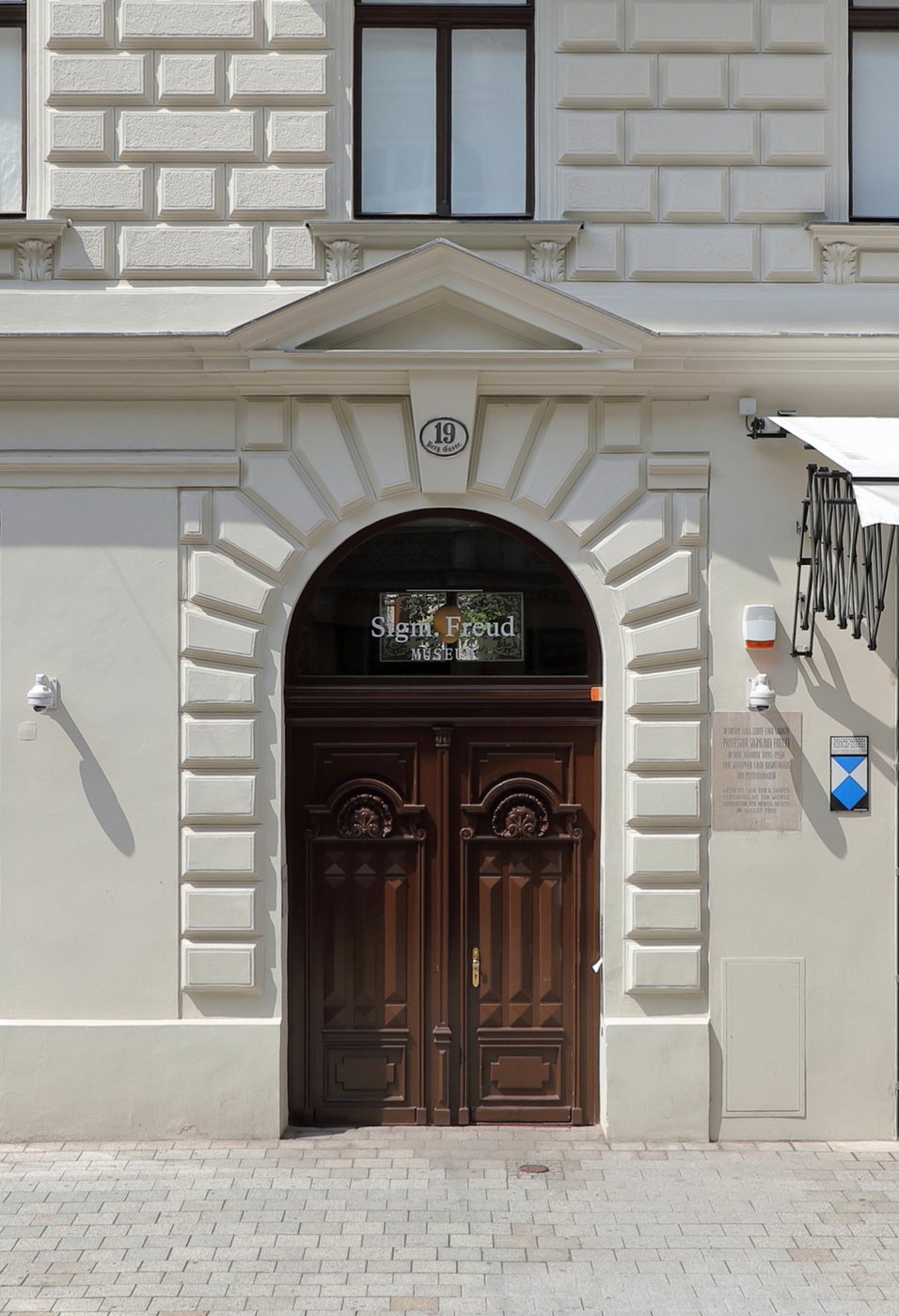
The house at Berggasse 19, in Vienna’s ninth district, is where Freud lived and listened to his patients from 1891 to 1938, almost half a century of his life. The Interpretation of Dreams was written here, and the cases of Dora, Little Hans and the Rat Man were conducted here. Today the house receives visitors as the Sigmund Freud Museum.

It is often forgotten that Freud himself was the child of a migrant family. Born in 1856 in the small town of Freiberg in Moravia, today Příbor in the Czech Republic, he was taken by his family, because of economic hardship, first to Leipzig and then, when he was four, to Vienna. Freud spoke from time to time of the loss of this first home, of the woods and meadows of his childhood; this longing for his early years has been read as one of the personal backgrounds to the importance psychoanalysis gives to childhood memories. At the end of his life he had to migrate once more. When Austria was annexed by Nazi Germany in March 1938 he was eighty-one; before leaving Vienna in June, in a letter to his son he expressed one of the two hopes that kept him going, switching suddenly into English in the middle of the German of the letter: to die in freedom.
The founder of psychoanalysis thus knew exile both in childhood and in old age. This is a reminder that psychoanalysis is not only a method of treatment but also a way of telling of a lost home and a lost language. For families from Turkey who have built a life in Austria, in the Vienna districts of Favoriten or Ottakring, in the textile towns of Vorarlberg, or in Linz, Salzburg or Innsbruck, this city’s relation to psychoanalysis has a strange closeness: to live in Freud’s city and yet be able to tell one’s own story not in Freud’s language but in one’s own mother tongue.
What is often talked about in the sessions
Among the questions analysands living in Austria often bring to the sessions are growing up between two languages, conflicts between the generations within the family, marriage and relationships, burnout and experiences of exclusion at work, worries and mourning concerning parents far away, and the uncertainty of the decision to return to Turkey or to stay.
Practical information
Time difference. Austria uses UTC+1 in winter and UTC+2 in summer. Turkey is UTC+3 all year; it is two hours ahead in winter and one in summer.
Insurance. In Austria psychotherapy is regulated by the Psychotherapy Act of 1990, and health insurance covers, under certain conditions, part of the sessions with psychotherapists registered in Austria. Sessions with a practitioner working outside Austria are not within this scope.
Language. The sessions can be held in Turkish, English or French. I do not offer sessions in German.
In an emergency
These sessions are not an emergency service. If there is a danger of harming yourself or someone else, call 112 at once, or 144 for an ambulance. You can reach Telefonseelsorge on 142 at any hour of the day, free of charge; for children and young people Rat auf Draht offers help on 147.
- Emergency services112
- Ambulance (Rettung)144
- Telefonseelsorge142
- Rat auf Draht (children and young people)147
Frequently asked questions
Does health insurance in Austria cover these sessions?
No. Health insurance in Austria contributes under certain conditions only to sessions with psychotherapists registered in Austria. These sessions are outside this system.
In which languages are the sessions held?
Turkish, English or French. You choose the language in which you want to speak, and during a session you can move between languages.
The first session is free. To arrange a day and time or to ask your questions, you can write to me.
Contact form